
10 Signs Your Boss Wants You to Leave And What to Do Next

The most common signs your boss wants you to leave include being excluded from important meetings, receiving constant criticism, losing meaningful responsibilities, and facing unrealistic expectations without adequate support. When several of these changes happen together, you may have reason to believe your manager wants you to quit.
But a difficult workplace relationship doesn’t always mean your employer is trying to get rid of you. Sometimes, managers are overwhelmed, organizational priorities change, or legitimate performance concerns emerge. The challenge is understanding whether you’re experiencing temporary workplace friction or a sustained pattern of professional exclusion.
Here are 10 signs worth paying attention to, along with practical steps to protect your career.
1. Your Salary Increases and Career Growth Suddenly Stop
For several years, perhaps your compensation increased regularly and management discussed opportunities for future growth. Then, without a clear explanation, everything stops.
Your responsibilities may continue increasing, but salary reviews, promotions, training opportunities, and professional development discussions disappear. Of course, compensation freezes can result from genuine financial constraints. Organizations sometimes reduce salary increases across entire departments or business units.
The more concerning situation is when your professional growth stalls without transparent criteria, particularly while similarly situated colleagues continue receiving opportunities.
What you should do: Request a career-development discussion. Ask what specific performance outcomes are required for your next salary review or promotion. If management cannot provide reasonable expectations or a clear process, evaluate whether the organization still offers meaningful long-term opportunities.
2. Your Boss Suddenly Stops Communicating With You
Think about how your relationship with your manager used to work. Perhaps you had regular conversations, received timely responses, and were consulted whenever an important decision needed to be made.
Now, something feels different.
Your emails remain unanswered, meetings are cancelled, and conversations that previously involved you happen without your knowledge. Even when you reach out, responses are brief or unusually distant.
This change can be particularly concerning when your manager continues communicating normally with other team members. However, don’t assume every delayed email means rejection. Look for a consistent pattern that affects your ability to perform your responsibilities.
What you should do: Request a short discussion about communication expectations. Explain that you want to stay aligned with priorities and ask how you should obtain essential updates. If the situation doesn’t improve, document the operational problems caused by the communication gap.
3. You’re No Longer Invited to Important Meetings
Being excluded from an occasional meeting is normal. Being consistently excluded from discussions directly related to your responsibilities is a different matter.
Imagine being responsible for delivering a project while major decisions about that project are being made without you. You discover the changes later, often through colleagues, yet you’re still expected to deliver results on time.
Over time, this reduces your influence and can make your performance appear weaker than it actually is.
The most concerning situation is when your accountability remains unchanged, but your access to decisions and information disappears.
What you should do: Ask to participate in meetings relevant to your assigned responsibilities. Frame your request around successful delivery rather than personal exclusion. If management declines, request written updates and clearly defined decision-making arrangements.
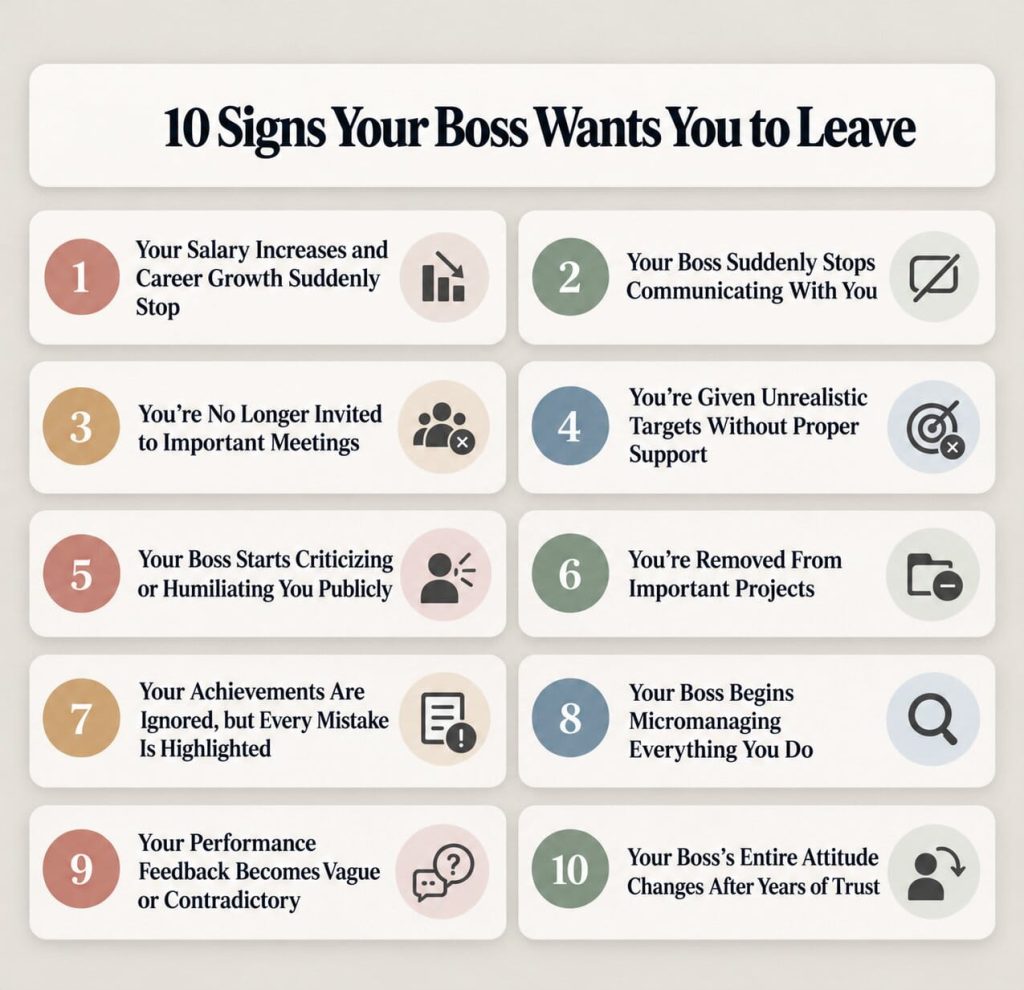
4. You’re Given Unrealistic Targets Without Proper Support
Being assigned challenging work isn’t necessarily a negative sign. In fact, demanding assignments often indicate that management trusts your abilities.
The problem starts when expectations become disconnected from reality.
You might receive a major project with an aggressive deadline, insufficient resources, limited authority, and constantly expanding requirements. Despite those limitations, management expects results without considering the practical constraints.
When the project doesn’t meet expectations, the discussion may focus entirely on your perceived failure rather than the circumstances that made delivery difficult.
This situation becomes especially concerning when you repeatedly raise reasonable concerns, but management refuses to review priorities or provide necessary support.
What you should do: Communicate constraints in writing. Explain what can realistically be delivered, identify missing resources, and propose alternative deadlines or priorities. This makes your concerns measurable rather than emotional.
5. Your Boss Starts Criticizing or Humiliating You Publicly
Constructive criticism is part of professional development. Public humiliation is something else entirely.
A manager who previously recognized your contributions might suddenly begin criticizing you in meetings, dismissing your opinions, or questioning your abilities in front of colleagues.
This can damage your confidence and professional reputation, particularly when the criticism is vague, exaggerated, or unrelated to measurable performance.
One difficult conversation doesn’t necessarily mean your boss wants you gone. But repeated public criticism, especially without private coaching or clear improvement guidance, deserves serious attention.
What you should do: Avoid emotional confrontations during meetings. Clarify factual mistakes calmly and request a private conversation afterward. If the behavior continues, document specific incidents and consider using the organization’s appropriate reporting channels.
6. You’re Removed From Important Projects
Important projects provide more than additional responsibilities. They offer visibility, professional development, influence, and opportunities to demonstrate your capabilities.
That’s why losing those assignments without explanation can be deeply unsettling.
You may have spent years leading meaningful initiatives, contributing to strategic decisions, and developing relationships across departments. Suddenly, your major responsibilities are transferred to other employees, and your role becomes increasingly limited.
Organizational restructuring can explain some of these changes. However, repeated removal from meaningful assignments without a clear business reason may indicate that management’s confidence or plans for your role have changed.
What you should do: Ask how your responsibilities are being redefined and what future opportunities remain available. Maintain a professional record of your achievements, and continue developing skills that will remain valuable outside your current position.
7. Your Achievements Are Ignored, but Every Mistake Is Highlighted
There was a time when completing a difficult project brought recognition, encouragement, or appreciation from management.
Now, even strong results receive little attention.
Instead, conversations seem to revolve around minor mistakes, missed details, or perceived shortcomings. Your accomplishments rarely appear in performance discussions, while criticism becomes increasingly frequent.
The real issue isn’t a lack of compliments. It’s whether your work is being evaluated fairly and consistently.
When feedback repeatedly overlooks documented achievements, you may begin questioning your own performance even when meaningful results are being delivered.
What you should do: Maintain a factual achievement record covering projects, targets, measurable outcomes, and responsibilities. Use that information during formal performance discussions and request specific explanations when assessments seem inconsistent.
8. Your Boss Begins Micromanaging Everything You Do
A manager who once trusted your judgment may suddenly want to approve every email, monitor routine activities, or question minor decisions.
Increased supervision isn’t always inappropriate. Certain projects require closer monitoring, especially when there are quality concerns or significant business risks.
However, excessive control becomes problematic when expectations constantly change, approvals create unnecessary delays, and supervision feels disconnected from actual performance requirements.
The key question is whether management is providing support or creating obstacles that make successful performance increasingly difficult.
What you should do: Propose a structured reporting arrangement with clear deliverables, review schedules, and approval requirements. This demonstrates accountability while making it easier to identify whether the additional supervision serves a legitimate purpose.
9. Your Performance Feedback Becomes Vague or Contradictory
Good performance feedback should help you understand what needs improvement and what successful performance looks like.
But some employees receive comments such as “Your attitude needs improvement,” “You’re not meeting expectations,” or “You aren’t the right fit anymore,” without meaningful examples.
These statements can be frustrating because they provide no clear path toward improvement.
The situation becomes more concerning when performance targets change repeatedly or previous achievements are dismissed without explanation.
You may feel as though you’re being evaluated against expectations that were never clearly communicated.
What you should do: Ask for measurable objectives, specific examples of performance gaps, and a reasonable timeline for improvement. If you’re placed on a performance improvement plan, review its expectations carefully and document your progress.
10. Your Boss’s Entire Attitude Changes After Years of Trust
Perhaps the most confusing warning sign is a complete reversal in your professional relationship.
For years, your manager may have trusted your decisions, praised your achievements, increased your responsibilities, and involved you in important matters.
Then, following a difficult project, organizational conflict, or change in expectations, the relationship starts deteriorating.
Communication declines, recognition disappears, and criticism becomes more frequent.
What makes this particularly difficult is that your earlier professional relationship was positive. You may struggle to understand how years of trust could change so quickly.
It’s tempting to assume that colleagues have influenced your manager or that workplace politics are responsible. Those possibilities shouldn’t be treated as facts without evidence.
What you should do: Review when the relationship changed and what happened around that time. Compare your earlier responsibilities and performance expectations with your current situation. Seek direct clarification, focus on observable behavior, and assess whether the professional relationship can realistically improve.
How Can You Tell Whether Your Boss Wants You to Quit?
Not every negative workplace experience is quiet firing.
Managers sometimes communicate poorly, make inconsistent decisions, or struggle to handle demanding business situations. Even good employees can experience legitimate performance concerns.
Instead of trying to read your manager’s mind, evaluate three factors: the pattern of behavior, the effect on your responsibilities, and management’s willingness to address your concerns.
For example, a cancelled meeting might be insignificant. But repeated exclusion from project discussions, combined with unclear expectations and continuous criticism, deserves closer examination.
Similarly, losing a salary increase might reflect financial constraints. But when it happens alongside the withdrawal of career opportunities and unexplained reassignment of responsibilities, the broader pattern becomes more meaningful.
The most useful question is whether management still provides a reasonable opportunity for you to succeed.
If expectations are clear, support is available, and constructive discussions remain possible, the relationship may be recoverable.
If those conditions consistently disappear, you should begin preparing alternatives.
What Should You Say if You Think Your Boss Wants You Gone?
Directly asking, “Are you trying to make me resign?” rarely creates a productive conversation.
A better approach is to discuss observable changes and request clear expectations.
You can use the following script:
“I’d like to discuss my current responsibilities and performance expectations. I’ve noticed some changes in my project assignments, communication arrangements, and involvement in important decisions.
I want to ensure that I’m aligned with management’s expectations and delivering the results the organization requires.
Could we clarify my key priorities, the areas where improvement is expected, and how my performance will be evaluated moving forward?”
This approach allows you to raise concerns without making accusations.
After the meeting, send a short follow-up email documenting the agreed responsibilities, performance expectations, and any support management has committed to providing.
The goal isn’t to prove that your boss dislikes you. It’s to establish whether a fair and practical working relationship remains possible.
What to Do if Your Boss Is Trying to Push You Out
When you suspect that management wants you to leave, your first reaction may be anger, anxiety, or an immediate desire to resign.
But an emotional decision can limit your options.
A more effective approach is to spend the next 30 days assessing the situation systematically.
First 10 Days: Understand What Has Changed
Review your recent work experience and identify the most significant changes in responsibilities, communication, recognition, and performance expectations.
Document specific events rather than assumptions. Preserve appropriate records of completed projects, feedback, and management instructions while respecting confidentiality and company policies.
At this stage, your objective is to establish what has actually happened.
Days 11–20: Seek Clarity and Assess Management’s Response
Arrange a professional discussion with your manager and ask for clear expectations.
If the relationship is recoverable, you should begin seeing meaningful improvements in communication, performance guidance, or clarity about responsibilities.
If your concerns are repeatedly dismissed and contradictory expectations continue, the situation may require escalation or a broader career reassessment.
Where appropriate, seek confidential guidance from HR or another suitable workplace representative.
Days 21–30: Prepare Your Career Options
Update your résumé, review your professional achievements, and explore opportunities inside or outside the organization.
You don’t have to resign immediately. You can evaluate other positions while continuing to fulfill your current responsibilities.
Also consider your financial obligations, contractual notice period, and the practical consequences of changing jobs.
The purpose of the 30-day approach isn’t to force a resignation decision. It’s to replace uncertainty with evidence and preparation.
If you’re experiencing serious harassment, threats, or other urgent concerns, don’t delay seeking appropriate assistance merely to complete this timeline.
Should You Stay or Leave?
This is often the most difficult decision.
Leaving immediately may provide emotional relief, but it can also create financial pressure and interrupt your career plans. Staying indefinitely in an environment where your contributions are consistently undermined can also carry a significant cost.
The decision should depend on whether the employment relationship still offers a realistic path toward effective performance, fair evaluation, and professional growth.
Consider staying when management is willing to communicate clearly, performance expectations are reasonable, and problems can be addressed through constructive discussion.
Consider preparing to leave when repeated attempts to resolve serious concerns produce no improvement, your responsibilities continue shrinking, or the work environment becomes professionally or personally harmful.
Neither decision should be based solely on assumptions about your boss’s intentions.
Your long-term professional interests, financial stability, and well-being should carry more weight than a temporary emotional reaction.
Common Mistakes Employees Make When They Feel Pushed Out
One of the most damaging mistakes is resigning immediately after a difficult confrontation. Even when the workplace situation is genuinely unfair, leaving without understanding your contractual obligations or employment alternatives can create avoidable problems.
Another mistake is accusing colleagues of jealousy, manipulation, or deliberate sabotage without sufficient evidence. Workplace politics can influence professional relationships, but assumptions about people’s motives should never replace documented facts.
Employees also sometimes become so focused on management’s behavior that they stop examining their own performance. A fair evaluation requires considering both workplace conditions and legitimate expectations.
Finally, avoid discussing your frustrations widely with colleagues or responding publicly to every criticism. These reactions can make an already difficult relationship harder to repair.
Stay professional, maintain appropriate records, and make decisions based on what you can verify.
When Should You Involve HR or Seek Outside Advice?
If the situation involves repeated humiliation, bullying, discrimination, retaliation, threats, or serious changes in employment conditions, you may need assistance beyond a direct conversation with your manager.
Begin by reviewing your organization’s grievance and reporting procedures. Prepare a clear explanation of the incidents, relevant dates, and any reasonable attempts you made to address the problems.
For general guidance, organizations such as Acas in the United Kingdom and the U.S. Equal Employment Opportunity Commission (EEOC) provide resources about workplace bullying, harassment, reporting concerns, and relevant employee protections.
However, employment rights and available remedies vary significantly by country and jurisdiction.
This article provides general career information rather than legal, financial, or mental health advice. If you’re considering resigning under pressure, facing possible unlawful treatment, or experiencing serious health effects, consult an appropriate qualified professional.
Frequently Asked Questions
Some managers may create conditions that make employees feel pressured to resign, often described as quiet firing. However, difficult management behavior alone doesn’t establish deliberate intent or unlawful conduct. Evaluate documented patterns and seek relevant professional advice before making a resignation decision.
A consistent combination of professional exclusion, reduced responsibilities, vague criticism, and lack of management support is more concerning than a single incident. Pay particular attention to whether your manager refuses reasonable attempts to clarify expectations or improve the working relationship.
You may notice important responsibilities being transferred to another employee, reduced decision-making authority, or fewer opportunities to participate in relevant projects. These changes can also result from restructuring or succession planning, so request clarification before assuming replacement is intended.
It’s usually more productive to ask about your performance, responsibilities, and future expectations. This creates an opportunity for a factual discussion without turning the conversation into an accusation.
Repeated humiliation should be taken seriously, but resignation isn’t automatically the best immediate response. Consider documenting incidents, using appropriate reporting channels, obtaining professional advice, and reviewing your financial and career alternatives before deciding.
Final Thoughts: Protect Your Career, Not Just Your Current Job
Realizing that your relationship with your manager may have deteriorated is never easy, especially when you’ve invested years of effort in the organization.
But the purpose of recognizing these warning signs isn’t to become suspicious of every management decision.
It’s to understand when a workplace relationship is changing in ways that could affect your responsibilities, professional reputation, and future opportunities.
If several of these signs sound familiar, begin by documenting the most important changes and requesting clear performance expectations.
Then evaluate management’s response.
If the relationship can improve, work toward rebuilding it. If repeated efforts produce no meaningful progress, begin preparing your next career move.
Your goal shouldn’t be to remain in one organization at any cost. It should be to build a career where your capabilities can produce meaningful results and where you have a fair opportunity to succeed.





4 Comments