
Setting Personal Boundaries at Work Without Damaging Relationships
We hear a lot about self-care, yet many of us still struggle with setting personal boundaries at work. We answer messages late at night, say yes when we’re exhausted, and feel guilty if we protect our time. But healthy boundaries are not selfish; they are a basic requirement for long-term performance and mental health. Research from the World Health Organization links long working hours to higher risks of anxiety and burnout, which shows how important it is to protect your limits in a fast-paced work culture.
In this article, we’ll talk about what boundaries really are, why they matter, and how to set personal boundaries at work in ways that feel respectful, realistic, and doable; especially if you’re not naturally confrontational.
What Workplace Boundaries Actually Look Like
It is easy to talk about boundaries in the abstract, but what do they actually look like in practice on a random Wednesday afternoon? Many people mistake boundaries for being rude or unhelpful. In reality, a healthy boundary is simply a clear instruction manual for how to interact with you. It removes the guesswork for your colleagues and the stress for you.
To make this concrete, let’s look at the difference between a workplace with blurry lines and one where healthy boundaries are in action.
A. The “Always On” vs. The Focused Professional
Without Boundaries: You see an email notification pop up at 9:45 PM. It is not urgent, but you worry that if you don’t reply, your boss will think you are slacking. You reply from bed, sleep poorly because you are thinking about work, and wake up tired. Your team now expects you to be responsive at all hours, so they stop checking if it is a convenient time to contact you.
With Boundaries: You see the notification at 9:45 PM. You remind yourself that your workday ended at 6:00 PM. You do not open the email. The next morning at 8:30 AM, you reply with a fresh mind and clear focus. Over time, your boss learns that you are highly reliable during work hours but unavailable afterwards. They start scheduling their requests accordingly, respecting your off-the-clock time because you respected it first.
B. The People-Pleaser vs. The Strategic Partner
Without Boundaries: A colleague from another department asks if you can “just quickly” help with a presentation. You are already drowning in your own deadlines, but you say “yes” because you want to be a team player. You end up rushing your own important work, making mistakes, and resenting the colleague who asked for help. The quality of both projects suffers.
With Boundaries: When asked, you pause. You check your calendar and reply, “I would love to help, but I have a hard deadline for the Q3 report on Friday. I won’t be able to look at this until next week. If it’s urgent, have you tried asking Sarah? She might have more bandwidth.” This response is professional, honest, and helpful without sacrificing your own performance. You are viewed as someone who manages their time well, not someone who can be dumped on.
C. The Emotional Sponge vs. The Supportive Colleague
Without Boundaries: A coworker constantly comes to your desk to vent about their personal drama or office politics. You listen for 45 minutes, nodding politely, even though your stress levels are rising and your work is piling up. You leave the conversation feeling drained and heavy, carrying their negativity with you for the rest of the day.
With Boundaries: As the coworker starts venting, you gently interject. “I’m really sorry you’re dealing with that, it sounds tough. I’m in a bit of a crunch right now and need to get this done by noon. Let’s grab coffee on Friday so I can give you my full attention then.” You have acknowledged their feelings but prioritized your mental space and your job. You protect your energy so you can actually be a better friend when you do have the time.
Why We Are Terrified of Boundaries
Before we dive into the “how,” we need to address the elephant in the room: fear. Most of us hesitate to draw lines because we are afraid of the consequences. We worry that saying “no” will make us look lazy, uncooperative, or difficult. We fear that if we don’t answer that email at 9 PM, we might be passed over for a promotion or worse, lose our jobs.
These fears are valid, but they are often exaggerated by our own anxieties. The truth is that people with healthy boundaries are often respected more, not less. When you respect your own time, you teach others to respect it too. Employees who rest well, have hobbies, and disconnect are sharper, more creative, and more pleasant to be around than those running on caffeine and panic.
How to Set Personal Boundaries at Work
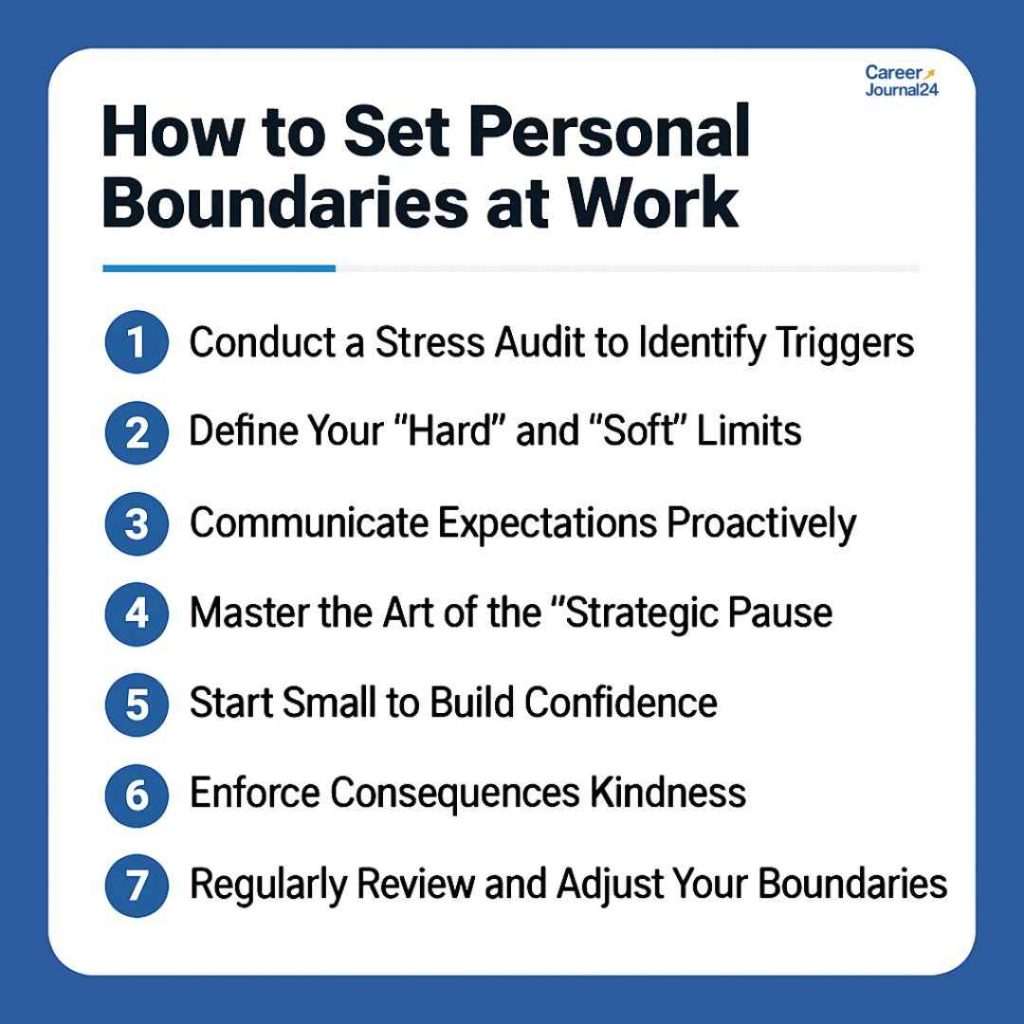
Now that we understand the theory, it is time to move into action. Learning how to set personal boundaries at work is a process, not a switch you flip. It requires a strategic approach to ensure you are protecting your mental health without alienating your team. If you are ready to reclaim your time and reduce workplace stress, follow these seven practical steps to establish firm, healthy, and professional limits.
Step 1: Conduct a Stress Audit to Identify Triggers
You cannot solve a problem you haven’t defined. The first step in establishing healthy boundaries is to pay close attention to your body and your mood throughout the work week. Notice the specific moments when your stomach tightens, your pulse races, or you feel a sudden wave of resentment. These physical cues are your body’s way of telling you that a limit has been crossed. Perhaps it is the anxiety of seeing an email notification during dinner, or the discomfort of being pulled into negative conversations by colleagues. If you find yourself constantly drained by office drama, learning how to deal with gossip at work might be the specific boundary you need to prioritize to protect your mental energy. By identifying these specific stressors, you move from a vague feeling of burnout to a concrete list of situations that need to change.
Step 2: Define Your “Hard” and “Soft” Limits
Once you know your triggers, you need to categorize them into non-negotiables and flexible preferences. A “hard limit” might be that you absolutely do not work on weekends because that is your family time. A “soft limit” might be that you prefer not to have meetings after 4 PM, but you are willing to make an exception for a major client launch. Writing these down helps you clarify exactly what you are willing to tolerate. When you clearly define your professional limits in private, you will feel much more confident when the time comes to enforce them in public. This clarity prevents you from wavering in the moment when a colleague puts you on the spot.
Step 3: Communicate Expectations Proactively
The biggest mistake employees make is waiting until they are angry or overwhelmed to speak up. The most effective way to manage workplace expectations is to communicate your boundaries when things are calm and neutral. You might have a brief conversation with your manager or team to outline your working hours or your response times. For example, you could explain that you are trying to improve your productivity by checking emails only at specific intervals rather than constantly throughout the day. When you frame your boundaries as a method to improve your work quality rather than just a personal preference, your colleagues are far more likely to respect them without taking it personally.
Step 4: Master the Art of the “Strategic Pause”
Reflexive people-pleasing is the enemy of boundaries. When a boss or coworker asks for a favor, the instinct is often to say “yes” immediately to appear helpful. To combat this, you must practice the strategic pause. When a request comes in, force yourself to take a moment before answering. You can simply say that you need to check your current capacity or review your calendar before committing. This brief delay breaks the habit of automatic agreement and gives you the mental space to evaluate if you actually have the time and energy to take on the task. It transforms your “yes” from a knee-jerk reaction into a deliberate professional choice.
Step 5: Start Small to Build Confidence
If you suddenly erect a fortress around your desk after years of being available 24/7, you might give your team whiplash. It is often more effective to start with small, manageable changes to build your confidence. You might begin by simply taking your full lunch break away from your computer every day for a week. Once you become comfortable with that small act of reclaiming your time, you can move on to larger boundaries, like turning off notifications after hours. This gradual approach helps you get used to the feeling of prioritizing your needs and shows you that the office won’t fall apart just because you stepped away for thirty minutes.
Step 6: Enforce Consequences Kindness
A boundary is meaningless if you do not maintain it when it is tested. There will inevitably be times when a colleague forgets your rules or tries to push past them. When this happens, it is crucial to reinforce your limit immediately but kindly. If someone emails you on a Saturday, and you reply, you have just taught them that your “no weekends” rule is not real. Instead, wait until Monday morning to reply. If someone interrupts your focus time, gently remind them that you are unavailable until a specific time. Consistency is key here; you teach people how to treat you by what you tolerate. Gentle, consistent reinforcement trains your team to respect your time without you ever needing to be aggressive.
Step 7: Regularly Review and Adjust Your Boundaries
Your career and your life are constantly evolving, and your boundaries should evolve with them. What worked for you as a junior associate might not work for you as a manager. Furthermore, life circumstances such as a new baby, a family illness, or a change in project scope will require you to shift your priorities. Make it a habit to review your working style every few months. Ask yourself if your current boundaries are still serving you or if they have become too rigid or too loose. Being flexible and willing to adjust your approach ensures that your work-life balance remains sustainable over the long term, keeping you happy and productive.
Handling Difficult Conversations with Managers
Setting boundaries with colleagues is one thing. Doing it with your boss feels entirely different. The power dynamic can make these conversations feel risky.
But here’s what managers often appreciate: employees who communicate clearly about their capacity. Most good managers would rather know upfront that you’re struggling than find out later when deadlines are missed and quality suffers.
When approaching your manager, frame boundaries in terms of productivity and quality. Instead of saying you don’t want to work evenings, explain that you do your best work when you have time to recharge. Rather than complaining about your workload, come with solutions about how to prioritize.
The Harvard Business Review has published extensively on navigating workplace relationships, and the consistent theme is that direct, professional communication beats passive frustration every time.
If your manager consistently dismisses your boundaries despite professional communication, that tells you something important about the workplace culture. Some organizations simply don’t value employee wellbeing, and that’s information you need when making decisions about your career.
Creating Digital Boundaries in a Connected World
We live in an age of constant connectivity. Work follows us home through our phones, infiltrates our evenings through Slack notifications, and interrupts our weekends with email pings.
Creating digital boundaries has become essential for modern workers. Start by separating work and personal devices if possible. If that’s not an option, at least remove work email from your personal phone or turn off notifications outside work hours.
Use the tools available to you. Most email platforms let you schedule sends so you can work when it suits you without creating an expectation that colleagues should respond at odd hours. Status indicators on messaging platforms can signal when you’re focused or unavailable.
Have an honest conversation with your team about response time expectations. Does that Slack message really need a response within five minutes, or would an hour be acceptable? Often, we create urgency where none exists simply because the technology makes instant communication possible.
Consider designating certain times as completely device-free. Dinner with family, the first hour after waking, or Sunday mornings. These technology-free zones give your brain a genuine break from work mode.
Dealing With Pushback
Let’s be real; not everyone will love your new boundaries. You might have that one colleague who says, “Must be nice to leave at 5 PM” with just enough sarcasm to make you question yourself. Or the boss who “forgets” you don’t check emails on weekends and follows up with “Did you see my message?”
This is where most people cave, and I get it. The pressure is real. But remember, pushback is often a test, not a verdict. People push boundaries to see if they’re real. Stay calm and consistent. That colleague making snide comments? They’re probably jealous that you’re doing what they wish they could do. That boss testing your limits? They’re learning how to work with you effectively.
I once had a client who would call me at all hours with “emergencies” that were never actually urgent. Instead of getting frustrated, I created an emergency protocol document that clearly defined what constituted an actual emergency (spoiler alert: very few things did). I shared it professionally, explaining how this would help me serve them better. The late-night calls stopped, and our working relationship actually improved because expectations were clear.
When someone challenges your boundaries, respond with curiosity, not defensiveness. “I understand this is important to you. Help me understand the urgency so we can find the best solution.” This approach, which aligns with emotional intelligence principles in leadership, shifts the conversation from confrontation to collaboration.
Final Thoughts
Setting personal boundaries at work isn’t about being difficult or uncommitted. It’s about being sustainable. It’s about recognizing that you are a finite resource who needs protection and maintenance just like any other valuable asset. The process takes courage, especially at first. There will be uncomfortable moments and conversations you’d rather avoid. But on the other side of that discomfort is a work life that actually works for you.
Start today with one small boundary. Maybe it’s not checking email during lunch. Perhaps it’s declining one meeting that doesn’t need your presence. Whatever it is, practice holding that line. You’ll likely discover that the catastrophic reactions you feared don’t materialize. Most people adjust. Your work quality improves. Your relationships, both at work and at home, get better.
Your time and energy are precious. Treat them that way, and watch how your entire work experience transforms.






One Comment