
How to Silently Quit Your Job: A Guide to Reclaiming Your Life
We have all been there. You are sitting at your desk (or your kitchen table, if you are remote), staring at a screen that seems to be sucking the life out of you. The passion you once had for the role has evaporated, replaced by a quiet dread that settles in your stomach every Sunday evening. You know you need to leave, but the thought of a dramatic resignation or the financial instability of unemployment is terrifying. This is where learning how to silently quit your job can become your most valuable career strategy.
Silent quitting isn’t about being lazy or malicious; it is about self-preservation. It is the process of slowly disengaging from the “above and beyond” mentality while looking for your next opportunity. It is reclaiming your energy so you have enough fuel left in the tank to find a career that actually makes you happy. In this guide, we will walk through exactly how to execute this maneuver gracefully, professionally, and effectively.
What Does Silent Quitting Actually Look Like?
Before you start pulling back, you need to understand what this concept really means in practice. It is often confused with “quiet quitting,” a buzzword that exploded on social media recently. While quiet quitting is about setting boundaries and only doing what you are paid for, silent quitting is a specific exit strategy. It is the active process of preparing to leave while maintaining a steady, but not exhaustive, performance at your current role.
Think of it like a relationship that has run its course. You don’t necessarily want a screaming match or a sudden breakup. Instead, you slowly stop making future plans, you stop investing emotional energy into fixing every little problem, and you start focusing on your own life outside the partnership.
In a workplace context, this looks like skipping the optional happy hour to work on your resume. It means nodding politely during a meeting about the company’s five-year plan instead of volunteering to lead a new initiative. It is a mental shift. You are still physically present and doing your job, but your mind has already checked out and moved on to greener pastures. This mental distance is crucial because it protects you from burnout while you search for something better.
The Strategic Roadmap to Silently Quitting
Feeling stuck in a draining job but not ready to walk away just yet? “The Strategic Roadmap to Silently Quitting” is your essential guide to reclaiming your time and sanity without burning bridges. This step-by-step framework teaches you how to dial back your effort professionally, protect your mental energy, and quietly prepare for your next career move, all while maintaining your paycheck and reputation. Learn the art of the “slow fade” and turn your current 9-to-5 into a launchpad for your future. Here is the The Strategic Roadmap on how to silently quit your job
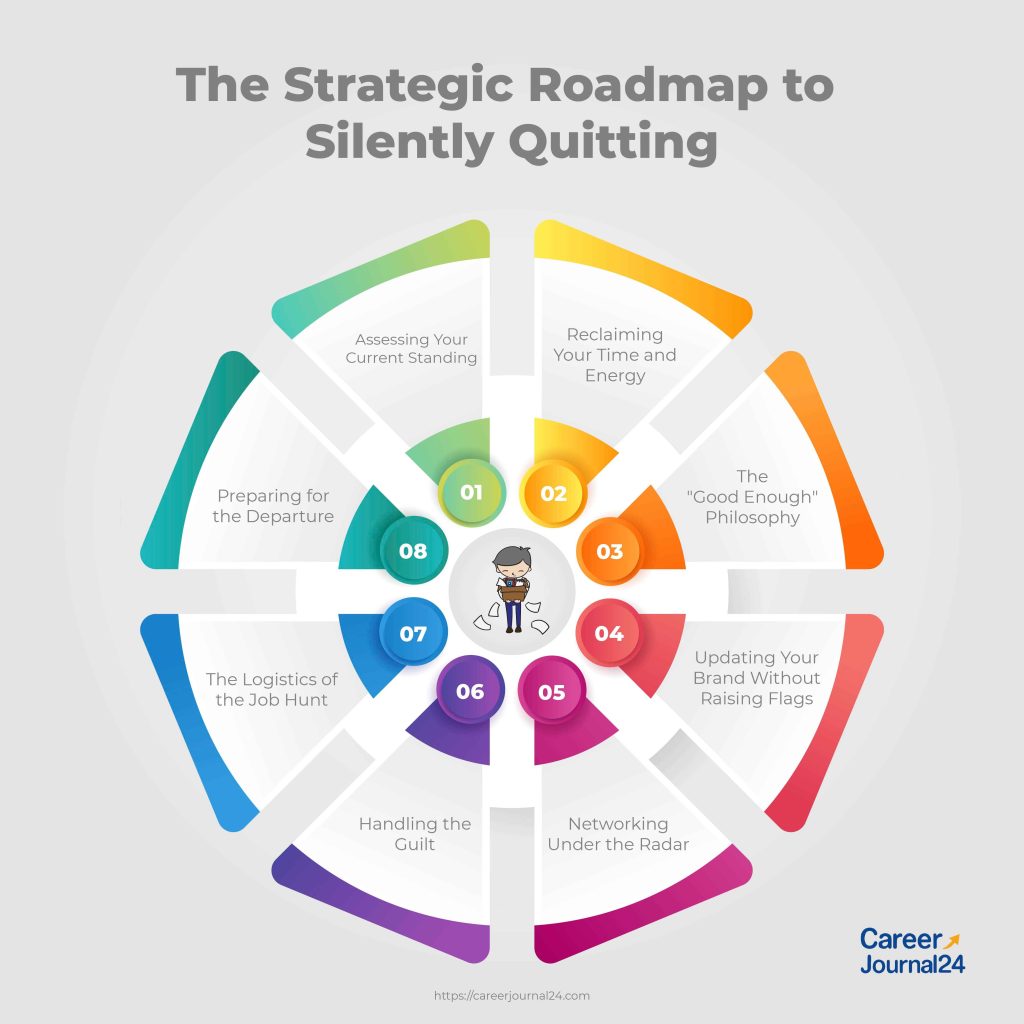
1. Assessing Your Current Standing
You cannot effectively fade into the background if you are already under a microscope. Before you change your behavior, you need to take an honest look at your current reputation. Are you known as the reliable “yes” person? Or are you already on a Performance Improvement Plan (PIP)?
If you have built a strong reservoir of goodwill over the years, you have much more runway to silently quit. Your manager is likely to attribute a slight dip in enthusiasm to a “rough patch” or personal fatigue rather than a desire to leave. For example, if you usually answer emails at 9:00 PM and suddenly stop, a boss who trusts you might just think you are finally setting boundaries.
However, if your standing is shaky, you have to be more careful. Silent quitting in a hostile environment requires a delicate touch. You need to meet your metrics strictly so they have no grounds to fire you, but offer nothing extra. It is a balancing act. You want to become “satisfactory.” Not excellent, not terrible, just pleasantly average. This makes you invisible, which is exactly where you want to be while you plot your next move.
2. Reclaiming Your Time and Energy
The most critical resource you need for a job search is time. When you are giving 110% to your current employer, you have nothing left for yourself. To silently quit effectively, you must ruthlessly audit your schedule.
Start with your calendar. Look for those recurring meetings that could be emails. If you can’t cancel them, learn the art of being a passive participant. You don’t always need to have an opinion or a solution. It is okay to just listen. This saves your creative battery for writing cover letters later that evening.
Next, examine your “emotional labor.” This is the energy you spend managing other people’s feelings or workplace politics. If you are the person everyone vents to, or the one who organizes the birthday cards, it is time to step back. You can say something like, “I’m really swamped with this quarterly report, so I can’t organize the lunch this week.”
By reclaiming these small pockets of time and mental space, you are essentially paying yourself first. You are taking back the hours you were donating to the company and investing them into your future. It feels selfish at first, especially if you are a high achiever, but remember: a company will replace you in two weeks if you leave. You owe it to yourself to prioritize your own career trajectory.
3. The “Good Enough” Philosophy
Perfectionism is the enemy of the silent quitter. Many of us are wired to polish every presentation until it shines and double-check every spreadsheet three times. But when you are on your way out, “perfect” is a waste of resources. You need to embrace “good enough.”
This doesn’t mean submitting sloppy work that gets you in trouble. It means hitting the standard requirements and stopping there. If a report is due on Friday, submit it on Friday, not Wednesday. If the project requires three slides, don’t make ten.
Imagine you are painting a wall in a house you are about to sell. You want it to look clean and presentable, but you aren’t going to spend weeks hand-painting a mural. You do the job, you do it well enough to pass inspection, and you move on.
Applying this to your work life reduces stress significantly. When you stop striving for an A+ and settle for a B, you liberate a massive amount of mental bandwidth. That anxiety about whether your boss liked your font choice disappears because, frankly, you no longer care. This detachment is the secret weapon of the silent quitter. It allows you to view your job as a transaction, money for services, rather than an identity.
4. Updating Your Brand Without Raising Flags
One of the trickiest parts of looking for a new job while employed is updating your professional presence without alerting your current employer. If you haven’t touched your LinkedIn profile in five years and suddenly you have a new headshot and a detailed “About” section, people will notice.
The key is gradual implementation. Start by engaging with content relevant to your industry. Comment on articles, share interesting news, and slowly increase your visibility. Then, make small tweaks to your profile over a few weeks. One week, update your skills section. The next week, refine the description of your current role to highlight the achievements that match the jobs you want.
You can frame this activity as “personal branding” or “networking” if anyone asks. It is a common practice for professionals to keep their profiles current. If your boss gets suspicious, you can casually mention that you attended a webinar on professional development that suggested keeping your network active.
When it comes to your resume, focus on impact. Since you are silently quitting, you are no longer volunteering for new projects, so use this time to catalog what you have already done. Dig through your old emails and folders to find data points. Did you increase sales by 10% last year? Did you streamline a process that saved the team 5 hours a week? Write these down. This is the ammunition you will need for interviews.
5. Networking Under the Radar
Networking is essential, but it feels dangerous when you are trying to be stealthy. You can’t exactly post “I’m looking for a new job!” on social media. You have to be more strategic.
Focus on one-on-one connections. Reach out to former colleagues who have left your company. They are usually the safest people to talk to because they understand the culture you are trying to escape and have no allegiance to your current boss. Invite them for a virtual coffee and ask about their transition.
You can also attend industry events, but be mindful of who is on the guest list. Virtual events are great for this because you can often participate without being physically seen by a coworker.
When talking to new contacts, you don’t have to say you are desperate to leave. You can frame it as “passively looking” or “open to the right opportunity.” This makes you sound desirable and high-value, rather than unhappy. It positions you as a professional who is always looking to grow, rather than an employee who is running away from a bad situation.
6. Handling the Guilt
This is the part no one talks about. When you start silently quitting, you might feel guilty. You might feel like you are betraying your team or lying to your boss. This is a natural reaction, especially if you are a loyal person.
However, it is helpful to reframe the situation. Employment is a contract. You agree to perform specific tasks in exchange for a salary. As long as you are fulfilling that contract, you are not doing anything wrong. The “extra” stuff, the late nights, the emotional investment, the constant availability, was never in the contract. That was a bonus you were giving them for free.
Remind yourself why you are doing this. Are you underpaid? Undervalued? Stressed to the point of illness? Keep your “why” at the forefront of your mind. You are protecting your future and your health.
Also, consider that by leaving, you might actually be helping the team in the long run. If you are burned out and unhappy, you aren’t doing your best work anyway. Moving on allows the company to eventually hire someone who is fresh and excited about the role, and it allows you to find a place where you can thrive. It is eventually a win-win, even if the transition is awkward.
7. The Logistics of the Job Hunt
Now that you have mentally disengaged and freed up time, you need a system. Job hunting is a job in itself. You need to treat it with the same discipline you used to apply to your actual work.
Set aside specific hours for the hunt. maybe it is Tuesday and Thursday evenings, or Saturday mornings. during these blocks, you are focused. You are tailoring cover letters, researching companies, and applying.
Use a personal device for everything. Never, ever use your work laptop or work email for job applications. It sounds obvious, but people get caught doing this all the time. Your employer likely has the right to monitor activity on their devices. Keep your search completely separate.
If you have to take an interview during the workday, try to schedule it during your lunch break. If that’s not possible, use a generic excuse for the time off. “I have a dentist appointment” or “I have a personal matter to attend to” usually works fine. Don’t over-explain. The more details you give, the more it sounds like a lie.
8. Preparing for the Departure
Once you get an offer, and you will, the silent quitting phase ends and the resignation phase begins. Because you have been slowly detaching, this part will be much easier emotionally. You haven’t been in the trenches fighting fires for the last three months; you’ve been calmly doing your job while looking ahead.
Make sure you have your finances and documents in order. Save any personal files you have on your work computer (family photos, non-proprietary documents) before you hand in your notice. Sometimes companies will walk you out the door immediately, so be prepared for that possibility.
Draft a standard, professional resignation letter. You don’t need to air your grievances here. Remember, the goal of silent quitting was a smooth exit. To ensure your conversation is handled perfectly, learn exactly how to tell your boss you’re quitting. Keep your letter brief, state your last day, and thank them for the opportunity.
Why People Choose This Path
The reasons behind this movement are deeply rooted in workplace culture shifts and personal realizations. Burnout has become an epidemic, recognized by the World Health Organization as an occupational phenomenon. People are exhausted, not just physically, but emotionally and mentally drained from years of giving their all to companies that view them as replaceable.
Many workers have experienced that gut-wrenching moment when they realize their extra effort goes unnoticed and unrewarded. You stay late for months, skip lunch breaks, work weekends, and then watch as your annual raise barely covers inflation. Or worse, you see someone who does the bare minimum get the same recognition you do. That’s when it clicks: why am I doing this to myself?
The pandemic accelerated this awakening. When lockdowns forced everyone home, people suddenly had time to think. They realized they’d been missing dinners with their kids, neglecting their health, and sacrificing relationships for jobs that would replace them within two weeks if they dropped dead tomorrow. That’s harsh, but it’s true.
Financial stress plays a role too. When living costs skyrocket but salaries stagnate, people naturally question why they should give unpaid extra effort. If companies won’t compensate fairly for the standard work, why would anyone volunteer additional labor?
Some people choose this approach as a form of quiet protest against toxic work environments where speaking up leads to retaliation rather than improvement. It’s a way to protect yourself while you figure out your next move.
The Risks Involved
While silent quitting is a great tool for mental health, it is not without risks. If you pull back too much, you could be labeled as a low performer. This is why the “silent” part is key. You shouldn’t announce to your coworkers that you are checking out. Do not post about it on social media where your boss could see it.
Keep your interactions professional and pleasant. You can be the person who leaves exactly at 5:00 PM and still be a delight to work with. In fact, people often respect colleagues who have firm boundaries, provided they are polite and reliable. The danger comes if you become cynical, rude, or miss deadlines. Stick to the job description, but ensure you are actually doing the job description.
Conclusion: The Ultimate Career Hack
Learning how to silently quit your job is not about being a slacker. It is a sophisticated career management tool. It acknowledges that your job is just one part of your life, not the whole picture. By dialing back your effort to a sustainable level, you preserve your mental health and create the space necessary to find a role that truly values you.
It allows you to leave on your own terms, with your reputation intact and your sanity preserved. It changes the dynamic from you being a victim of a bad workplace to you being the architect of your own future. So, take a deep breath, close that extra spreadsheet, and start planning your next great adventure. You’ve got this.





One Comment