
Microaggression in the Workplace: Signs, Examples, and What to Do
Have you ever been in a meeting where a comment was made that felt slightly “off”? Maybe it wasn’t outright rude, and it certainly wasn’t shouting, but it left a lingering sense of discomfort in the room. This subtle tension is often the result of microaggression in the workplace. While the prefix “micro” suggests something small, the impact of these interactions is anything but.
For many professionals, navigating these moments feels like walking through a minefield blindfolded. You want to build a career, foster relationships, and do good work, but these quiet indignities can slowly erode your confidence and sense of belonging. Learning how to navigate this emotional landscape often starts with setting personal boundaries at work to protect your well-being.
What Is Microaggression in the Workplace?
So, what is microaggression in the workplace exactly? The term was first coined by psychiatrist Chester Pierce in the 1970s, and it refers to brief, everyday exchanges that send negative messages to certain individuals based on their group membership. These can be verbal comments, behavioral actions, or even environmental cues that communicate hostility, insensitivity, or dismissiveness toward someone’s identity.
Here’s the thing that makes microaggressions tricky: they’re often unintentional. The person saying or doing something may have no idea they’ve caused harm. They might even think they’re being complimentary. But intent doesn’t erase impact. When someone tells a colleague, “You’re so articulate,” with a tone of surprise because of that person’s race, the underlying message, whether intended or not, is clear.
Microaggressions differ from overt discrimination because they’re subtle and can be easily dismissed or rationalized. This subtlety is precisely what makes them so challenging to address. The recipient might question whether they’re overreacting, while the perpetrator might genuinely believe they did nothing wrong.
According to research published by the American Psychological Association, repeated exposure to microaggressions can lead to increased stress, anxiety, and decreased job satisfaction. This isn’t about being overly sensitive; it’s about the cumulative effect of feeling othered, questioned, or diminished day after day.
The Most Common Types of Microaggression
To truly address the issue, we have to recognize the specific shapes it takes. Psychologist Derald Wing Sue, a pioneer in this field, identified three distinct categories that help us decode these uncomfortable interactions. By breaking them down, we can spot the patterns in our own office environments more easily.
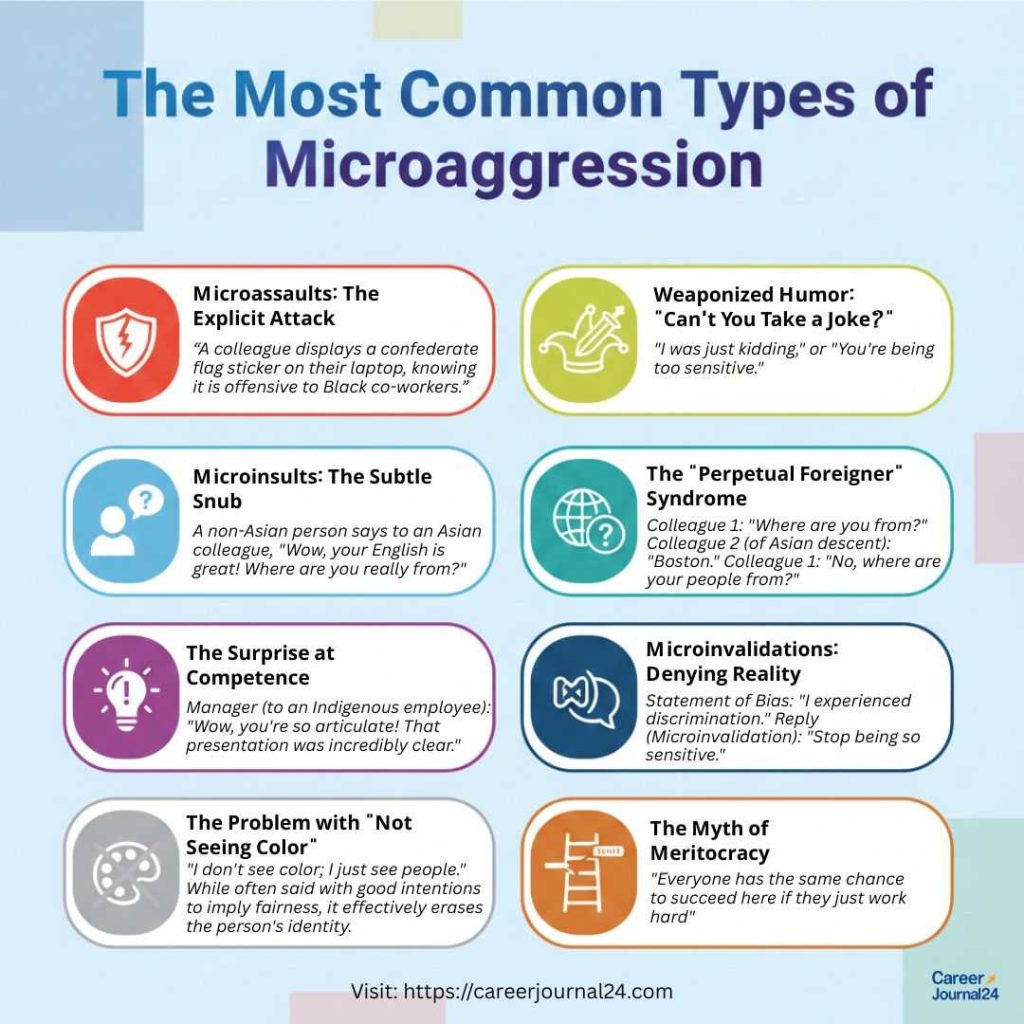
1. Microassaults: The Explicit Attack
The first category, microassaults, is the most obvious. These are explicit, conscious, and intentional actions or slurs meant to hurt the victim. In many ways, this is “old-fashioned” discrimination. It includes displaying offensive symbols at a desk or using racial epithets. While these are less common in modern, corporate settings due to strict HR policies, they still occur and create an immediate, hostile environment.
2. Weaponized Humor: “Can’t You Take a Joke?”
Microassaults often try to hide in plain sight disguised as humor. A colleague might share an offensive meme or make a derogatory comment about a group of people, only to retreat immediately when challenged. The defense is almost always, “I was just kidding,” or “You’re being too sensitive.” This tactic allows the aggressor to express bias while maintaining plausible deniability, leaving the victim questioning their own reaction rather than the aggressor’s intent.
3. Microinsults: The Subtle Snub
Moving into the grayer areas, we have microinsults. These are communications that convey rudeness or insensitivity and demean a person’s racial heritage or identity, often without the speaker realizing it. The perpetrator usually believes they are being complimentary or just making conversation. However, the hidden message sends a clear signal: “You are lesser than.”
4. The “Perpetual Foreigner” Syndrome
A classic example of a microinsult is the interrogation regarding origins. When an Asian-American or Latino employee says they are from “Ohio,” and a colleague presses with, “No, where are you really from?”, it sends a damaging message. Even if the intent is curiosity, the impact tells the colleague that they are a foreigner in their own country; that they don’t truly “belong” in the same way the white colleague does.
5. The Surprise at Competence
Another common microinsult involves expressing shock when a marginalized person is intelligent or articulate. If a manager says to a Black employee, “Wow, you wrote that report so well,” with a tone of genuine surprise, it is a backhanded compliment. It implies that the baseline expectation for that employee was incompetence and that their intelligence is an anomaly rather than the norm.
6. Microinvalidations: Denying Reality
The third and perhaps sneakiest category is microinvalidations. These are comments or behaviors that exclude, negate, or nullify the psychological thoughts, feelings, or experiential reality of a marginalized person. These are dangerous because they often masquerade as “objective” or “logical” arguments, making the victim feel like they are imagining the bias they face.
7. The Problem with “Not Seeing Color”
A frequent microinvalidation is the phrase, “I don’t see color; I just see people.” While often said with good intentions to imply fairness, it effectively erases the person’s identity. It suggests that the employee’s race, and the unique cultural history and struggles associated with it, does not exist. It denies their lived experience and shuts down any conversation about the very real inequalities they might be facing in the workplace.
8. The Myth of Meritocracy
Finally, microinvalidations often surface when discussing success. Statements like “Everyone has the same chance to succeed here if they just work hard” can be incredibly invalidating to someone facing systemic barriers. It implies that if a person of color or a woman isn’t succeeding, it is solely due to a lack of effort, completely ignoring the uneven playing field and the extra hurdles they have to jump over just to arrive at the same starting line.
Real Microaggression Examples in the Workplace
Let’s get specific. Understanding microaggression examples in the workplace through real scenarios makes it easier to recognize them in your own environment. These aren’t hypothetical situations, they happen in offices, on video calls, and in break rooms every single day.
1. Microinsults Targeting Race and Ethnicity
These are communications that convey rudeness or insensitivity and demean a person’s heritage or identity.
A colleague tells a person of color, “You’re so well-spoken,” implying that their eloquence is a surprise given their background.
Asking a colleague of Asian descent, “Can you really eat that for lunch?” when they bring in traditional food, treating their cultural practice as exotic or strange.
When a Hispanic employee makes a minor mistake, a manager says, “Maybe you need to slow down,” connecting the error to a stereotype of temperament or efficiency.
Repeatedly mispronouncing a person’s non-Western name after being corrected, signaling that the correct pronunciation is too much effort.
A white employee touches a Black colleague’s hair without permission, treating their physical body as an object of curiosity.
After an Asian employee achieves a promotion, a peer suggests it must be because the company “needs to meet a quota.”
2. Microinvalidations Against Gender
These subtle slights dismiss the reality, identity, or professional capabilities of women or non-binary individuals.
A male manager gives a female subordinate an explanation of something she just said, a practice known as “mansplaining.”
In a meeting, a woman proposes an idea that is ignored, only for a man to suggest the exact same thing moments later and be praised for the “innovation.”
Referring to women in leadership roles as “bossy” or “aggressive,” while men exhibiting the same behavior are simply called “assertive.”
Asking a female employee how she “balances” her job and family, a question rarely posed to male employees, implying her commitment is inherently divided.
Referring to an adult woman as “sweetheart” or “honey” in a professional context, undermining her authority.
A hiring manager says, “I’m worried you’ll just leave to have children,” invalidating her professional commitment based on a gender stereotype.
3. Microaggressions Related to Sexual Orientation and Gender Identity (SOGI)
These comments subtly reject or minimize the experiences of LGBTQIA+ individuals.
Referring to a transgender person by their former name or incorrect pronouns (deadnaming and misgendering), even after being corrected.
A colleague says, “I support the community, but do you have to be so out about it?” implying LGBTQIA+ identity should be kept secret.
Asking an LGBTQIA+ employee invasive, personal questions about their surgery, sex life, or relationships, treating them as an exhibit rather than a colleague.
Assuming that a person of the opposite sex is a romantic partner (e.g., asking a gay man, “Is your wife coming to the party?”), enforcing heteronormative assumptions.
Telling a bisexual employee that they are “just confused” or that their orientation is “a phase.”
Saying, “We’re all one big family here, so gay people are welcome,” implying that their welcome is conditional or special.
4. Microinvalidations Targeting Disability and Health
These actions deny the reality of a person’s disability or their need for accommodations.
Telling an employee with a chronic illness, “You don’t look sick,” minimizing the severity and reality of their invisible disability.
Parking in an accessible parking space or using an accessible restroom stall when not needed, implicitly denying the rights and needs of disabled colleagues.
Telling an employee who uses accommodations, “I wish I could have that special treatment,” suggesting their accommodation is an undeserved advantage.
When a physically disabled employee is promoted, a colleague remarks, “It’s so inspirational to see you succeed,” focusing excessively on their disability rather than their competence.
Speaking very loudly or slowly to an employee who is visually impaired, assuming their sight disability extends to hearing or comprehension.
Referring to people with mental health challenges as “crazy,” “unstable,” or “bipolar” in a derogatory way, fostering a stigmatizing environment.
5. Microassaults and Microinsults Based on Age, Class, and Appearance
These examples show how assumptions about socioeconomic status, age, or physical appearance can manifest as workplace slights.
A young employee presents an idea, and an older colleague says, “That’s a great idea for a Gen Z-er,” minimizing the idea’s value to a generational novelty.
Telling an older colleague, “You’re practically retired already,” questioning their relevance or commitment to a long-term project.
Commenting on a colleague’s body or weight, even in a supposedly “complimentary” way (e.g., “You’ve lost weight! You look so much better!”), enforcing unwanted scrutiny.
A manager says to an employee who wears their hair in a natural style, “Is that new? It looks unprofessional,” enforcing Eurocentric standards of beauty.
Assuming an employee who is a first-generation college graduate or comes from a low-income background only got into the company via “luck” or “special programs,” dismissing their hard work.
Dismissing a suggestion from an older employee with, “That’s how things were back in your day,” implying their experience is irrelevant.
Why Microaggressions Matter More Than You Think
Some people dismiss microaggressions as oversensitivity or political correctness gone too far. But here’s what the research actually shows: microaggressions have measurable negative effects on mental health, job performance, and employee retention.
A study highlighted by Harvard Business Review found that employees who experience microaggressions regularly are more likely to feel disengaged, less likely to contribute ideas in meetings, and more likely to leave their jobs within two years. For organizations, this translates directly into higher turnover costs, reduced innovation, and damaged team dynamics.
The psychological toll is significant too. When you’re constantly questioning whether a comment was offensive or whether you’re just being too sensitive, it creates cognitive exhaustion. This energy, spent analyzing interactions and managing emotional responses, gets diverted from actual work. It’s like trying to run a marathon while carrying an invisible weight that nobody else can see.
Beyond individual impact, microaggressions shape workplace culture in subtle but powerful ways. They signal who truly belongs and who is merely tolerated. They communicate whose comfort matters and whose experiences can be dismissed. Over time, this creates environments where talented employees either shrink themselves to fit in or leave altogether.
The business case for addressing microaggressions isn’t just about being nice; it’s about building teams where everyone can do their best work without the burden of feeling like an outsider.
How to Respond When You Experience Microaggressions
When you’re on the receiving end of a microaggression, your immediate priority should always be your well-being and safety. There’s no single correct way to handle these moments; the best response depends on your personal comfort level, the specific situation, and your relationship with the person involved. The key is to choose an action that feels empowering to you.
1. Prioritize Your Energy: It’s Valid Not to Respond
The first, and often most important, step is to acknowledge that addressing every slight can be emotionally draining. This is often referred to as microaggression fatigue. It is completely valid to choose not to respond at all. Preserving your energy, focusing on your work, and protecting your peace is a form of self-care. Choosing silence isn’t “giving the behavior a pass”; it’s recognizing that you get to pick your battles, and sometimes, the best decision is to simply move on.
2. Address It In the Moment: The Gentle Clarification
If you feel safe and capable, addressing the microaggression right when it happens can be highly effective. This doesn’t have to be confrontational or aggressive. A simple technique is to ask for clarification, which puts the responsibility back on the speaker to examine their own words. You might use a neutralizing phrase like, “I’m not sure I understand, can you explain what you mean by that?” or “Help me understand why you phrased it that way.” This gentle confrontation often makes the person realize the negative implication of their statement without needing a dramatic public calling out.
3. Use the “Ouch” or “Wait” Approach: The Quick Interruption
For a faster, low-effort response, you can interrupt the comment immediately with a simple, direct statement. For example, if someone makes a comment based on a stereotype, you could immediately say, “Ouch,” or “Wait, that comment didn’t land well with me.” This signals discomfort and stops the conversation instantly, creating a pause that forces the speaker to reconsider their words. It’s effective because it shifts the focus to the impact of the words without requiring you to launch into a full explanation or defense.
4. Address It Later: The Private Conversation
If you didn’t feel safe or comfortable responding immediately, or if the comment took you by surprise, circle back to the person privately. Approaching them one-on-one allows for a potentially more constructive dialogue, away from the pressure of an audience. Frame the discussion around the impact, not their intent. You could say, “Yesterday, when you said X, the impact on me was Y because it suggests Z. I wanted to bring that up so we can communicate better going forward.” This gives them a chance to apologize and learn without feeling publicly shamed, which can lead to genuine behavioral change.
5. Find an Ally: The Bystander Intervention
If you have trusted colleagues, discuss the incident with them. If they witnessed it, an ally can often intervene on your behalf or back you up, especially if the perpetrator is senior to you. Allyship and bystander intervention are crucial. If someone else steps in to say, “I think Jane wasn’t finished with her thought,” or “That comment felt unnecessary,” it validates your experience and shares the emotional load of confrontation.
6. Document, Document, Document: Creating a Record
Whenever a microaggression occurs, it is wise to document the incident, especially if it’s a recurring issue or involves someone in a position of power. Keep a detailed, private record. This should include: what was said, when and where it happened, who was present (witnesses), and how it made you feel. This documentation can reveal a pattern of behavior and is essential if you decide to escalate the issue to Human Resources (HR) or management later.
7. Seek Support: Utilizing Your Resources
Microaggressions take a significant emotional toll. Do not try to bear the burden alone. Utilize your resources:
- Talk to a trusted mentor or manager (if they are not the aggressor).
- Consult HR using your documentation (especially if the behavior persists).
- Seek external support through an Employee Assistance Program (EAP) or a professional therapist to process the emotional impact.
If you’re struggling with how to handle a particular situation, consider reaching out to a trusted mentor, a colleague who has had similar experiences, or resources from organizations like SHRM that offer guidance on navigating workplace challenges.
The Value of Microaggression Training in the Workplace
Many organizations are now investing in microaggression training in the workplace as part of their broader diversity and inclusion efforts. But does this training actually work? The answer depends largely on how it’s implemented.
Effective microaggression training goes beyond simply listing what not to say. It helps employees understand the underlying psychology of bias, recognize their own blind spots, and develop skills for responding constructively when microaggressions occur – whether they’re the recipient, the perpetrator, or a bystander.
Good training creates space for honest conversation. It acknowledges that everyone, regardless of their identity, has unconscious biases that shape their behavior. The goal isn’t to shame people but to build awareness and provide tools for change.
Interactive elements make training more impactful. Role-playing scenarios, small group discussions, and real-world case studies help participants practice new behaviors in a safe environment. Simply watching a video or reading a policy document rarely creates lasting change.
Follow-up matters too. One-time training sessions often produce short-term awareness that fades within weeks. Organizations that see real improvement typically integrate ongoing learning, regular check-ins, and accountability measures into their culture rather than treating diversity training as a checkbox exercise.
Leadership involvement is crucial. When executives and managers actively participate in training and model inclusive behavior, it signals that this isn’t just an HR initiative, it’s a genuine organizational priority.
That said, training alone isn’t enough. It needs to be part of a broader ecosystem that includes clear policies, safe reporting mechanisms, and consequences for repeated harmful behavior. Without these structural supports, even the best training program will fall short.
Building a More Inclusive Workplace Culture
Creating an environment where microaggressions are rare, and addressed when they occur, requires intentional effort from everyone, not just those who are most affected.
Start with curiosity over defensiveness. If someone tells you that something you said was hurtful, resist the urge to explain why you didn’t mean it that way. Instead, listen. Ask questions. Try to understand their perspective rather than defending your intentions. This single shift can transform potentially tense conversations into opportunities for genuine connection and growth.
Practice active allyship. If you witness a microaggression happening to a colleague, don’t stay silent. Speaking up doesn’t have to be dramatic; a simple “I don’t think that’s what they meant” or “Let’s give Maria a chance to finish her thought” can make a significant difference. When marginalized colleagues don’t have to fight every battle alone, the workplace becomes safer for everyone.
Examine your own assumptions regularly. We all have biases, and they don’t disappear just because we’re well-intentioned. Pay attention to the assumptions you make about colleagues based on their appearance, name, accent, or background. Question where those assumptions come from and whether they’re fair.
Create feedback loops. Make it safe for employees to share when they’ve experienced or witnessed problematic behavior. Anonymous surveys, regular check-ins, and accessible HR resources all contribute to an environment where issues can be surfaced and addressed before they fester.
Celebrate diverse perspectives genuinely. Inclusion isn’t about tolerating differences – it’s about recognizing that diverse viewpoints make teams stronger, more creative, and more resilient. When employees feel valued for who they are, not despite who they are, everyone benefits.
Moving Forward Together
Addressing microaggression in the workplace isn’t about walking on eggshells or creating a culture of fear around saying the wrong thing. It’s about building workplaces where everyone can show up as their full selves, contribute their best ideas, and feel respected.
Change happens gradually. Nobody goes from unaware to perfectly inclusive overnight. What matters is the willingness to learn, the humility to acknowledge mistakes, and the commitment to do better.
Whether you’re a leader looking to improve your organization’s culture, an employee trying to navigate challenging dynamics, or someone who simply wants to be a better colleague, the first step is awareness. Now that you understand what microaggressions are, how they manifest, and why they matter, you’re better equipped to recognize them, and to be part of the solution.
Small actions accumulate into significant change. Every time you pause before making an assumption, speak up when you witness something problematic, or create space for a colleague’s perspective, you’re contributing to a healthier workplace. And that benefits everyone.