Employment Gap Resume Sample: A Practical Guide to Explain Career Breaks with Confidence
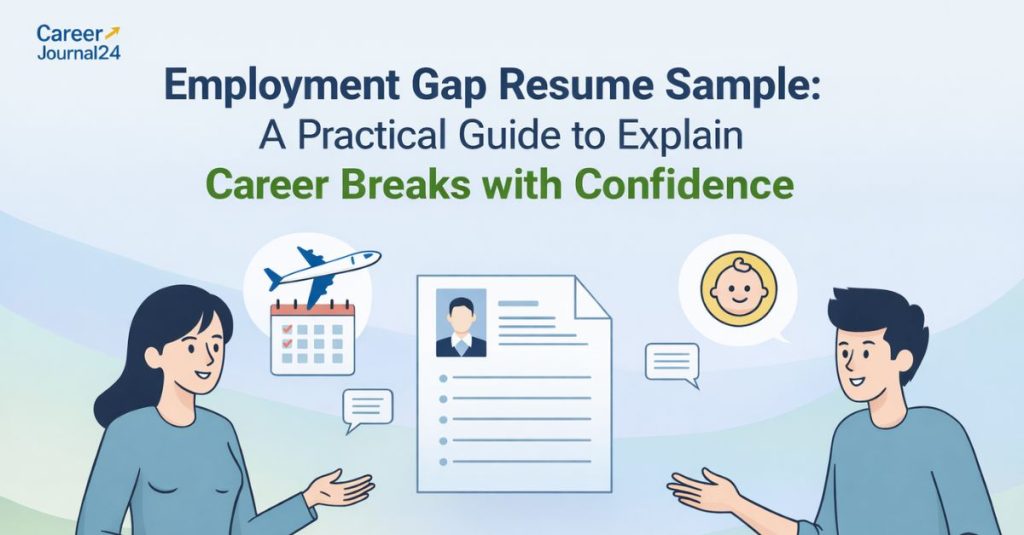
If you’re trying to write a resume after a career break, you might be searching for an employment gap resume sample that feels honest, clean, and professional. The good news is that employment gaps are more common than ever. Whether your break happened because of layoffs, family responsibilities, health reasons, burnout, or personal growth, there are smart ways to present your story so employers see value, not worry.
This piece of content shows you how to talk about your career break naturally, how to fill in employment gaps on a resume, and several sample resumes with gaps in employment that you can adapt immediately. Everything is written in easy, practical language, with examples from everyday life so the whole article feels human and relatable.
How Employers View Career Gaps Today
Here’s a helpful fact: according to LinkedIn’s 2022 Career Break Report, nearly 62% of employees have taken a career break, and 35% of hiring managers say they now view breaks as “valuable experiences.”
That means employers aren’t automatically judging you, they just want clarity. A resume with unexplained blank spaces feels confusing, but a resume that clearly shows what you were doing, even if it wasn’t a formal job, builds trust. Your goal is not to hide your gap. It’s to frame it.
First, Let’s Normalise the Gap
Before we dive into the “how,” let’s get one thing straight: employment gaps are incredibly common. The idea of a perfect, linear career path is a myth. Life happens. People get laid off (especially in recent years), take time off to care for a family member, go back to school, travel, deal with health issues, or even try to start a business.
A 2025 study showed that a significant percentage of workers have a gap of six months or more on their resume. Recruiters know this. They aren’t robots scanning for perfect timelines; they are humans looking for capable, reliable people. Your gap doesn’t automatically disqualify you. How you present it does. So take a deep breath. You are not alone in this.
The Golden Rule: To List or Not to List?
This is the first big decision. Do you try to hide the gap, or do you address it head-on? The answer depends on the size and recency of the gap.
- Gaps under 3-4 months: If the gap is short and not recent (i.e., it happened years ago), you can often get away with just listing the years for your jobs (e.g., 2018 – 2021) instead of specific months. This can visually smooth over a couple of months of unemployment without you having to say anything.
- Gaps longer than 3-4 months (or recent gaps): Don’t hide these. Trying to be clever with formatting will only draw more attention to it. The best strategy is to be prepared to explain it confidently. This is where a how to fill in employment gaps on resume samples approach becomes your best friend.
The Two Main Strategies: Hiding vs. Framing
There are two primary ways to handle a significant gap on your resume itself.
1. The Functional/Hybrid Resume (The “Hiding” Method)
This format de-emphasises your chronological work history and puts the spotlight on your skills. Instead of a “Work Experience” section at the top, you have a “Summary of Qualifications” or “Relevant Skills” section. Under this, you list skills and accomplishments, and then you briefly note where you used them (e.g., “Project Management Skills: Successfully managed a complex home renovation project from budgeting to completion”).
- When to use it: This is good for career changers or people with very long, unexplained gaps.
- The Catch: Many recruiters and Applicant Tracking Systems (ATS) prefer the traditional chronological format. Use this strategy with caution.
2. The Chronological Resume with an Explanation (The “Framing” Method)
This is my recommended approach 90% of the time. It’s honest, ATS-friendly, and shows confidence. You keep the standard chronological format, but you fill the gap with something meaningful. This is the core of how to fill in employment gaps on a resume – samples speak louder than words here.
Let’s look at a “before” and “after.”
BEFORE (The Scary Gap):
Senior Marketing Manager | ABC Corp | New York, NY
January 2020 – March 2022(Big, scary empty space here)
Marketing Coordinator | XYZ Inc. | New York, NY
June 2017 – December 2019
This looks like you were unemployed for almost two years. Yikes.
AFTER (The Framed Gap):
Now, let’s fill that space based on what you were actually doing.
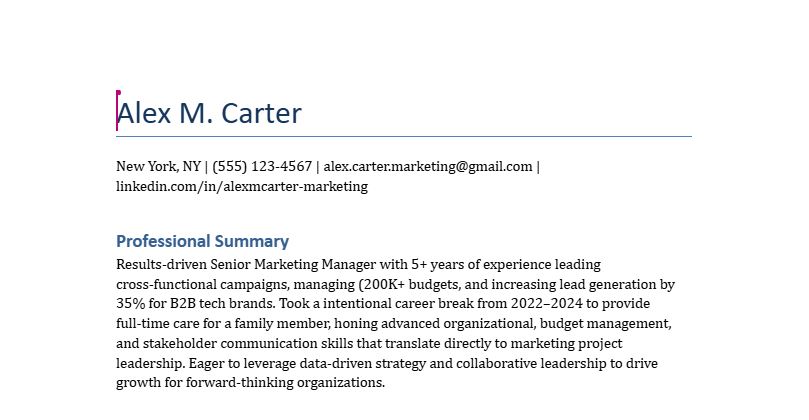
Employment Gap Resume Sample 1: Caring for a Family Member
This is a powerful story of responsibility, patience, and project management. Don’t just say “Caregiver.” Frame it professionally.
Senior Marketing Manager | ABC Corp | New York, NY
January 2020 – March 2022Family Care & Household Management | Self-Employed | New York, NY
April 2022 – Present
- Managed complex daily schedules and medical appointments for a family member, demonstrating exceptional organisation and reliability.
- Handled budgeting and financial planning for household needs, ensuring fiscal responsibility.
- Coordinated with healthcare professionals and support networks, honing communication and advocacy skills.
Marketing Coordinator | XYZ Inc. | New York, NY
June 2017 – December 2019
See the difference? You’re not “unemployed.” You were a project manager, a CFO, and a lead negotiator.
Employment Gap Resume Sample 2: Upskilling or Studying
Were you learning to code? Getting a certification in digital marketing? Taking online courses? Put it on your resume! This shows initiative. A great resource for this is Coursera for professional certificates.
Senior Marketing Manager | ABC Corp | New York, NY
January 2020 – March 2022Professional Development & Certification | Self-Study | Remote
April 2022 – October 2022
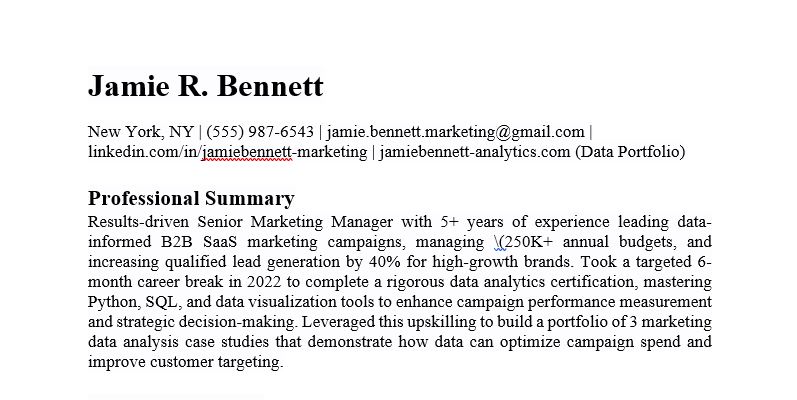
- Completed intensive 6-month certification in Data Analytics using Python and SQL.
- Developed personal projects to analyse marketing datasets, resulting in a portfolio of three case studies.
- Mastered new data visualisation tools including Tableau and Power BI.
Marketing Coordinator | XYZ Inc. | New York, NY
June 2017 – December 2019
Employment Gap Resume Sample 3: Dealing with Health Issues
You owe no one a detailed medical history. Be brief, professional, and pivot to the positive.
Senior Marketing Manager | ABC Corp | New York, NY
January 2020 – March 2022Sabbatical for Health & Wellness | New York, NY
April 2022 – Present
- Took a planned sabbatical to focus on personal health and recovery.
- Engaged in continuous learning through online courses in mindful leadership.
- Now fully recovered and eager to re-enter the workforce with renewed energy and focus.
Marketing Coordinator | XYZ Inc. | New York, NY
June 2017 – December 2019
Employment Gap Resume Sample 4: Travel or a “Life Sabbatical”
Don’t just say “Traveled.” What skills did you gain? Budgeting? Navigation? Cross-cultural communication? Independence?
Senior Marketing Manager | ABC Corp | New York, NY
January 2020 – March 2022Independent Travel & Cultural Immersion | Southeast Asia & South America
April 2022 – October 2022
- Planned and executed a 6-month, multi-country trip on a fixed budget, demonstrating advanced logistical and financial planning skills.
- Navigated unfamiliar environments independently, building resilience and problem-solving abilities.
- Engaged with diverse cultures, enhancing cross-cultural communication and adaptability.
Marketing Coordinator | XYZ Inc. | New York, NY
June 2017 – December 2019
Your Cover Letter: The Perfect Place for Your Story
Your resume states the facts and your cover letter tells the story. This is your chance to connect the dots for the recruiter before they even have a chance to wonder. Don’t apologise for your gap. Own it.
Here’s a simple, powerful template:
“After my role at ABC Corp, I made the decision to take some time away from the corporate world to [briefly and positively state the reason – e.g., ‘care for an immediate family member’ or ‘pursue a long-held goal of upskilling in data analytics’]. During this time, I not only [mention a positive outcome, e.g., ‘honed my project management skills’] but also gained a renewed sense of purpose. I am now incredibly excited to bring this fresh perspective and my skills in [mention 2-3 key skills from the job description] to the Marketing Manager role at your company.”
This approach is confident, concise, and immediately pivots back to the value you can bring to them. For more on structuring your narrative, check out The Muse’s guide to resume formats.
Also Read: How to Silently Quit Your Job
Final Takeaways on Employment Gap Resume Sample
- Be Honest, Always. Lying on a resume is the fastest way to get your offer rescinded.
- Confidence is Key. If you treat the gap like a shameful secret, so will they. If you treat it like a period of growth, they will too.
- Focus on Skills, Not Time. What did you do during that time? Manage a budget? Learn a new software? Care for someone? Organise a trip? These are all skills.
- Use the Right Format. For most people, the chronological resume with a well-framed gap entry is the strongest choice.
An employment gap resume sample isn’t about hiding a flaw; it’s about showcasing your life’s full, rich tapestry. Your career isn’t a straight line. It’s a winding road with interesting detours. Embrace those detours. They made you who you are today; and they might just be the very thing that lands you your next great job.



6 Comments