
The Ultimate List of Transferable Skills With Everyday Examples
Most of us only think about our abilities when we’re updating a CV or preparing for an interview, but your real value often shows up in your everyday life. The strengths you use to plan a family event, solve a problem at home, or help a friend understand something tricky all belong on your personal list of transferable skills, the abilities you can carry with you from one job, role, or stage of life to another.
These skills aren’t tied to any single profession. They’re the way you communicate, organise, learn, lead, and adapt, wherever you are. You might have built them through part-time jobs, school projects, parenting, volunteering, or even hobbies like gaming or sports. In this article, we’ll break down what transferable skills really are, show you how to spot them in your own life, and help you describe them in a way that feels honest, practical, and confident so they can genuinely support your next career step.
What Are Transferable Skills?
If you’ve ever changed jobs, switched careers, or even moved from school to your first role, you’ve already relied on transferable skills. These are the abilities you carry with you from one situation to another, no matter the job title, company, or industry.
Put simply, the definition of transferable skills is:
Skills you develop in one context (work, school, hobbies, life) that you can apply in a different context.
So when people ask, “What are transferable skills?”, think of things like communicating clearly, solving problems, staying organised, or working with others. You might have picked them up:
- At school or university
- In part-time jobs or internships
- Through volunteering or community work
- From hobbies, sports, or caring for family
They’re the “soft” (and sometimes “hard”) skills that don’t belong to a specific profession, yet quietly power almost every role you take on.
The Ultimate List of Transferable Skills With Everyday Examples
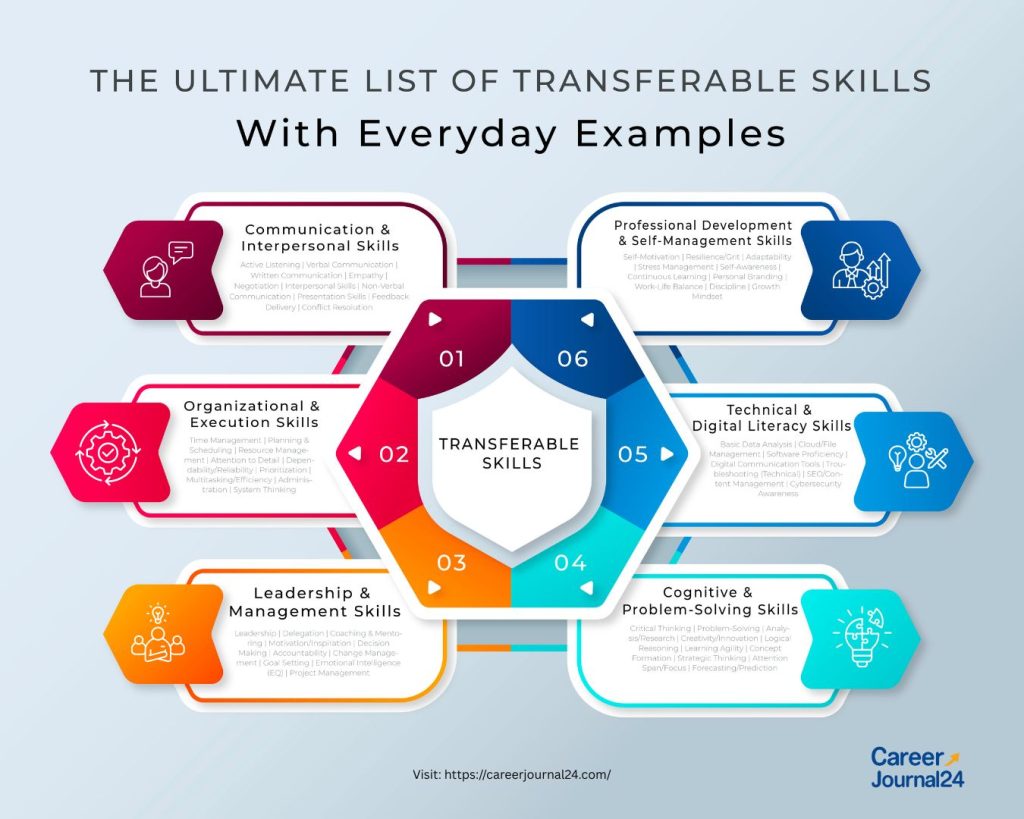
The most successful professionals, regardless of their industry, share a common core of essential abilities. These are the competencies that allow them to adapt, collaborate, and innovate. When analyzing your own history, it’s helpful to categorize these skills. For this detailed transferable skills analysis, we have grouped them into five powerful clusters: Communication & Interpersonal Skills, Organizational & Execution Skills, Leadership & Management Skills, Cognitive & Problem-Solving Skills, and Technical & Digital Literacy.
Here are the most sought-after examples of transferable skills, demonstrated through relatable, real-world scenarios:
A. Communication & Interpersonal Skills
These skills are the foundation of all professional relationships. They are often called ‘soft skills,’ but their impact is anything but soft; they determine your ability to negotiate, persuade, empathize, and build rapport. Strong communication isn’t just about what you say; it’s about how effectively you listen, write, and present ideas to diverse audiences. Mastering this area allows you to navigate conflicts, inspire teams, and ensure everyone is aligned on goals and expectations. This category is crucial because most professional failures can be traced back to a breakdown in communication, proving that these skills are essential for both individual and organizational success.
| Skill | Definition/Concept | Everyday Example | Professional Application |
| Active Listening | Paying full attention to, and absorbing, what others are saying. | Remembering specific details from a friend’s past conversations and bringing them up later. | Taking accurate notes during client meetings and repeating back key concerns for confirmation. |
| Verbal Communication | Clearly articulating thoughts, ideas, and information when speaking. | Explaining a complex board game or set of instructions clearly to a group of beginners. | Delivering a compelling presentation to stakeholders or giving concise direction during a team huddle. |
| Written Communication | Expressing ideas clearly and persuasively through text. | Writing a thank-you note or a detailed itinerary for a trip that leaves no room for confusion. | Drafting a professional email, proposal, or report that is free of jargon and mistakes. |
| Empathy | Understanding and sharing the feelings of others. | Comforting a distressed family member by truly listening to their feelings without judgment. | Handling customer complaints with genuine understanding and tailoring solutions to their emotional state. |
| Negotiation | Reaching a mutually acceptable agreement between two or more parties. | Bargaining for a better price on a used item or agreeing on a movie choice with a large group. | Discussing salary, contract terms, or resource allocation with another department. |
| Interpersonal Skills | The ability to interact effectively and appropriately with others. | Easily striking up a conversation with a new person at a social gathering. | Quickly integrating into a new team and establishing a good working relationship with colleagues. |
| Non-Verbal Communication | Using body language, tone, and facial expressions effectively. | Maintaining steady eye contact and an open posture while having a serious discussion. | Projecting confidence and authority during a pitch or interview through posture and gesture. |
| Presentation Skills | Delivering content to an audience in an engaging and clear manner. | Giving a toast or a speech at a party or event that captures everyone’s attention. | Leading a webinar or presenting quarterly results to the management team. |
| Feedback Delivery | Providing constructive criticism in a way that is motivating and helpful. | Gently pointing out a mistake in a friend’s plan while offering a concrete solution. | Giving a subordinate actionable steps for improvement during a performance review. |
| Conflict Resolution | Mediating disagreements and finding mutually agreeable solutions. | Stepping in to diffuse an argument between two family members over holiday plans. | Mediating a disagreement between two team members over project priorities. |
B. Organizational & Execution Skills
This category reflects your ability to translate plans into results. These skills are about structure, efficiency, and reliability, the bedrock of high performance. Execution skills demonstrate to an employer that you can manage multiple demands simultaneously, adhere to deadlines, and maintain high standards of quality even when under pressure. If you are the person friends and family rely on to organize events or manage complex paperwork, you have excellent skills in this domain. They prove you are dependable and capable of handling complexity and delivering on your commitments consistently.
| Skill | Definition/Concept | Everyday Example | Professional Application |
| Time Management | Prioritizing tasks and using time effectively to meet deadlines. | Successfully studying for exams, working a part-time job, and maintaining a social life simultaneously. | Juggling multiple high-priority client accounts and ensuring all tasks are completed on time. |
| Planning & Scheduling | Structuring tasks, resources, and time for maximum efficiency. | Planning a move to a new apartment, including packing, scheduling utilities, and managing timelines. | Creating a detailed project plan with milestones, dependencies, and resource allocations. |
| Resource Management | Utilizing assets (time, money, materials) efficiently and effectively. | Sticking to a strict budget for a home renovation project or a large purchase. | Allocating the team’s budget, software licenses, or equipment across various projects optimally. |
| Attention to Detail | Noticing and correcting small errors; ensuring accuracy in all work. | Meticulously checking a lengthy legal document or financial statement before submitting it. | Proofreading a major press release, performing quality assurance (QA), or auditing data. |
| Dependability/Reliability | Being consistently responsible, trustworthy, and committed to seeing tasks through. | Being the friend who is always on time and always follows through on commitments. | Consistently meeting performance targets and being the “go-to” person for difficult, urgent tasks. |
| Prioritization | Determining the most important tasks to focus on first to maximize impact. | Deciding which chores or errands must be completed today versus which can wait until tomorrow. | Using frameworks (like the Eisenhower Matrix) to focus on high-impact, urgent business tasks. |
| Multitasking/Efficiency | Handling multiple tasks simultaneously without sacrificing quality. | Cooking a three-course meal while helping a child with homework and answering the door. | Managing incoming email inquiries, attending meetings, and working on a major deliverable concurrently. |
| Record Keeping/Administration | Maintaining accurate and organized documentation. | Managing all personal financial documents, warranties, and insurance paperwork neatly. | Filing necessary legal or compliance documentation and maintaining a searchable archive of company data. |
| System Thinking | Understanding how individual parts contribute to a larger process or whole. | Fixing a problem with a home appliance by understanding the interconnected mechanics. | Analyzing a business process to find a single point of failure that affects the entire workflow. |
| Process Improvement | Identifying inefficiencies and suggesting better, more effective ways to complete tasks. | Finding a shortcut or a new tool that significantly reduces the time you spend on a repetitive household chore. | Streamlining an outdated onboarding process for new hires or automating a manual reporting task. |
C. Leadership & Management Skills
These skills are not restricted to people with a “Manager” title. Leadership is about influence, motivation, and responsibility, which can be demonstrated at any level. Employers seek out individuals who can take initiative, delegate effectively, and inspire others toward a shared vision. Management, in this context, refers to the ability to manage resources, projects, and expectations, not just people. Demonstrating these transferable skills proves you are capable of stepping up, guiding groups, and taking ownership of results, all of which are essential for career advancement.
| Skill | Definition/Concept | Everyday Example | Professional Application |
| Leadership | Guiding, motivating, and directing a group toward a common goal. | Taking charge during a crisis (e.g., a car breakdown) and assigning necessary roles to passengers. | Mentoring a new employee, leading a cross-department task force, or managing a critical project launch. |
| Delegation | Assigning tasks and responsibility to others effectively and fairly. | Assigning specific tasks (e.g., shopping, cooking, cleanup) to family members for a big dinner. | Distributing work across a team based on individual strengths and bandwidth, and trusting them to deliver. |
| Coaching & Mentoring | Guiding others through instruction, demonstration, and constructive feedback. | Teaching a family member a new sport or skill, such as riding a bike or managing a budget. | Training new hires, leading professional development sessions, or serving as a formal mentor. |
| Motivation/Inspiration | Encouraging others to perform at their best and maintain a positive attitude. | Cheering up a disheartened friend and helping them refocus on their goals. | Articulating the vision of a project to team members to increase their enthusiasm and effort. |
| Decision Making | Analyzing choices and selecting the best course of action promptly. | Quickly deciding the best and safest route to take when faced with unexpected road closures. | Evaluating market data and team capacity to make a final call on a new product feature rollout. |
| Accountability | Taking ownership of outcomes (both successes and failures). | Admitting you were wrong about a plan or prediction and actively working to correct the issue. | Taking responsibility for a budget overrun or a missed deadline and presenting corrective action steps. |
| Change Management | Helping individuals and teams adjust to new processes or environments. | Calming down stressed friends/family members when plans abruptly change and outlining the new path forward. | Leading a team through a difficult transition, such as adopting new software or shifting company strategy. |
| Goal Setting | Defining clear, measurable, and achievable targets. | Setting a clear personal fitness goal (e.g., running a 10K) and outlining the steps to achieve it. | Defining SMART (Specific, Measurable, Achievable, Relevant, Time-bound) objectives for a quarterly business unit. |
| Emotional Intelligence (EQ) | Monitoring one’s own and others’ emotions and using that information to guide thinking and actions. | Recognizing when you are overly stressed and taking a break before reacting poorly to a situation. | Sensing tension in a meeting and proactively shifting the agenda or suggesting a break to reset the mood. |
| Project Management | The ability to oversee a project from inception to completion, managing scope, time, and budget. | Running a successful volunteer drive or managing the construction of a deck or garden shed. | Using tools (like Asana or Jira) to track, report, and deliver a complex deliverable on time and scope. |
D. Cognitive & Problem-Solving Skills
These skills define how you use your brain to process information, evaluate options, and devise original solutions. Often referred to as “harder soft skills,” they are essential for analytical, strategic, and creative roles. Employers highly value candidates who can move beyond simple task execution to actually think critically about why something is being done and how it can be done better. Your past ability to find ingenious solutions, analyze large amounts of data to draw conclusions, or learn complex new concepts rapidly are all proof of strong cognitive transferable skills.
| Skill | Definition/Concept | Everyday Example | Professional Application |
| Critical Thinking | Analyzing information objectively to form a reasoned judgment. | Researching and comparing multiple mortgages, car loans, or insurance policies before making a major life decision. | Evaluating the pros and cons of two different technology platforms before recommending one to the executive team. |
| Problem-Solving | Identifying issues, analyzing causes, and implementing effective solutions. | Diagnosing why your car, Wi-Fi, or home appliance is malfunctioning and researching a fix. | Analyzing a sudden dip in sales performance and proposing a new strategy to re-engage users. |
| Analysis/Research | Gathering, interpreting, and structuring data or information. | Reading reviews, comparing features, and compiling a summary before purchasing a major appliance. | Conducting market research, performing competitive analysis, and synthesizing results into an actionable report. |
| Creativity/Innovation | Generating new ideas, approaches, or solutions. | Finding a unique, low-cost way to decorate a room or planning a surprise party with a novel theme. | Developing a fresh marketing angle for an existing product or designing an entirely new, efficient business process. |
| Logical Reasoning | Using a systematic process to arrive at a conclusion. | Successfully solving a complex puzzle, Sudoku, or following a detailed troubleshooting guide. | Structuring a legal argument or developing an algorithm based on a set of defined business rules. |
| Learning Agility | The ability to rapidly acquire new knowledge, skills, and behaviors. | Quickly mastering a new smartphone app or navigating a foreign city where you don’t speak the language. | Mastering a new software tool after the company switches systems or quickly getting up to speed on a new industry trend. |
| Concept Formation | Synthesizing disparate pieces of information into a coherent idea or model. | Explaining a complicated philosophical concept (like cryptocurrency) in simple terms to a beginner. | Building a new training module or framework to explain a complex operational procedure to new employees. |
| Strategic Thinking | Planning actions with an eye on long-term goals and implications. | Choosing a university degree or career path based on future earning potential and industry growth. | Developing a 3-year roadmap for product development that aligns with the company’s long-term mission. |
| Attention Span/Focus | The ability to concentrate on a task for an extended period without distraction. | Spending an entire Saturday successfully assembling a complex piece of furniture or finishing a large novel. | Dedicating focused, uninterrupted time to writing code, drafting a major report, or analyzing large datasets. |
| Forecasting/Prediction | Using current data and trends to anticipate future outcomes. | Estimating how much food/drink will be needed for a large gathering based on the RSVP count. | Creating a sales forecast for the next quarter based on historical data, market trends, and pipeline health. |
E. Technical & Digital Literacy Skills
In the modern world, proficiency with tools and technology is itself a crucial transferable skill, regardless of the industry. This is much more than knowing how to use Microsoft Office; it encompasses the ability to learn new software rapidly, manage data, and understand the basic principles of digital workflow. From understanding cloud storage to knowing how to filter a large dataset, these transferable skills are non-negotiable for almost every professional role today. Being digitally literate proves you can thrive in the contemporary, technology-driven workplace.
| Skill | Definition/Concept | Everyday Example | Professional Application |
| Basic Data Analysis | Organizing and interpreting data, often in a spreadsheet. | Tracking personal monthly expenses and identifying areas for saving using an Excel sheet. | Creating pivot tables in Excel/Google Sheets to analyze sales data or survey responses. |
| Cloud/File Management | Storing, sharing, and organizing documents and data online. | Effectively managing family photos, tax documents, and shared folders on platforms like Google Drive or Dropbox. | Using SharePoint or a shared cloud drive to manage version control and collaborative documentation for a project. |
| Software Proficiency | Quickly mastering and utilizing job-specific or common software tools. | Rapidly learning the interface and features of a new banking app, streaming service, or scheduling platform. | Quickly becoming an expert user of a new CRM (Customer Relationship Management) system or design software. |
| Digital Communication Tools | Effectively using various online platforms for professional interaction. | Setting up and running a successful video call (Zoom/Teams) for a remote social gathering. | Managing a company Slack channel, conducting remote interviews, or using project management software. |
| Troubleshooting (Technical) | Diagnosing and resolving issues with hardware or software. | Fixing a printer jam, restoring a lost Wi-Fi connection, or helping a relative fix their phone settings. | Debugging a minor issue in a spreadsheet macro or resolving a ticket submission for a common IT error. |
| SEO/Content Management | Understanding how to structure information for online visibility and consumption. | Creating a social media post that successfully gets noticed by your target friends/followers. | Updating website content using a CMS (Content Management System) or optimizing a blog post for search engines. |
| Cybersecurity Awareness | Understanding and practicing safe habits regarding digital security. | Using strong, unique passwords and avoiding clicking on suspicious links in emails. | Ensuring all client data is handled according to company privacy policies and reporting potential threats. |
| Database Querying (Basic) | Understanding how to filter and pull specific information from a structured dataset. | Using advanced search functions on a major website or filtering emails in your inbox by specific criteria. | Writing basic SQL queries or using advanced filters in a database interface to extract customer information. |
| Data Visualization | Presenting complex data in understandable graphs, charts, or diagrams. | Creating a simple chart to track a personal goal (e.g., weight loss, savings) over time. | Designing a dashboard in Tableau or Power BI to present key performance indicators (KPIs) to the leadership team. |
| Basic Coding/Automation | Understanding programming logic or using tools to automate simple, repetitive tasks. | Setting up “If This Then That” (IFTTT) rules to automate aspects of your smart home or email. | Writing simple scripts (e.g., Python or a batch file) to organize files or automate a data entry task. |
F. Professional Development & Self-Management Skills
This final cluster of skills focuses inward, defining how you manage your own emotions, handle stress, seek continuous improvement, and adapt to personal and professional changes. While often overlooked, self-management skills are the engine of career longevity and resilience. They determine your ability to bounce back from setbacks, maintain focus under pressure, and drive your own learning trajectory. Employers are increasingly looking for candidates who demonstrate high levels of self-awareness and accountability, as these traits predict reliability and a reduced need for constant external supervision. Cultivating these transferable skills ensures you are not just capable in your role, but durable throughout your entire career.
| Skill | Definition/Concept | Everyday Example | Professional Application |
| Self-Motivation | The internal drive to start, pursue, and finish tasks without external pressure. | Completing a difficult workout routine or teaching yourself a new language purely out of personal interest. | Taking initiative on new projects, consistently meeting personal growth targets, and proactively suggesting improvements. |
| Resilience/Grit | The ability to recover quickly from difficulties, setbacks, or failures. | Failing a test or interview and immediately planning new study/preparation strategies instead of giving up. | Recovering quickly from a major project failure, taking lessons learned, and restarting the work with renewed energy. |
| Adaptability | Adjusting smoothly to new conditions, technologies, roles, or unexpected challenges. | Quickly learning to use a drastically different operating system (e.g., switching from PC to Mac, or vice versa). | Seamlessly transitioning roles within a company, mastering new industry regulations, or pivoting strategies due to market shifts. |
| Stress Management | Employing techniques to control one’s level of stress, especially during peak workload. | Utilizing meditation, exercise, or scheduling short, intentional breaks during a highly busy week. | Remaining calm, rational, and effective during a high-stakes, crisis situation or a period of intense organizational change. |
| Self-Awareness | A deep understanding of one’s own personality, including strengths, weaknesses, beliefs, and emotions. | Knowing your own best time of day for deep work (e.g., mornings) and scheduling demanding tasks accordingly. | Accurately assessing your need for training in a certain area and seeking out targeted development opportunities. |
| Continuous Learning | The ongoing process of acquiring new skills and knowledge throughout your career. | Regularly reading industry news, listening to educational podcasts, or taking non-mandatory online courses. | Seeking certifications, attending professional development workshops, and applying new methods to daily tasks. |
| Personal Branding | Defining and projecting a positive, professional image and reputation. | Carefully curating your social media profiles and ensuring your online communication reflects maturity and professionalism. | Consistently communicating your expertise in meetings and online forums to be recognized as a subject matter expert. |
| Work-Life Balance | The ability to successfully manage professional and personal responsibilities to maintain overall well-being. | Setting firm boundaries by turning off work notifications outside of business hours to dedicate time to family/hobbies. | Encouraging healthy team dynamics by respecting colleagues’ time off and advocating for reasonable workload distribution. |
| Discipline | The practice of training oneself to act in accordance with rules and behavioral standards, even when difficult. | Sticking to a rigorous savings plan or meal prep schedule over several months to meet a long-term goal. | Consistently following compliance protocols, maintaining data security standards, and adhering to strict quality control measures. |
| Growth Mindset | Believing that your abilities and intelligence can be developed through dedication and hard work. | Viewing constructive criticism not as an attack, but as valuable data on where to focus your efforts for improvement. | Voluntarily taking on challenges that are slightly outside your comfort zone to push the limits of your current capability. |
Transferable Skills Analysis
A transferable skills analysis is simply a structured way to figure out what you’re good at and how it maps to a new goal. Here’s a practical method you can do in under an hour.
Step 1: Pick 3 moments you’re proud of
Choose wins from anywhere: work, school, volunteering, parenting, clubs, side projects.
Examples:
- You fixed a recurring issue on your team
- You handled a difficult customer situation
- You organized something that improved results
Step 2: Write what you actually did (not the job title)
Instead of “Managed a project,” write:
- “Set a timeline, clarified responsibilities, tracked progress, and handled blockers.”
This is where transferable skills live: actions, not labels.
Step 3: Label the skills behind those actions
Use simple tags from the list above:
- “prioritization,” “stakeholder communication,” “problem-solving,” “leadership,” “attention to detail.”
Step 4: Match those skills to your target role
Look at 5-10 job postings and highlight repeated themes:
- communication, coordination, reporting, customer interaction, process improvement, etc.
Then pick the overlap: those are your headline transferable skills.
For job-skill language alignment, it can help to browse job descriptions and skill definitions in a structured system like O*NET Online.
Step 5: Turn skills into proof
Employers don’t hire “I’m organized.” They hire “I’m organized and here’s evidence.”
A simple formula:
Skill + action + outcome
- “Improved scheduling by setting up a weekly plan, reducing last-minute changes.”
- “Resolved recurring issues by documenting a process, cutting repeat questions.”
You don’t always need numbers, but outcomes matter. Even small outcomes count when they’re clear and believable.
Using Transferable Skills in Your CV, Interviews, and Daily Life
Knowing your skills is useful; using them is powerful. Here’s how to make them work for you.
A. On Your CV and LinkedIn Profile
Instead of only listing tasks, show the transferable skill and the impact:
- “Resolved 20+ customer issues per day while maintaining positive feedback scores” (communication, resilience)
- “Coordinated schedules for a team of 5 to meet deadlines across 3 major projects” (teamwork, time management)
- “Taught myself new software and trained colleagues within two weeks of implementation” (adaptability, initiative)
For more ideas, you can explore sample CVs and skill descriptions on trusted career sites like Indeed Career Guide or National Careers Service (UK).
If you’re returning to work after time off or changing careers, looking at an Employment Gap Resume Sample can help you see how to position your transferable skills honestly and confidently.
B. In Interviews
When asked, “What are your strengths?” or “Tell me about a time you solved a problem,” use your transferable skills examples:
- State the skill: “One of my key transferable skills is problem-solving.”
- Give context: “In my last role / at university / while volunteering…”
- Describe what you did and the result.
For example:
“One of my main transferable skills is communication. In my part-time retail job, we often had frustrated customers when items were out of stock. I listened carefully, explained the situation clearly, and suggested alternatives or online orders. Many customers left satisfied, and my manager praised my calm approach.”
This turns a simple job into evidence of valuable skills.
C. In Daily Life
You can intentionally develop these skills every day:
- Offer to organise something (a meetup, family event, project) to practice leadership and planning.
- Volunteer for a local organisation to build teamwork and communication.
- Set a small personal project with a deadline (like learning a tool or launching a blog) to practice time management and self-discipline.
The more you practice, the easier it becomes to talk about your skills with confidence.
Common Mistakes People Make With Transferable Skills
- Listing skills without proof
“Leadership” means little unless you show what you led and what happened. - Being too generic
“Hardworking” is nice, but it’s not specific. Replace it with something observable: “reliable under deadlines,” “consistent follow-through,” “fast learner.” - Undervaluing non-work experience
If you’ve coordinated people, managed time, solved problems, or delivered outcomes, it counts. - Assuming transferable skills are only soft skills
Tools and systems can be transferable too: spreadsheets, documentation, reporting, training guides, workflow improvements.
Common Mistakes People Make With Transferable Skills
Even when people understand what transferable skills are, they often struggle to present them in a way that feels convincing and concrete. Here are some of the most common mistakes and how to fix them in a practical, down‑to‑earth way.
1) Listing skills without proof
One of the quickest ways to lose a recruiter’s attention is to write a string of skills with no evidence behind them. Words like “leadership,” “communication,” or “problem-solving” are common because they’re valuable, but they’re also vague unless you show what they looked like in action.
Instead of saying:
- “Strong leadership skills”
Show it with a simple, believable example:
- “Led a small team through a deadline week by assigning responsibilities, checking progress daily, and removing blockers so the work shipped on time.”
Or:
- “Took ownership of onboarding new teammates by creating a quick-start guide and answering questions, which helped them ramp up faster.”
The goal isn’t to impress with big language. It’s to make the reader think, “I can clearly picture this person doing the job here.”
A good rule: every skill you mention should have at least one supporting moment you could explain in 20–30 seconds.
2) Being too generic
Many people describe themselves the way everyone describes themselves: hardworking, motivated, team player, detail-oriented. These aren’t “bad” traits; they’re just hard to verify. If anyone can claim it, it doesn’t help you stand out.
Make your skills observable. Replace general labels with specific behaviors someone could actually notice.
Instead of:
- “Hardworking”
Try:
- “Reliable under tight deadlines; I plan my week early and flag risks before they become problems.”
Instead of:
- “Good communicator”
Try:
- “I keep communication simple and proactive, recap decisions in writing, confirm next steps, and follow up before deadlines.”
Instead of:
- “Detail-oriented”
Try:
- “I catch issues early by using checklists and doing a final review before submitting work.”
Generic skills are like blurry photos, technically accurate, but not useful. Specific skills are sharp enough to evaluate.
3) Undervaluing non-work experience
A lot of transferable skills are built outside traditional jobs, but people hesitate to include them because they don’t feel “professional enough.” That’s a mistake. Employers care about capability, not where it came from, especially if you can clearly connect it to the role.
Non-work experiences that often contain strong transferable skills:
- Volunteering (coordination, teamwork, communication, reliability)
- School projects (planning, research, presenting, collaboration)
- Caregiving/parenting (prioritization, conflict management, patience, logistics)
- Community leadership (organizing, persuasion, accountability)
- Side projects (ownership, creativity, problem-solving, customer focus)
Example: If you organized a fundraiser, you didn’t just “help out.” You likely scheduled tasks, coordinated people, followed up, handled last-minute issues, and communicated with different groups. That’s project coordination, stakeholder communication, and problem-solving.
The key is to describe it in work-like terms:
- What was the goal?
- What did you do?
- What changed because you did it?
When you frame it that way, your experience reads as credible and relevant, because it is.
4) Assuming transferable skills are only soft skills
Many people think transferable skills are only personality-based skills like communication or teamwork. Those matter, but they’re not the whole picture. Plenty of practical, tool-based abilities transfer across jobs, too, especially in today’s workplace where most roles involve systems, documentation, and coordination.
Examples of “hard” transferable skills that apply widely:
- Spreadsheets (tracking, organizing data, basic analysis)
- Reporting (summarizing progress, metrics, or results)
- Documentation (creating checklists, SOPs, FAQs, guides)
- Process improvement (finding inefficiencies and simplifying steps)
- Project tracking tools (Trello, Asana, Notion, Jira, principles transfer even if tools change)
- Basic data handling (cleaning lists, spotting patterns, presenting insights)
If you created a template that saved time, built a simple tracker that prevented missed deadlines, or wrote a guide that reduced repeat questions, that’s not “just admin.” That’s operational improvement, knowledge management, and efficiency.
Quick Recap
- Transferable skills are portable abilities you can use across roles and industries.
- A strong list of transferable skills includes communication, teamwork, problem-solving, organization, leadership, people skills, digital skills, and adaptability.
- The best way to stand out is to pair skills with real outcomes using a transferable skills analysis.
- If you’ve ever solved a real-life problem, coordinated people, or improved a process, you have more transferable skills than you think.
If you want, share the role you’re targeting and your last job (just the general type, not personal details). I’ll map your top transferable skills to that role and draft resume bullets that sound natural and specific.

8 Comments