Difference Between Upskilling and Reskilling and Why It Matters
The difference between upskilling and reskilling has become one of the most important workplace conversations today. As technology evolves, job roles change, and industries shift, both employees and employers are under pressure to adapt. Many people feel this change personally; one day you’re confident in your role, and the next, new tools or processes make you wonder if your skills will still be relevant next year.
In simple terms, upskilling and reskilling are about staying useful in a fast-changing world of work. But they are not the same thing. Understanding the difference between upskilling and reskilling, when each is needed, and how organizations can apply them effectively can make the difference between growth and stagnation for individuals and businesses alike.
This article breaks down what upskilling and reskilling really mean, their benefits, and how companies can implement them in practical, human-centered ways.
What Is Upskilling and Reskilling?
Before comparing them, it’s important to clearly understand what each term means in everyday language.
Upskilling means learning new skills that help you perform better in your current role or a related one. You’re building on what you already know. For example, a marketing executive learning data analytics to improve campaign performance is upskilling.
Reskilling, on the other hand, means learning an entirely new set of skills to move into a different role. This usually happens when a job is changing drastically or becoming less relevant. A customer support agent training to become a UX designer is an example of reskilling.
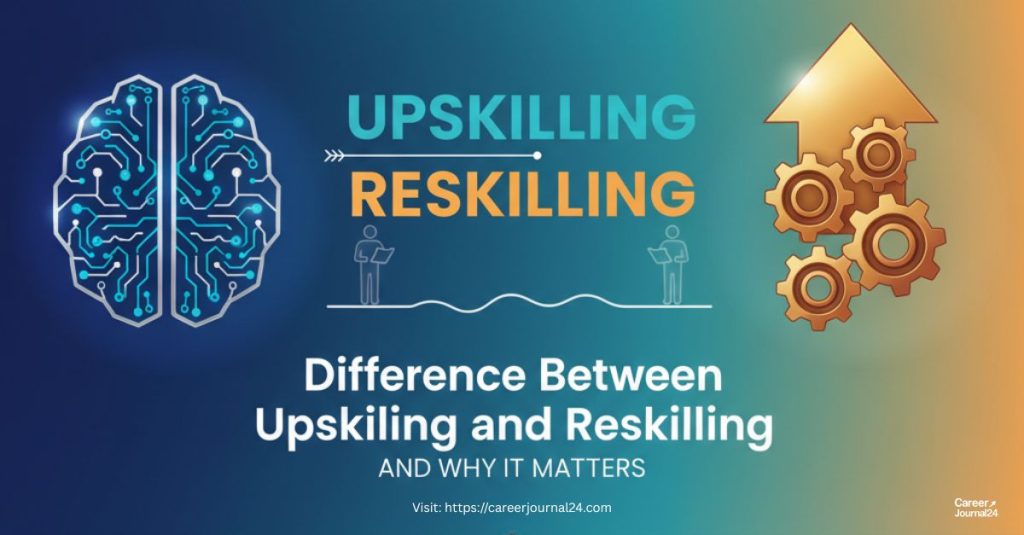
Think of it this way: upskilling helps you grow within your lane, while reskilling helps you change lanes.
The Core Difference Between Upskilling and Reskilling
The difference between upskilling and reskilling is far more than just semantics; it’s a difference in fundamental career strategy, intent, and outcome. While both are powerful forms of professional development, they are deployed for completely different reasons and yield different results for both the individual and the organization.

A. Career Direction: Depth vs. Transition
The most crucial difference is the direction of the professional journey:
- Upskilling Focuses on Depth and Specialization: Think of upskilling as digging a well deeper. You stay in your current field, your well is in the same location, but you sharpen your abilities to stay competitive and become the absolute expert in your area. The goal is vertical growth. For example, a financial analyst might upskill by learning advanced predictive modeling software. They remain an analyst, but they become a Tier 1 specialist capable of handling more complex, higher-value tasks. The field is the same; the mastery is elevated. This is about meeting the ever-increasing complexity of an evolving job role.
- Reskilling Focuses on Transition and Reinvention: Reskilling, by contrast, is closing one well and starting to dig a completely new one in a different field. This strategy is an intentional transition, where you prepare for a different role, often driven by necessity, such as industry disruption or automation. When a specific job role becomes obsolete (for example, many data entry positions), the employee doesn’t just need to be “better” at data entry; they need a new job entirely. Reskilling becomes much easier when professionals can rely on transferable skills such as communication, problem-solving, and adaptability, which can be applied across different roles and industries.
B. The Role of Urgency: Proactive vs. Reactive Adaptation
The timing and motivation behind these two actions often differ significantly, highlighting a key difference in organizational strategy:
- Upskilling is Primarily Proactive: It is often initiated to stay ahead of the curve. A company might mandate that all IT staff undergo training on the latest cybersecurity protocols before a major breach happens. An individual proactively learns a new coding language because they see it becoming the industry standard next year. It’s an investment made from a position of strength, ensuring continued relevance and peak performance.
- Reskilling Can Be Reactive (but is better when proactive): While reskilling should ideally be part of a proactive talent strategy, it is sometimes reactive; done because a role is fading or evolving too fast for incremental upskilling to suffice. When 50% of an employee’s daily tasks are absorbed by an AI tool, the business reacts by offering reskilling to move them into a non-automated role. The urgency is higher because the alternative is job displacement. However, the most successful companies proactively identify future skills gaps and begin reskilling employees long before their current roles become redundant, turning a potential crisis into a strategic advantage.
C. Investment Scope: Incremental vs. Foundational Learning
The nature of the training required for each strategy dictates a different scope and depth of investment:
- Upskilling Investment is Incremental and Focused: The training for upskilling typically involves shorter, specialized courses, certifications, or workshops. The content is highly relevant to the existing domain, meaning the time and resource investment are usually lower per instance. For example, a developer needs a weekend boot camp to learn a new JavaScript framework. The company is investing in refining an existing high-value asset. The existing knowledge base (the foundation) is already strong; the company just needs to add new, modern tools.
- Reskilling Investment is Foundational and Lengthy: Reskilling requires comprehensive, often months-long programs, apprenticeships, or intensive boot camps. The employee is learning an entirely new professional language, from the ground up. This involves a much larger investment of both time and budget, as the company is essentially transforming an employee’s professional identity. For a company, this commitment is a strategic bet on the employee’s cultural fit and institutional knowledge, outweighing the cost of hiring new external talent.
D. Impact on Structure: Role Enhancement vs. Workforce Agility
The resulting impact on the company’s organizational chart is also a clear differentiator:
- Upskilling Leads to Role Enhancement: When an employee upskills, their title and position on the organizational chart may not change immediately, but the scope, responsibility, and value of their current role increase. An upskilled Marketing Specialist might simply be a more effective specialist, but eventually, this leads to a vertical move to Senior Specialist or Team Lead. The structure is reinforced and strengthened at the core.
- Reskilling Drives Workforce Agility and Mobility: Reskilling creates internal mobility and directly changes the organizational chart by moving employees between departments or functions. It’s the strategy that allows a company to shut down one obsolete division and immediately staff a new, emerging one without external hiring. This flexibility makes the entire organization more agile, allowing it to pivot to market demands, like shifting from traditional retail to e-commerce, using the same pool of trusted, culture-fit employees.
E. The Emotional and Psychological Landscape
Finally, the emotional experience for the employee is fundamentally different, which organizations must acknowledge when implementing these programs:
- Upskilling Usually Feels Safer: Because you’re enhancing what you already know, upskilling leverages existing competencies and deep-seated confidence. The employee is building upon a familiar foundation, which reduces anxiety. It feels like an enhancement or an upgrade, leading to increased job satisfaction and a stronger sense of mastery.
- Reskilling Can Feel Intimidating, but Empowering: Reskilling carries a heavier psychological load because it requires starting over in some ways. Learning a new skill set, especially a complex one like coding or data science, involves temporary incompetence, which can be stressful. However, this challenge can also be profoundly empowering when it opens doors to entirely new opportunities. The ability to reinvent oneself is a major confidence booster, and successfully completing a reskilling program can reignite an employee’s passion and provide a renewed sense of purpose and long-term career security.
Benefits of Upskilling and Reskilling
Upskilling and reskilling offer value far beyond learning new tools or completing training programs. When done thoughtfully, they create long-term benefits for both employees and organizations. Below are five key benefits explained in a practical and easy-to-understand way.
1. Stronger job security and career resilience
One of the biggest benefits of upskilling and reskilling is increased job security. As roles evolve and some tasks become automated, employees with updated or diversified skills are far less likely to be replaced. Upskilling helps individuals stay relevant in their current roles, while reskilling allows them to transition into emerging roles instead of facing redundancy. This adaptability makes careers more resilient in uncertain job markets.
2. Higher employee engagement and motivation
Learning something new often reignites a sense of purpose at work. Employees who are given opportunities to upskill feel invested in and valued by their organization. Reskilling can be even more powerful for those who feel stuck or burned out, as it offers a fresh start and new direction. When people see a future for themselves, they are more engaged, motivated, and willing to contribute meaningfully.
3. Improved productivity and performance
Upskilling directly impacts day-to-day performance. Employees work faster, make better decisions, and rely less on supervision when they have the right skills. Reskilling, although it may take time initially, allows organizations to place people in roles where their strengths are better aligned. Over time, this leads to higher productivity and better-quality outcomes across teams.
4. Reduced hiring costs and talent gaps
Hiring externally is expensive, time-consuming, and uncertain. Upskilling existing employees helps organizations fill skill gaps without constantly recruiting new talent. Reskilling enables businesses to redeploy employees into high-demand roles instead of laying them off and rehiring later. This not only reduces costs but also preserves institutional knowledge that would otherwise be lost.
5. A future-ready and adaptable workforce
Perhaps the most important benefit is long-term readiness. Organizations that prioritize upskilling and reskilling build a culture of continuous learning. Employees become more open to change, quicker to adapt, and better prepared for future challenges. This adaptability gives companies a competitive edge and helps individuals grow alongside the organization instead of being left behind.
How to Upskill and Reskill Employees Effectively
Learning initiatives often fail when they feel disconnected from real work. To truly understand how to upskill and reskill employees, organizations must focus on relevance and practicality.
Start with skill mapping. Identify current skills, future needs, and gaps. This helps determine whether upskilling or reskilling is the right approach.
Next, make learning accessible. Online courses, microlearning, mentorship, and internal projects allow employees to learn without stepping away from their responsibilities entirely. Platforms like Coursera for Business and LinkedIn Learning offer structured programs aligned with industry needs.
Equally important is psychological safety. Employees should feel supported, not judged, while learning. Encouraging experimentation and allowing room for mistakes makes learning sustainable.
Finally, connect learning to real outcomes. When employees can apply new skills immediately, through projects, role rotations, or promotions, learning becomes meaningful rather than theoretical.
Conclusion
Understanding the difference between upskilling and reskilling helps you make smarter career moves instead of guessing your way through change. Upskilling is about getting better at what you already do so you can grow, earn more, and stay valuable in your current path. Reskilling is about learning a new set of abilities so you can shift into a different role when your interests change, your industry evolves, or your current job is fading out.
The best approach is the one that matches your reality right now. If your role is expanding and you enjoy the work, upskill and aim for deeper expertise. If your job is being reshaped by technology or you’re ready for a fresh direction, reskill and build a clear transition plan. Either way, the goal is the same: keep your options open.
Start small and stay consistent. Pick one skill, give yourself a simple weekly routine, and look for ways to apply what you learn immediately at work. Over time, those small steps add up to real confidence, stronger performance, and a career that can adapt no matter what comes next.