
The First 90 Days at a New Job: How to Start Strong
Starting a new job feels like walking into a party where everyone already knows each other. You’re excited, slightly nervous, and desperately hoping you don’t accidentally sit in someone’s favorite chair. Having a first 90 days in a new job checklist can transform this uncertain period into your biggest career opportunity. Think of these three months as your chance to write the opening chapter of your success story at this company, and trust me, first impressions last longer than that awkward handshake you’re worried about.
The reality is that most companies consciously or unconsciously judge your long-term potential during these initial months. It’s not about being perfect; it’s about showing you’re the right person they decided to hire. Let’s walk through a practical roadmap that’ll help you navigate these crucial weeks with confidence.
Why the First 90 Days Matter
Think of your first 90 days as the equivalent of a movie’s opening scene. It sets the tone, introduces the characters, and gives the audience a reason to keep watching. In professional terms, these early weeks determine whether you’ll be seen as someone who adds genuine value or just someone who fills a seat. Research from management psychologists suggests that new employees who actively focus on learning and relationship-building during their first three months receive higher performance ratings a year later than those who simply try to get through each day without making waves.
The first 90 days also give you time to understand whether the job actually fits what you expected. Many people accept positions based on interviews that showcase the best of a company, only to discover mismatches once they start. This period allows you to gather information about the organizational culture, the realities of daily work, and the actual path for advancement. Making a major career decision based on those first confusing weeks of orientation would be like judging a book by its table of contents. The first 90 days give you the context you need to make informed choices about your future.
There’s also a psychological component that shouldn’t be overlooked. Successfully navigating the early days of a new job builds your confidence and reduces your stress. When you know you’ve made a strong impression and understand how to succeed, you can focus your energy on doing great work instead of worrying about whether you’re making mistakes. That peace of mind is worth more than you might think, especially when you’re trying to learn new systems, meet new people, and deliver results all at the same time.
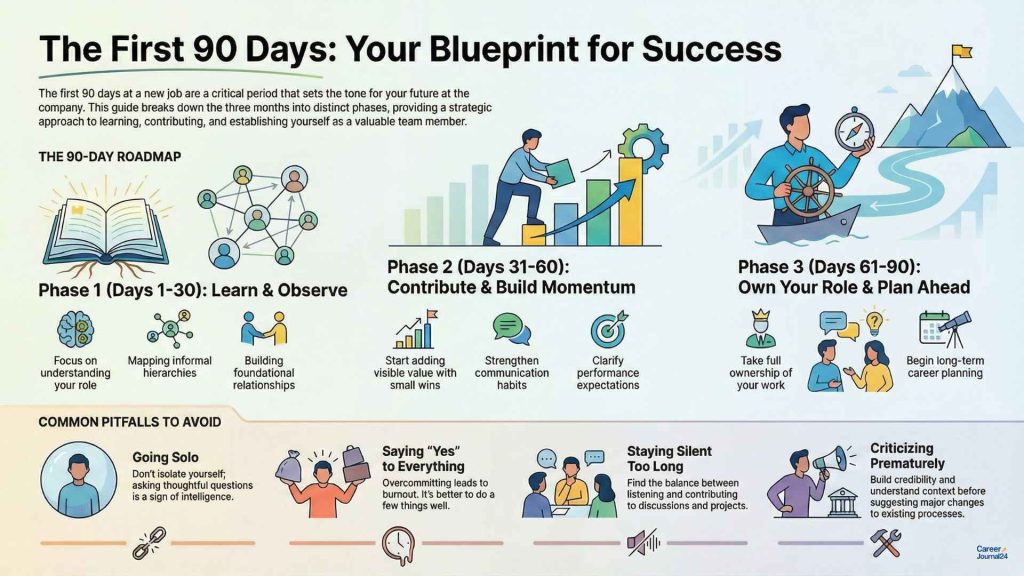
A. Days 1-30: Learn, Observe, and Set the Basics
The first month of your new job should feel less like a sprint and more like a careful reconnaissance mission. You’re gathering information, understanding the landscape, and figuring out where you fit into the bigger picture. Many new employees make the mistake of trying to prove themselves immediately by suggesting changes or working long hours before they understand what actually needs changing. Instead, spend these early weeks building the foundation that will support everything else.
1. Understand Your Role Clearly
One of the most common sources of frustration in new jobs is the gap between what you thought you’d be doing and what you’re actually asked to do. That job description you read during the interview process was a rough sketch, not a detailed blueprint. During your first week, take time to have a detailed conversation with your manager about what success looks like in your role. What specific outcomes are expected? How will your performance be measured? Who are the key stakeholders you’ll be working with?
When I started a new position several years ago, I spent my first two weeks assuming I knew what my priorities should be based on the job posting. I was wrong. My manager had completely different expectations, ones that had evolved since the position was advertised. A simple conversation in week one could have saved me weeks of working on the wrong things. Don’t make that mistake. Ask questions, take notes, and confirm your understanding. It’s better to appear overly thorough in your first week than to spend months drifting in the wrong direction.
2. Learn How the Company Really Works
Every organization has an official structure documented on paper, and then there’s the real way things get done. The official hierarchy might say that decisions go through your direct manager, but in practice, you might discover that the administrative assistant has more influence over certain processes than anyone realizes. Learning these informal dynamics takes time and observation.
Pay attention to how information flows through your team. Who talks to whom? Which meetings actually drive decisions, and which are just for show? How do people handle conflicts or disagreements? You won’t understand everything in your first month, but you can start noticing patterns. Watch how your colleagues interact with different departments, notice who gets invited to important meetings, and observe which opinions carry weight in discussions. This isn’t about becoming political; it’s about understanding how to be effective in your new environment.
Take notes on the small things too, like how people prefer to communicate. Some teams use Slack constantly while others rely on email. Some managers want daily updates while others prefer weekly check-ins. These preferences might seem trivial, but getting them wrong early can create friction that takes weeks to smooth over. A new employee who bombards a busy colleague with messages might not realize they’re being perceived as annoying rather than engaged.
3. Build Early Connections
Your first month is the easiest time to build relationships because people expect you to be reaching out. Once the “new person” label wears off, it becomes harder to justify taking up someone’s time for coffee chats or quick questions. Use this window to start building the relationships that will make your job easier and more enjoyable.
Think beyond your immediate team. Who else interacts with your work? Who are the people who can make your life easier when you need something done quickly? The IT support person who always returns your calls, the executive assistant who controls access to leadership, the finance team member who processes reimbursements quickly, these relationships matter more than you might expect. A simple conversation and a genuine attitude of respect can open doors that remain closed to those who only interact with others when they need something.
Schedule short meetings with your new colleagues, even if it’s just a 15-minute coffee chat. Ask about their role, what challenges they face, and what they wish they had known when they started. People generally appreciate the opportunity to share their experience, and you’ll gather valuable information while building goodwill. Just be mindful of their time, especially in your first week when everyone is still figuring out who you are.
B. Days 31-60: Contribute, Clarify, and Build Momentum
By your second month, you’ve gathered enough information to start making real contributions. The learning phase isn’t over, but you’re moving from pure observation to active participation. This is where you begin proving your value while continuing to fill in the gaps in your understanding.
1. Start Adding Visible Value
At some point during your second month, you should look for opportunities to make a contribution that others will notice. This doesn’t mean overhauling entire systems or suggesting dramatic changes to established processes. It means finding small problems you can solve, inefficiencies you can address, or improvements you can implement with minimal disruption. Maybe you notice that a particular process creates unnecessary delays, or maybe you have expertise in a tool that your team hasn’t fully utilized. Look for ways to add value that align with your strengths.
The key is to be helpful without being disruptive. New employees who immediately start criticizing how things are done earn a reputation for being difficult, even if their suggestions are valid. Instead, frame improvements as questions or experiments. “I noticed that we do X this way. I’m curious if we’ve ever tried Y, which worked well for me at my previous company. Would it make sense to test it on a smaller scale?” This approach shows initiative without suggesting that everything was wrong before you arrived.
Document your contributions as well, especially if your organization conducts formal performance reviews. Keep a simple list of what you’ve accomplished, problems you’ve solved, and positive feedback you’ve received. This information will be invaluable when it’s time to discuss your progress, and it will help you articulate your value during conversations about your role and compensation.
2. Strengthen Communication Habits
By your second month, you should have a good sense of how communication works in your new organization. Now is the time to build habits that will serve you well throughout your tenure. This includes how you communicate with your manager about your progress, how you share information with colleagues, and how you represent your team to external stakeholders.
Regular check-ins with your manager become increasingly important during this phase. These shouldn’t just be status reports but conversations about your development, your challenges, and your alignment with team goals. Come prepared with specific topics you want to discuss, updates on your progress, and questions that show you’re thinking strategically about your role. Managers appreciate employees who take initiative in these conversations rather than simply waiting to be told what to do.
Pay attention to how you communicate in writing as well. Emails, instant messages, and meeting contributions all contribute to how you’re perceived. Clear, concise communication that respects others’ time tends to be valued everywhere. So does communication that maintains confidentiality when appropriate and shares credit generously when it’s due. The habits you build in your second month will become second nature, so choose them carefully.
3. Understand Performance Expectations
Your second month is a good time to get clearer about how your performance will actually be evaluated. If your organization has a formal review process, learn what criteria are used and when reviews occur. If it’s more informal, have a direct conversation with your manager about what “good” looks like in your role.
This is also when you should start identifying potential obstacles to your success. What resource constraints might limit your accomplishments? How could organizational politics affect the reception of your work? Who are the other teams or individuals you depend on that might create delays? Understanding these factors early allows you to manage expectations appropriately and to ask for support when you need it.
C. Days 61-90: Own Your Role and Think Long-Term
Your third month marks the transition from new employee to established team member. The excuse of not knowing how things work no longer applies, and people will begin expecting you to function with increasing independence. This is when you solidify your position and start thinking about your long-term trajectory.
1. Take Ownership with Confidence
By day 60, you should have enough experience to start taking real ownership of your responsibilities. This means making decisions within your scope without constantly seeking validation, proactively addressing problems you notice, and holding yourself accountable for outcomes rather than just activities. Ownership doesn’t mean ignoring when you need help; it means recognizing that you’re the person primarily responsible for your work and its impact.
Start looking for opportunities to lead in small ways, even if leadership isn’t explicitly part of your title. This might mean mentoring newer employees, facilitating meetings, or taking point on a project within your area of expertise. When you demonstrate that you’re someone who steps up rather than waits to be assigned tasks, you become more valuable to your organization and more prepared for future opportunities.
2. Ask for Honest Feedback
Your first 90 days should include at least one formal feedback conversation with your manager, ideally around the end of the third month. This isn’t about waiting for praise; it’s about genuinely understanding how you’re perceived and where you can improve. The best time to ask for feedback is when you can still do something about what you hear.
When you ask for feedback, create space for honest answers by responding constructively rather than defensively. If someone points out a weakness, your first instinct might be to explain why they’re wrong or to feel discouraged. Instead, thank them for the input, ask for specific examples, and commit to working on the issue. People will be more likely to give you honest feedback in the future if they trust that you’ll receive it professionally.
3. Think Beyond the First 90 Days
As your first 90 days wrap up, start thinking about what comes next. Where do you want to be in six months? In a year? What skills do you want to develop? What relationships do you want to deepen? The beginning of a new job is the perfect time to think strategically about your career because you have fresh perspective and haven’t yet become comfortable with the status quo.
Consider having a conversation with your manager about your development path. How do you define the path to promotion? Which specific experiences will accelerate your growth? You should also determine which skills are prized most highly in your organization. These conversations signal that you’re thinking long-term and committed to building a career rather than just holding a position. They’re also practical, giving you information you can use to make decisions about where to invest your energy.
Common Mistakes to Avoid in the First 90 Days
Certain pitfalls derail more new employees than any lack of skill or experience. Understanding these mistakes in advance helps you avoid them, or at least recognize when you’ve stumbled so you can recover quickly.
1. Going Solo When You Should Ask for Help
One of the most damaging mistakes is isolating yourself too much in an effort to figure things out independently. While it’s true that you need to learn how to do your job, doing so in a vacuum makes the process slower and more difficult than it needs to be. It also signals to colleagues that you might not be a team player.
Asking questions and seeking help isn’t a sign of weakness; it’s a sign of intelligence. People generally enjoy helping those who show genuine interest and appreciation. The key is asking thoughtful questions after you’ve done some initial research, not expecting others to do your thinking for you. When someone helps you, follow up later to show how you applied their advice. This encourages them to help you again in the future.
2. Saying Yes to Everything Until You Drown
Another common error is overcommitting or trying to prove yourself by saying yes to everything. When you’re new, it’s tempting to volunteer for every project, stay late every night, and agree to deadlines that aren’t realistic. This approach leads to burnout and disappointment when you inevitably fall short.
Instead, be thoughtful about what you take on. It’s better to do a few things exceptionally well than to spread yourself thin across many mediocre efforts. Learn to say “I’d love to help with that. Let me check my current commitments and get back to you” instead of immediately saying yes. This gives you time to assess whether you can genuinely deliver without compromising your existing responsibilities.
3. Staying Silent for Too Long
Some new employees make the opposite mistake, waiting too long to speak up or contribute. There’s a reasonable adjustment period, but it shouldn’t last forever. If you’ve been in a role for two months and still haven’t made any independent contributions, people will start questioning whether you have what it takes.
Find the balance between learning first and contributing second. Start small by sharing an interesting article relevant to your team’s work or offering a perspective based on your previous experience. You don’t need to have all the answers to add value to a discussion. Sometimes asking a well-thought-out question that makes others think differently is contribution enough.
4. Criticizing Before You’ve Earned Credibility
Finally, be careful with negativity or criticism during your first 90 days. Even if you see obvious problems, you’re not in a position to address them effectively until you’ve built credibility and understanding. A new employee who complains about how things are done before they’ve earned the right to comment rarely succeeds.
There’s usually a reason things work the way they do, even if that reason isn’t immediately obvious. Instead of pointing out problems, observe and learn. When you eventually suggest changes, frame them as questions or experiments rather than corrections of others’ mistakes. “I’m curious about why we do X this way. Could you help me understand the background?” works much better than “This process is inefficient.”
Final Thoughts
The first 90 days in a new job fly by faster than you expect. One day you’re filling out paperwork and learning where the coffee machine is, and suddenly people are treating you like you’ve always been there. How you navigate this period will affect not just your immediate success but your long-term trajectory in your career. By approaching these early weeks with curiosity, humility, and a genuine desire to contribute, you set yourself up for a rewarding experience rather than a difficult one.
Remember that nobody expects you to be perfect in your first 90 days. What people do notice is whether you’re learning, whether you’re adding value, and whether you’re someone they’d want to work with. Focus on those three things, and you’ll do just fine. The skills you develop during this period, the relationships you build, and the reputation you establish will serve you for years to come. Make them count.






One Comment