
Solopreneur Guide: Meaning, Ideas, Tools, and How to Succeed Alone
The dream of working for yourself is more powerful than ever. It’s the desire for freedom, flexibility, and the chance to build something that is truly yours. But the path of the entrepreneur can feel daunting, often requiring massive teams, huge funding, and immense pressure. What if there was a way to capture the spirit of entrepreneurship on your own terms? This is where the solopreneur comes in. It’s a modern approach to business that empowers individuals to turn their passion into a profitable venture, all while maintaining control and a balanced life. This guide is your roadmap to understanding, launching, and thriving as a solopreneur in today’s digital world.
What Exactly Is a Solopreneur?
Before we dive into the strategies for success, it’s important to clarify the solopreneur meaning. At its core, a solopreneur is an entrepreneur who runs their business entirely alone. They are the CEO, the marketing department, the sales team, and the support staff, all rolled into one. When you ask what is a solopreneur, think of the freelance graphic designer, the online coach, the niche content creator, or the independent consultant. They might hire contractors for specific tasks, but the ultimate responsibility and vision rest on their shoulders.
This is a crucial distinction from a traditional business owner who builds a team and a company structure that can eventually run without their constant presence. The solopreneur is the heart and soul of their enterprise. This model is fueled by technology that allows one person to achieve what once required an entire department. It’s about leveraging your unique skills and knowledge to create value directly for a specific audience. The goal isn’t necessarily to build a massive corporation, but to create a sustainable, enjoyable, and profitable one-person show.
Solopreneur vs. Entrepreneur: What’s the Real Difference?
| Feature | Solopreneur | Entrepreneur |
|---|---|---|
| Primary Goal | To create a sustainable business that supports their lifestyle and autonomy. | To build a scalable company that grows into a large, self-sustaining organization. |
| Team Structure | Works alone. Hires contractors for specific tasks but has no employees. | Actively builds a team by hiring employees to delegate tasks and fuel growth. |
| Focus of Work | Mastering their craft and delivering a personal service directly to clients. | Building systems, processes, and a company structure that can run without them. |
| View on Growth | Growth means refining skills, increasing rates, and improving personal efficiency. | Growth means expanding market share, increasing headcount, and scaling operations. |
| Exit Strategy | Often no exit strategy; the business is their career until they choose to stop. | The business is an asset to be sold, taken public, or passed on. |
People often use the terms interchangeably, but there’s a key difference in scale and structure. An entrepreneur typically starts a business with the goal of scaling it. They build teams, seek investors, and their focus is on growth and market share. Think of the founder of a tech startup who aims to disrupt an entire industry. Their success is measured by company valuation and the number of employees.
A solopreneur, on the other hand, prioritizes control and lifestyle. Their business is built around their personal skills and capacity. While they absolutely want to grow their income and impact, their model is different. They might build a “lifestyle business” that provides a great income while allowing them to travel, work from home, or set their own hours. A solopreneur’s success is often measured by personal freedom, client satisfaction, and profit margin. One isn’t better than the other; they are simply two different paths to professional fulfillment. The solopreneur path is perfect for those who value autonomy and want to build a business that serves their life, not the other way around.
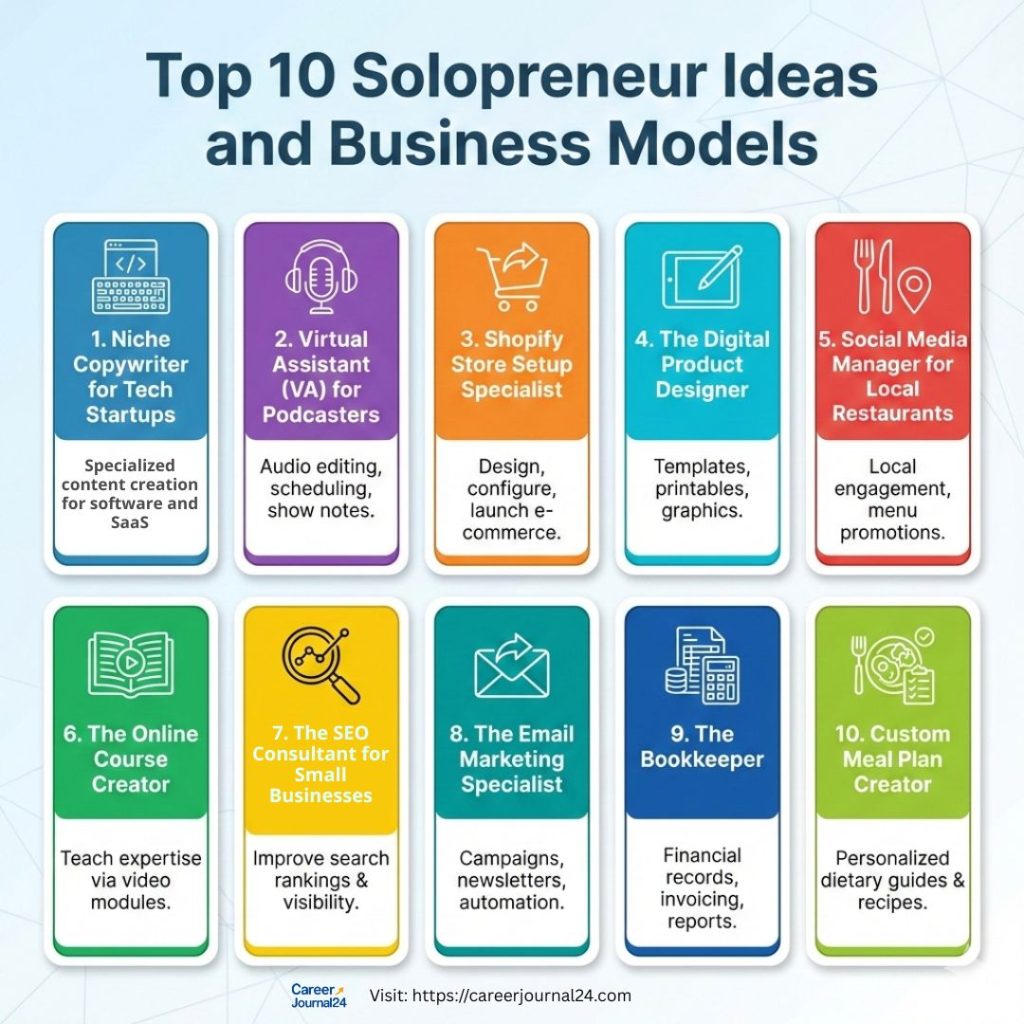
Top 10 Solopreneur Ideas and Business Models
The beauty of solopreneurship is that it can be applied to almost any industry. The key to success is to find a specific niche where your unique skills, genuine passions, and market demand intersect. While many of the ideas below focus on providing active services, it’s also wise to think about how you can build assets over time. In fact, many successful solopreneurs complement their main hustle with some of the passive income ideas to create more financial stability. Vague offerings get lost in the noise; specific solutions attract ideal clients. If you’re looking for inspiration, here are ten practical solopreneur ideas that are perfect for a one-person operation. Each of these solopreneur business ideas can be started with relatively low overhead and scaled based on your efforts.
1. Niche Copywriter for Tech Startups
Instead of being a generalist writer, you can specialize in crafting compelling website copy, blog posts, and email newsletters specifically for software-as-a-service (SaaS) companies. These businesses need to explain complex products in a simple, benefit-driven way, and they are willing to pay well for writers who understand their audience. You can start by building a portfolio with a few sample pieces and reaching out to tech founders on platforms like LinkedIn.
2. Virtual Assistant (VA) for Podcasters
Podcasters are often passionate creators who get bogged down by administrative tasks. As a specialized VA, you can handle everything from scheduling guest interviews and managing emails to uploading episodes and creating social media snippets. This is an ideal solopreneur venture because you can manage multiple clients from anywhere, providing a recurring monthly service that creates stable income.
3. Shopify Store Setup Specialist
Many aspiring e-commerce entrepreneurs have a great product idea but lack the technical skills to build a professional online store. You can become an expert in the Shopify platform, offering a package service to design and launch beautiful, functional stores for small businesses. This is a project-based role with high demand, and satisfied clients often return for ongoing maintenance or updates.
4. The Digital Product Designer
If you have a good eye for design and understand user experience, this is a fantastic model. Instead of trading time for money on a per-project basis, you can create and sell digital assets that generate passive income. Think of creating and selling custom-designed templates for platforms like Canva, Notion, or even PowerPoint. You could also design icon packs, website themes, or social media graphic kits. You do the work once, and then sell it over and over again to a global audience.
5. Social Media Manager for Local Restaurants
Local restaurants thrive on visual appeal and community engagement, making platforms like Instagram and Facebook essential. However, owners are often too busy running the kitchen to manage social media effectively. You can offer a monthly retainer to handle their content creation, post scheduling, and customer engagement, helping them attract more diners through mouth-watering photos and local promotions.
6. The Online Course Creator
If you have a teachable skill, you can package your knowledge into an online course. This is a powerful way to scale your impact and income beyond one-on-one services. The key is to solve a specific problem for a specific person. For example, instead of a “marketing course,” you could create a course on “Email Marketing for Etsy Sellers” or “Social Media for Local Restaurants.” You create the content once (by recording videos, creating worksheets, etc.) and can sell it for years.
7. The SEO Consultant for Small Businesses
Many small, local businesses know they need to be found on Google but have no idea where to start. As an SEO consultant, you can be their guide. You would help them optimize their website, manage their Google Business Profile, and create content that attracts local customers. This is a highly practical service that provides a clear return on investment. You could help a local dentist, a neighborhood bakery, or a home-service contractor get more visibility and, ultimately, more customers.
8. The Email Marketing Specialist
Email marketing consistently delivers one of the highest returns on investment of any marketing channel. Yet, many businesses struggle to do it effectively. As an email marketing specialist, you can build and manage email sequences, write engaging newsletters, and segment lists to increase sales and engagement for your clients. This is a service that directly impacts a company’s bottom line, making it a very valuable offering.
9. The Bookkeeper
Every business needs to track its finances, but most small business owners hate doing it. If you are organized and have a head for numbers, you can offer virtual bookkeeping services. Using cloud-based software like QuickBooks or Xero, you can manage accounts payable and receivable, reconcile bank statements, and generate financial reports for your clients. This is a recurring, high-demand service that provides peace of mind to business owners who would rather focus on their core work.
10. Custom Meal Plan Creator
With a growing focus on health and wellness, many people need help with their nutrition but don’t want a generic plan. If you have a background in nutrition or fitness, you can create customized weekly meal plans for clients based on their dietary needs (like gluten-free, vegan, or low-fodmap), fitness goals, and food preferences. This is a highly personal and repeatable service that can be delivered entirely online.
How to Become a successful Solopreneur
Transitioning from an idea to a functioning business requires a clear plan. How to become a successful solopreneur isn’t about luck; it’s about taking deliberate, consistent steps. Think of it as building a house: you need a solid foundation before you can put up the walls and decorate. This roadmap will guide you through the essential stages, turning your vision into a viable business.
Step 1: Discover Your Profitable Skill and Niche
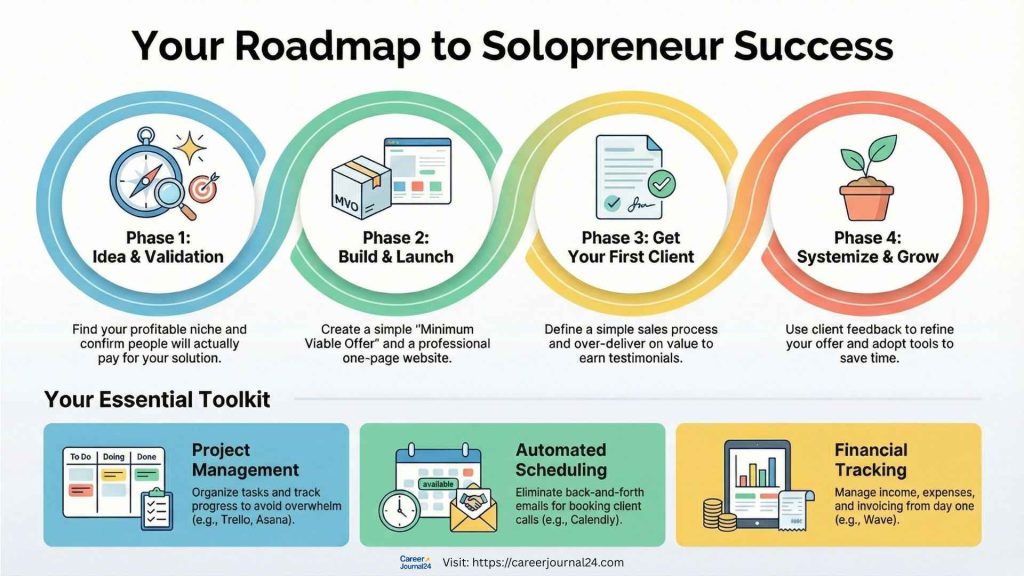
Before you can build anything, you need to know what you’re building with. The first step is to identify the intersection of three things: what you’re good at (your skill), what you enjoy doing (your passion), and what people are willing to pay for (a market need). Brainstorm a list of your skills, both professional and personal. Are you a great writer, an organized planner, a talented designer, or a skilled negotiator? Now, think about who needs those skills. Instead of aiming for a broad market, find a specific niche. For example, instead of being a “social media manager,” consider being a “social media manager for real estate agents.” This focus makes you a specialist, not a generalist, and is the foundation of a strong business.
Step 2: Validate Your Idea Before You Invest
One of the biggest mistakes new solopreneurs make is building something nobody wants. Validation is the process of confirming that your idea solves a real problem for real people. Before you spend money on a website or business cards, talk to potential customers. Use online forums, social media groups, or your personal network to ask questions. You don’t need a formal survey; a few honest conversations can be incredibly revealing. Ask questions like: “What’s your biggest challenge with [the problem you solve]?” and “Have you tried paying for a solution to this before?” If people are actively looking for a solution and are willing to pay for it, you’re on the right track.
Step 3: Create Your Minimum Viable Offer (MVO)
Don’t try to build a suite of ten services or products right away. Your next step is to create a Minimum Viable Offer. This is your simplest, most direct solution to the core problem you’ve identified. A writer could offer a package of three blog posts, while a consultant might focus on a one-time strategy session. A designer, on the other hand, may choose to sell a single logo package. The goal of your MVO is to get your first clients, deliver incredible value, and learn what works in the real world. This allows you to refine your process, gather powerful testimonials, and start generating revenue without getting bogged down in perfectionism.
Step 4: Establish Your Digital Home
You need a professional place where potential clients can find you and learn about your offer. This doesn’t have to be a complex, expensive website at the start. A simple, professional-looking one-page site that clearly explains who you help, what problem you solve, and how they can contact you is enough. Your digital home should include a clear description of your MVO, a way to get in touch (like a contact form or email), and any initial social proof (like testimonials from early users). This is your online business card and the central hub for all your marketing efforts.
Step 5: Build a Simple, Repeatable Sales Process
You can have the best offer in the world, but you won’t have a business if you can’t sell it. A “sales process” sounds intimidating, but it can be very simple. It’s just a clear path you follow when someone shows interest. For example, your process could be:
- A potential client fills out your contact form.
- You send them a link to book a free 15-minute discovery call.
- On the call, you ask questions to understand their needs and explain how your offer helps.
- You send a clear proposal or invoice.
The key is to make the next step obvious and easy for the client. By having a set process, you remove the guesswork and can focus on helping people, which naturally leads to more sales.
Step 6: Get Your First Client and Deliver Exceptional Value
This is the moment your idea becomes a real business. Your first client is your most important asset. Focus on over-delivering on your promise. Communicate clearly, meet your deadlines, and do everything you can to make the experience fantastic. A happy first client can provide you with a glowing testimonial, refer you to others, and give you the confidence boost you need. Don’t be afraid to start with a “beta” or introductory rate in exchange for a detailed testimonial. This initial success is the fuel that will power your growth.
Step 7: Systemize, Refine, and Grow
Once you’ve successfully served a few clients, it’s time to look back and optimize. What worked well? What was a struggle? Use this feedback to refine your offer, raise your prices, and improve your marketing messages. This is also the time to start thinking about systems. Can you create templates for your proposals or emails? Can you use a project management tool to stay organized? By systemizing the repetitive parts of your business, you free up your most valuable asset, your time, to focus on the high-value work that only you can do. This is the foundation for sustainable, long-term growth.
Essential Tools and Solutions for Solopreneurs
As a solopreneur, your greatest asset is your time. You can’t afford to get bogged down in administrative tasks. The right solopreneur tools and solutions act as your virtual team, automating processes and keeping you organized. You don’t need dozens of expensive apps, but a few well-chosen tools can make a world of difference. The goal is to find simple, effective solutions that give you more time to focus on the work that actually generates revenue.
Here are five categories of essential tools with popular examples to get you started:
1. Project and Task Management
To stay on top of everything, you need a central place to see what needs to be done today, this week, and this month. This is where project management software for solopreneurs comes in. Instead of relying on a messy to-do list or sticky notes, a tool like Trello or Asana allows you to organize your projects visually. You can create boards for different clients, break projects down into tasks, set deadlines, and track your progress. This clarity is crucial for avoiding overwhelm and ensuring you meet your deadlines.
2. Scheduling and Calendar Management
The back-and-forth of scheduling calls can be a huge time-waster. A scheduling tool eliminates this entirely. By connecting to your calendar (like Google Calendar or Outlook), a tool like Calendly allows potential clients to see your available slots and book a meeting directly. You simply send them a link, and they choose a time that works for them. This not only saves time but also makes you look professional and organized from the very first interaction.
3. Financial Management
Keeping your business and personal finances separate is non-negotiable. While you might eventually hire an accountant, you need a system to track your income and expenses day-to-day. A tool like Wave offers free, robust accounting, invoicing, and receipt scanning features that are perfect for a new solopreneur. It helps you see exactly how your business is performing at a glance and makes tax time infinitely less stressful.
4. Email Marketing
Social media algorithms change constantly, but your email list is an asset you own. An email marketing platform is essential for building a direct relationship with your audience and potential customers. A service like Mailchimp (which has a free plan to start) allows you to collect email addresses, send beautiful newsletters, and set up automated welcome sequences. This is one of the most effective ways to nurture leads and turn followers into paying clients.
5. Communication and File Storage
As a solopreneur, you need a professional way to communicate with clients and store your important documents. While email is a start, a tool like Google Workspace provides you with a professional email address (yourname@yourbusiness.com), along with shared drives for file storage, document creation, and video conferencing. Having a single, cloud-based hub for all your client communications and files keeps everything organized and accessible from anywhere.
Marketing and Sales for Solopreneurs
You can be the best in the world at what you do, but if no one knows you exist, you don’t have a business. This is where many solopreneurs get stuck. Marketing for solopreneurs doesn’t have to mean huge ad budgets or complicated funnels. It’s about building genuine connections and demonstrating your expertise. The most effective strategy is to choose one or two platforms where your ideal clients are and show up consistently with valuable content.
Think of it this way: don’t just post “buy my services.” Instead, teach, inspire, and entertain. If you’re a financial advisor for young families, share tips on Instagram about saving for college. If you’re a copywriter for SaaS companies, write insightful articles on LinkedIn about writing better website headlines. This approach, often called content marketing, builds trust and positions you as an expert before you ever ask for a sale. It’s a long-term strategy that pays huge dividends.
When it comes to solopreneurs sales and marketing help, the most powerful tool is a simple, repeatable process. A “sales process” doesn’t need to be pushy. It can be as simple as a discovery call template. When a potential client expresses interest, have a set of questions ready to understand their needs, their challenges, and their goals. Then, clearly explain how your service is the solution and what the next steps are. The key is to listen more than you talk. By focusing on helping and solving problems, the sales conversation feels natural and collaborative, not like a high-pressure pitch.
The Solopreneur Mindset: Growing on Your Own
Being a solopreneur is as much a mental game as it is a business one. You are the sole person responsible for your wins and your setbacks. This requires a high degree of self-discipline, resilience, and a commitment to continuous learning. It’s crucial to build a support system, even if it’s not a traditional team. This could be a mastermind group of other solopreneurs, a mentor in your field, or online communities where you can ask questions and share experiences.
One of the biggest challenges is avoiding burnout. When your business is your own, it’s easy to let work bleed into every hour of the day. Set clear boundaries. Define your work hours and stick to them as much as possible. Schedule time for breaks, exercise, and hobbies. Remember why you started this journey in the first place: for freedom and flexibility. Protect that.
Finally, embrace the role of a lifelong learner. The digital landscape changes quickly. Dedicate time each week to learning a new skill, reading industry blogs, or taking a course. This investment in yourself will keep you sharp, competitive, and excited about your work. Your business will only grow as much as you do.
Your Journey Starts Now
The path of the solopreneur is a rewarding one. It offers an unparalleled opportunity to build a career that aligns with your values, leverages your unique talents, and provides the freedom you crave. It’s not always easy, but by understanding the model, finding your niche, using the right tools, and focusing on authentic marketing, you can build a thriving one-person business. The world needs what only you can offer. The first step is simply to begin. For more inspiration on starting your own venture, you can explore resources like the U.S. Small Business Administration for foundational guidance. If you’re interested in the mindset of successful founders, Foundr’s content offers great insights into the entrepreneurial journey. Your business is waiting for you to build it.





3 Comments