
Followership: The Definition, Types and Qualities of Good Followers
In every success story we celebrate, there’s usually one person standing in the spotlight. We talk endlessly about leadership, vision, and charisma, but we rarely shine the same light on followership. Yet without strong followership, even the most brilliant leader is just someone talking to an empty room. Followership isn’t passive obedience or blind loyalty. It’s an active, thoughtful, and sometimes courageous choice to support, challenge, and move a team or organization forward. Understanding followership can completely change how you show up at work, whether you’re in a formal leadership role or not.
Most of us spend far more time as followers than as leaders in our careers. Recognizing that reality and learning to be exceptional at it is one of the fastest ways to grow influence, earn trust, and eventually step into bigger roles when the time comes.
What Is Followership and Why Does It Matter
Followership is the active, engaged, and intelligent participation in a group’s direction while accepting guidance from a leader. It isn’t blind obedience. Nor is it passive agreement. Instead, it’s a conscious choice to contribute your skills, perspective, and energy toward a shared goal.
Think about your last team project. Who was the person who quietly clarified the plan, asked the question that prevented a mistake, and made sure deadlines were met? That person demonstrated excellent followership. They weren’t the named leader, but they shaped the outcome more than most.
The relationship between leadership and followership works like a dance. One person may lead the steps, but the follower’s responsiveness, timing, and commitment determine whether the performance succeeds. Without skilled followers, even the most visionary leader stumbles.
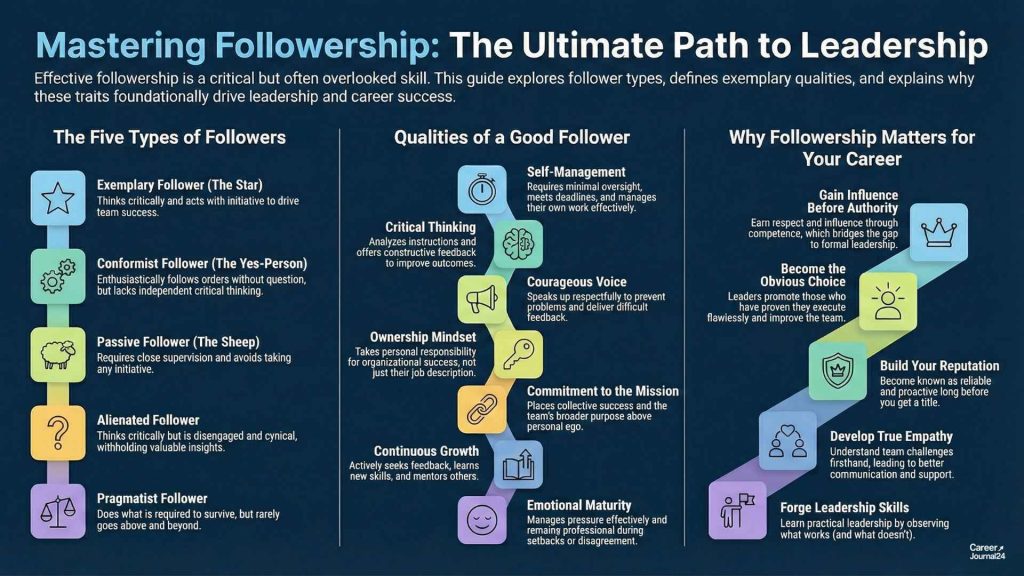
The Five Types of Followers (Kelley’s Followership Model)
Robert Kelley’s followership model, first introduced in 1988 and still widely used today, classifies followers based on two independent dimensions: the degree of independent, critical thinking and the level of active engagement. These two axes produce five distinct followership styles that appear in every organization. Understanding these types helps individuals recognize their own tendencies and enables managers to build balanced, high-performing teams.
1. Exemplary Followers (Star Followers)
Exemplary followers operate at the highest levels of both critical thinking and active engagement. They think for themselves, challenge assumptions when necessary, and take initiative without being asked. These individuals manage their own performance, anticipate problems, offer solutions, and willingly invest extra effort to ensure success. Exemplary followers partner with leaders rather than merely report to them. Research consistently shows they are the strongest predictors of team effectiveness and organizational adaptability.
2. Conformist Followers (Yes-People)
Conformist followers (originally termed “yes-people” by Kelley) display high active engagement but low independent critical thinking. They enthusiastically carry out orders, maintain a positive attitude, and rarely question direction, even when flaws are evident. While their willingness to act quickly can be valuable in stable or urgent situations, conformists risk becoming enablers of poor decisions. In environments that demand innovation or rapid course correction, excessive reliance on conformist followership can lead to costly mistakes.
3. Passive Followers (Sheep)
Passive followers exhibit low scores on both dimensions. They require detailed supervision, avoid initiative, and prefer to be told exactly what to do and how to do it. Often described as “sheep” in Kelley’s original terminology, passive followers contribute minimally unless closely managed. Although they rarely create problems directly, their dependence drains managerial time and slows overall team velocity. Organizations with large numbers of passive followers typically struggle with agility and responsiveness.
4. Alienated Followers
Alienated followers possess strong critical thinking skills yet remain largely disengaged. They notice flaws, foresee risks, and often hold valuable insights, but past experiences, such as ignored suggestions or toxic leadership, have led them to withdraw active participation. Alienated followers can appear cynical or detached. When their knowledge stays unspoken, teams lose access to important perspective. Recovering alienated followers represents one of the highest-return opportunities for thoughtful leaders.
5. Pragmatist Followers
Pragmatists occupy the middle ground on both axes. They perform adequately, adapt to changing priorities, and contribute when it serves their interests, but rarely go above and beyond. Pragmatists excel at surviving reorganizations and maintaining work-life balance. They provide stability and consistency without creating disruption. While not transformative, pragmatists form a necessary backbone in most organizations, especially during periods of transition or resource constraint.
Qualities of a Good Follower
Research and decades of observational evidence reveal a clear set of distinguishing qualities shared by followers who consistently elevate team performance and earn trust at every level. These seven attributes separate competent contributors from truly indispensable partners.
1. Self-Management
Exceptional followers require minimal oversight. They clarify expectations once, organize their work effectively, meet deadlines consistently, and flag potential obstacles early. Their managers spend time on strategy rather than chasing status updates. Self-management frees leaders to focus on vision while providing the reliable execution that turns ideas into results.
2. Critical Thinking
Strong followers think independently and constructively. They analyze instructions, data, and assumptions instead of accepting directives at face value. When they spot risks or better approaches, they raise concerns respectfully and back them with evidence. This habit prevents small oversights from becoming large failures and often improves the original plan.
3. Courageous Voice
Speaking up in environments where silence feels safer demands courage. Exceptional followers deliver difficult feedback with tact and timing, framing concerns as shared problems rather than personal criticism. Their willingness to voice dissent privately and early has saved countless projects, budgets, and reputations.
4. Ownership Mindset
Great followers treat organizational outcomes as personal responsibilities. They volunteer for unglamorous but critical tasks, follow through on commitments made by others when gaps appear, and refuse to let the ball drop simply because something falls outside their job description. This sense of ownership builds deep credibility across the entire team.
5. Commitment to the Larger Mission
Personal ego takes a backseat to collective success. Exceptional followers remain motivated by the broader purpose rather than individual recognition. They celebrate team wins graciously, share credit generously, and maintain effort even during stressful periods when short-term rewards feel distant.
6. Continuous Growth
Top followers actively seek feedback, pursue relevant skills, and stay current in their field. They view every assignment as a learning opportunity and willingly mentor others once competence is achieved. Their growth orientation ensures that their value to the organization compounds over time.
7. Emotional Maturity and Resilience
They manage emotions effectively under pressure, avoid drama, and maintain professionalism during disagreement or setback. Resilience enables them to absorb criticism without defensiveness and recover quickly from mistakes. Teams with emotionally mature followers experience lower conflict and higher psychological safety, creating the conditions for sustained high performance.
10 Followership Quotes
Throughout history, thoughtful observers have recognized that followership deserves as much respect and study as leadership. These ten followership quotes capture the essence of exemplary followership and its vital role in achievement.
“The most important thing a leader can do is to make followers aware of their own power.” – Rosabeth Moss Kanter
This statement reframes followership as an active, empowered state rather than a passive role.
“The manager accepts the status quo; the leader challenges it. But the follower decides which leader to follow.” – Warren Bennis
This highlights how followers fundamentally shape leadership legitimacy through their choice of commitment.
“Exemplary followers don’t just support the leader. They support the purpose.” – Robert Kelley
This distinction separates strategic followership from personality-driven loyalty.
“He who thinks he leads, but has no followers, is only taking a walk.” – John C. Maxwell
This underscores that leadership requires willing followership to exist.
“Management is doing things right; leadership is doing the right things. Followership is knowing the difference and having the courage to act on it.” – Peter Drucker
This frames followership as a judgment-driven competency.
“A leader’s job is not to do the work for others, it’s to help others figure out how to do it themselves. Followership is taking that help and running with it.” – Simon Sinek
This positions followership as the active execution arm of leadership development.
“Leadership is the art of getting someone else to do something you want done because he wants to do it. Followership is the art of finding leaders worth wanting to follow.” – Dwight D. Eisenhower
This speaks to the mutual selection process in effective leader-follower dynamics.
“The first responsibility of a leader is to define reality. The last is to say thank you. In between, the follower must act with intelligence and integrity.” – Max DePree
This emphasizes the action-oriented core of followership.
“When the best leader’s work is done, the people say, ‘We did it ourselves.’ The best follower says, ‘Let me help us do it.'” – Lao Tzu
This captures the humility and service orientation of strategic followership.
“Courageous followers assume responsibility for the organization, serve the leader, challenge the leader, and participate in transformation.” – Ira Chaleff
This comprehensive definition frames followership as a multi-dimensional, courageous act.
Why Followership Matters for Your Career
The career advancement paradox is that mastering followership, not demonstrating premature leadership ambition, creates the most reliable path to formal authority. Professionals who excel at followership competencies build leadership capabilities that self-proclaimed leaders often lack.
1. Leadership Skills Are Forged in Followership
Observing both effective and ineffective leaders up close provides practical education no MBA can replicate. Individuals learn what motivates teams, how communication lands, where processes break down, and how trust is built or lost. These insights later translate directly into more thoughtful leadership behavior.
2. Empathy Is Learned Through Experience, Not Theory
Receiving unclear instructions, unfair criticism, or insufficient recognition teaches empathy in ways that reading about it never can. Future leaders who have felt these frustrations firsthand communicate more clearly, delegate more effectively, and support their teams with greater understanding.
3. Reputation Travels Faster Than Titles
Exemplary followers become known as reliable, proactive, and mission-focused long before they hold formal authority. Senior leaders actively seek such individuals for special projects requiring advanced digital skills, stretch assignments, and eventual promotion because they have already demonstrated judgment and commitment under pressure.
4. Leaders Promote Those Who Make Them Better
Experienced executives recognize that their own success depends on strong followers. When deciding whom to groom for bigger roles, they naturally select individuals who have proven they can challenge constructively, execute flawlessly, and place collective goals above personal ambition, precisely the qualities of outstanding followership.
5. The Paradox of Influence
Paradoxically, those who master followership often gain influence long before acquiring a leadership title. Their ideas carry weight, their feedback is sought, and their presence stabilizes teams. This earned influence becomes the bridge to formal leadership rather than a sudden leap from obscurity.
Conclusion
Sustainable organizational success requires excellence in both leadership and followership. While leadership provides direction and inspiration, exemplary followership supplies the critical thinking, initiative, and resilience needed for execution in complex environments. Forward-thinking organizations now invest deliberately in developing both capabilities, recognizing that the quality of followership ultimately determines how far any vision can travel.





3 Comments