
How to Start an At-Home Business With No Money: 8 Simple Home Business Ideas You Can Start Today

Starting a business sounds expensive and overwhelming. But what if you could start a at home business with no money, using your skills, creativity, and the resources already around you? Whether you’re dreaming of earning extra income or building a full-time venture, it’s more possible than you think. This guide will walk you through simple, practical steps to begin a home-based business without upfront investment. Along the way, you’ll learn real ideas like how to start a baking business at home, how to start a t-shirt business at home, how to start a small food business at home, and more. Each path shares tips that apply to many businesses, especially when money is tight.
Why You Can Start With No Money
Before exploring specific business ideas like how to start a laundry business at home or how to start a nail business at home, let’s clear one thing up: money is not the only resource you need. Your time, network, skills, and willingness to learn are often more valuable in the early days.
Many successful entrepreneurs began without capital. They relied on pre-selling their services, bartering skills, leveraging free tools, and re-investing earnings back into their businesses. If you focus first on validating your idea and serving early customers well, money tends to follow. Over time, as your systems improve, you can even pivot these active roles into more sustainable passive income ideas that work for you while you sleep.
How to Start an At Home Business With No Money
Before diving into specific business ideas like baking, candles, or t-shirts, it’s important to lay a solid foundation. These practical steps will help you start smart, avoid common mistakes, and grow steadily even with no money.
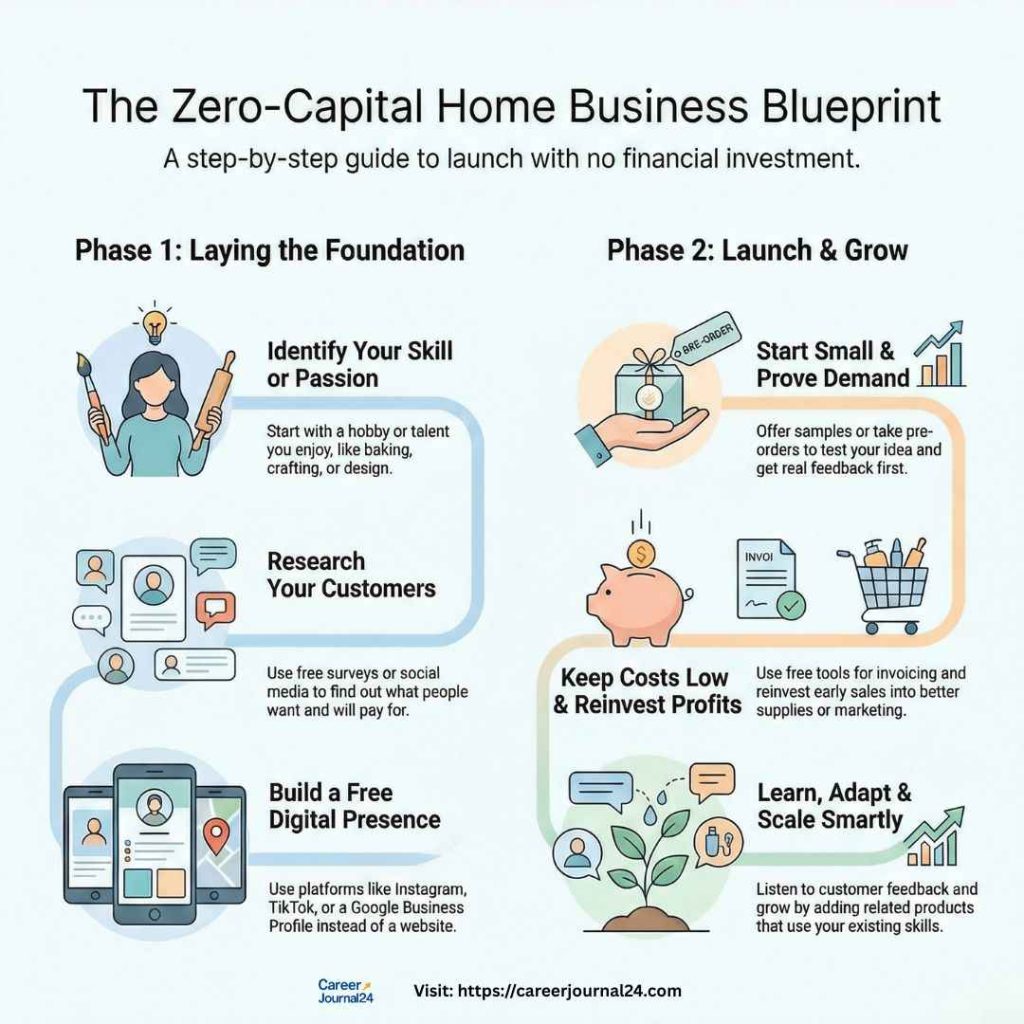
1. Identify your skill or passion
The first step is to focus on what you’re naturally good at or genuinely enjoy. Think about your hobbies, past experiences, or talents that others often compliment. For example, if you love baking, crafting, or hairstyling, these can become the core of your home business. Choosing something you’re passionate about keeps you motivated even during challenging days. It also makes it easier to create unique products or offer personalized services, which stand out in a crowded market. Starting with your strengths is especially useful for businesses like candles, candy, or beauty services, where creativity and skill make a big difference.
2. Research your customers
Once you know your skill or service, the next step is understanding who would buy it. Identify your target audience: Are they busy parents, students, office workers, or local residents? Talk to friends, family, or neighbors to get feedback, or join local Facebook groups and WhatsApp communities to gauge interest. Free online survey tools like Google Forms can also help you collect opinions quickly. The goal is to learn what people need, how much they are willing to pay, and what makes them choose one product or service over another. This research ensures you invest your time wisely and offer something people actually want.
3. Use free tools and platforms
Starting with no money means you need to leverage free resources as much as possible. Tools like Canva allow you to design attractive social media posts, flyers, and logos without hiring a designer. Google Sheets or Airtable can help track orders, expenses, and customer details. Messaging apps like WhatsApp or Messenger make it easy to communicate with customers directly, while platforms like Instagram, TikTok, or Facebook let you showcase your work to a larger audience. Even free blogging sites or marketplaces like Etsy or Fiverr can serve as a starting point. These tools help you promote and manage your business without spending a single dollar.
4. Set Up a Simple Digital Presence
A professional looking website is not required at the start. Instead create a free profile on a platform that already attracts buyers. For food‑related ideas a Instagram page works wonders; for apparel a TikTok channel can showcase the design process; for service based work a simple Google My Business listing will do.
When you write the profile make sure to sprinkle in the main keyword naturally. Example: “I help busy families enjoy fresh baked treats without leaving the house.” This phrasing reinforces the central theme and improves discoverability.
5. Start small and prove demand
Instead of waiting to be fully ready or investing in expensive equipment, begin with a small version of your idea. Make a few sample products, offer your service to neighbors, or take pre-orders from your first clients. This approach helps you test the market, get real feedback, and make improvements before scaling. For example, if you’re learning how to start a small food business at home, prepare a few dishes for friends and ask for honest reviews. By starting small, you reduce risk, save money, and gain confidence as you see what works. Once you get traction, you can gradually expand your offerings and reach more customers.
6. Keep Costs Low and Reinvest Smart
In the early stages, every dollar counts. Buy supplies in small batches and only after you know there’s demand. Use free tools for invoicing (like Wave or Google Sheets) and scheduling (like Calendly). As you make sales, reinvest in better tools or marketing.
7. Learn and Adapt
Your first few customers will teach you more than any business book. Listen to feedback, try new ideas, and don’t be afraid to pivot. Maybe your candle scents need tweaking, or your t-shirt designs could be more colorful. Adapt and grow.
8. Reinvest Profits Strategically
The first sale is exciting but the real growth comes from turning that revenue back into the business. Allocate a small percentage to improve packaging, purchase a better camera for product photos or boost a post on social media to reach a larger audience. As cash flow builds you can gradually expand the product line or hire a part‑time helper for a specific task.
9. Scale Without Overextending
Growth does not mean buying a commercial kitchen or renting a storefront right away. Instead focus on adding complementary items that use the same base skills. A baker might start offering frosting kits, a designer could launch matching tote bags, and a candle maker could introduce seasonal scents. Each addition should feel like a natural extension of what you already do.
10. Stay Motivated and Keep Learning
Running a home enterprise can be isolating. Join online groups where members share tips, celebrate wins and troubleshoot challenges. Listen to podcasts that discuss entrepreneurship, and read success stories of people who started with nothing. The more you absorb, the easier it becomes to adapt your approach when market trends shift.
8 Simple Home Business Ideas You Can Start Today
If you are ready to take the leap, here are eight specific paths you can take to become your own boss. Each of these allows you to leverage what you already have in your house to build a profitable future.
1. How to Start a Baking Business at Home
If your friends are always asking for your cookie recipe or begging you to bring your signature brownies to the party, you should learn how to start a baking business at home. This is one of the most accessible entry points because your kitchen is already a functional workspace. To start with no money, you must adopt a “made-to-order” philosophy. Instead of spending fifty dollars on ingredients to bake a batch of cupcakes you hope will sell, you should market your services first.
Once a customer places an order and pays a deposit, you use that cash to buy your flour, sugar, and eggs. This eliminates financial risk. To stand out, find a specific niche that the local grocery store doesn’t cover, such as gluten-free pastries or hyper-realistic birthday cakes. Use your social media accounts to post “process videos” of you decorating; people love to see the care that goes into homemade goods, and this builds the trust necessary to turn followers into paying customers.
2. How to Start a Small Food Business at Home
Beyond sweets, there is a massive market for savory, home-cooked goods. Knowing how to start a small food business at home involves identifying what people in your neighborhood are missing. Perhaps you make an incredible hot sauce, or maybe you have a talent for healthy, portion-controlled meal prepping for busy office workers. The key to a food business with no budget is keeping your menu extremely small.
By offering only one or two “specialties,” you reduce waste and keep your grocery list simple. This also makes you an expert in those specific items, which justifies a higher price point. Always check your local “Cottage Food Laws” to see which items you are allowed to sell from a residential kitchen without needing a commercial license. Selling at local farmers’ markets or through community groups is a great way to get your first few sales without paying for a traditional storefront.
3. How to Start a T-Shirt Business at Home
Many people assume you need expensive heat presses, screens, and stacks of blank shirts to learn how to start a tshirt business at home. While that is one way to do it, the zero-cost method is called “Print on Demand” (POD). With POD, you act as the designer and the marketer while a fulfillment company handles the rest. You create a unique design using free tools like Canva and upload it to a platform like Printful or Redbubble.
When a customer buys your shirt, the platform prints the design and ships it directly to them. They take a portion of the sale for the shirt and labor, and you keep the rest as profit. This model is perfect because you never have to buy inventory that might not sell. Your success depends entirely on your ability to create designs that speak to a specific audience, such as dog lovers, hobbyist gardeners, or fans of vintage typography.
4. How to Start a Laundry Business at Home
If you are looking for a service that provides immediate cash flow with no overhead, learning how to start a laundry business at home is a brilliant move. Everyone has laundry, and for many people, especially busy parents and professionals, it is the one chore they would gladly pay to outsource. Since you already own a washing machine and dryer, your only real costs are electricity, water, and detergent.
To start for free, you can ask your first few clients to provide their own preferred detergent, or you can use the profits from your first job to buy a bulk container of high-quality soap. Offer a “wash, dry, and fold” service where you pick up dirty bags of clothes and return them neatly stacked and ready for the closet. This business is highly scalable; what starts as a few loads a week in your guest room can quickly turn into a full-scale operation as word-of-mouth spreads through your neighborhood or local Facebook groups.
5. How to Start a Nail Business at Home
For those who have a creative eye and a steady hand, knowing how to start a nail business at home can turn a hobby into a high-demand career. If you already have a collection of quality polishes, files, and cuticle tools, you are ready to begin. The beauty industry is built on visual proof and personal trust. Start by offering discounted manicures to friends or family members in exchange for high-quality photos of your work.
Create a dedicated Instagram or TikTok account to serve as your digital portfolio. Instead of trying to compete with high-end salons that offer complex chemical extensions, focus on “natural nail health” or “intricate hand-painted art.” This requires less expensive equipment and appeals to a growing market of people who want personalized, artistic nails in a quiet, one-on-one environment. As you earn money, you can eventually reinvest in professional-grade LED lamps and specialized gel kits.
6. How to Start a Hair Business at Home
Similarly, learning how to start a hair business at home is about selling your technical skill and time. You don’t need a hydraulic chair or a wall of mirrors to get started; many successful stylists began by offering braiding, silk presses, or event styling (like prom or wedding hair) from a comfortable chair in their living room. Because you aren’t paying “chair rent” at a professional salon, your profit margins are much higher.
The secret to success here is specialized knowledge. If you can master a specific technique, like natural hair textures or vintage updos, people will travel to you. Use your own hair or a friend’s hair to create “how-to” videos or style showcases on social media. For more information on building a personal brand in the beauty space, you can check out resources like The Professional Beauty Association to see how to transition from a home setup to a professional career.
7. How to Start a Candle Business at Home
The home fragrance market is massive, and understanding how to start a candle business at home involves a mix of chemistry and storytelling. While you will eventually need to buy wax and wicks, you can start with a very small “test batch.” To keep your initial costs at zero, you can use the pre-order model: show your friends and followers your scent concepts and labels, and use their pre-payments to buy your bulk materials.
You can even upcycle unique glass jars or vintage tea cups from your own kitchen to create a “one-of-a-kind” aesthetic that big-box stores can’t replicate. What truly sells a candle is the atmosphere it promises. If you can brand your candles with evocative names like “Rainy Day in a Cedar Cabin” or “Fresh Linen and Morning Sunlight,” you create an emotional connection with the buyer. This allows you to charge a premium price for a product that costs relatively little to produce.
8. How to Start a Candy Business at Home
If you enjoy making sweets but want something with a longer shelf life than cake, you might wonder how to start a candy business at home. Sugar is one of the most affordable raw ingredients on the planet, which means the profit margins for items like handmade fudge, brittle, or gourmet marshmallows are incredibly high. Candy is also much easier to ship than baked goods, allowing you to sell to customers outside of your local area.
The trick to a successful candy business is the “unboxing experience.” Even if you are using simple clear bags, a handwritten note or a piece of colorful twine can make the product feel like a luxury gift. This is an excellent business for holiday seasons when people are looking for small, affordable gifts for teachers or coworkers. By focusing on high-quality ingredients and beautiful presentation, you can turn a few dollars’ worth of sugar into a high-end confectionery brand.
Conclusion
Starting a business from home with no money is not just a dream; it’s practical and achievable. Whether you’re figuring out how to start a baking business at home, how to start a t-shirt business at home, or how to start a laundry business at home, the key is to begin with what you have. Use your skills, talk to your community, leverage free tools, and always put customers first.
You don’t need fancy equipment or a big budget to begin. With clarity, consistency, and creativity, you can build something meaningful right from your home. Start today, the world needs your talent and your unique business.






4 Comments