
How to Start a Small Food Business at Home

Many of the world’s most recognizable food brands began with a single person standing in a kitchen, a family recipe, and a vision. If you have a signature sauce that friends always praise or a baked good that disappears in minutes, you have the foundation of a brand. Learning how to start a small food business at home is less about having a professional culinary degree and more about understanding the balance between culinary excellence and strategic logistics.
In today’s economy, the barriers to entry for food entrepreneurs have never been lower. You do not need a massive storefront or a fleet of delivery trucks to begin. You simply need a clear plan, a compliant workspace, and the passion to share your flavors with a wider audience. This guide provides a professional roadmap for transitioning from a home cook to a legitimate business owner.
Why Start a Food Business from Home?
Launching from your own kitchen allows you to test the waters without the massive overhead of a commercial lease. It provides the flexibility to grow at your own pace while minimizing financial risk. Many aspiring entrepreneurs ask, how do I start a food business from home while maintaining other professional commitments? The answer lies in the strategic use of “cottage food laws.”
Most regions have specific regulations that allow individuals to sell low-risk foods, such as baked goods, jams, and dry mixes, directly to consumers without needing a full-scale industrial kitchen. This model is ideal for those who want to validate their product in the real market before committing to significant capital investment. If you are focused on lean growth, learning how to start a at home business with no money allows you to leverage your existing kitchen tools and ingredients to build momentum without debt. It is about taking that first step from hobbyist to owner by treating your kitchen like a professional production environment.
How to Start a Small Food Business at Home
The transition from home cook to business owner requires a shift in mindset. You are no longer just feeding friends; you are building a brand. Here is your step-by-step execution plan.
1. Validate Your Product Idea Before Investing
The single biggest cause of startup failure is launching a product with no proven market demand, per CB Insights data, which found that 42% of failed startups cited this as their primary downfall. For food businesses, this risk is easily avoidable with low-cost validation steps:
Instead of investing in large quantities of ingredients upfront, test your product with real, paying customers. For example, a home confectioner in Ohio tested her coconut burfi at a local parent-teacher association meeting, offering pre-orders for (3 per box instead of free samples. She sold out her first batch within an hour and secured 12 repeat pre-orders for the following week, confirming there was genuine demand for her product.
Practical validation strategies include:
- Posting targeted polls in local neighborhood social media groups to gauge interest
- Selling small batches at local community events for a nominal fee
- Asking for specific feedback on flavor, portion size, and pricing, rather than generic praise
For a structured approach to validation, review the U.S. Small Business Administration’s guide to validating a business idea.
2. Understand Local Regulatory Requirements
Compliance with local food safety regulations is non-negotiable to avoid fines, temporary business closure, or legal liability. The rules vary by region, but most follow standardized cottage food guidelines:
First, use the Cottage Food Law database to look up your local requirements, which typically include:
- A food handler’s certificate, which is often available for free or at a low cost through local county extension offices
- A voluntary or mandatory home kitchen inspection to ensure compliance with basic food safety standards
- Annual sales limits, which usually range from $10,000 to $50,000 for unlicensed cottage food operations
You should also maintain simple records of every batch you produce, including ingredient sources, production dates, and customer sales records. This helps with traceability in the event of a food safety concern and simplifies tax filing at the end of the year.
3. Launch With No Upfront Money (or Minimal Investment)
You do not need to take out loans or dip into your emergency savings to launch a home food business. With strategic bootstrapping, you can start with nothing but your existing kitchen tools and a tested recipe:
- Pre-sell to cover ingredient costs: Collect payment from customers before purchasing supplies to eliminate upfront financial risk. For example, post a social media update stating, “Taking pre-orders for homemade sourdough bread this weekend, payment due by Thursday to cover ingredient costs.”
- Barter for essential services: Trade your products for support from other local small business owners. The Ohio confectioner traded a batch of burfi with a local graphic design student to create a simple logo for her social media posts, avoiding a $150 professional design fee.
- Leverage free tools: Use Canva for branded menu designs, Google Sheets for order tracking, and local Facebook Groups for free marketing.
For additional creative bootstrapping strategies, review Shopify’s tips for bootstrapping a small food business.
4. Optimize Your Home Kitchen for Efficiency and Safety
You do not need a renovated commercial kitchen to run a compliant home food business. Instead, focus on separating business operations from personal cooking to avoid cross-contamination and maintain organization:
- Dedicate one shelf in your pantry or refrigerator exclusively to business ingredients to avoid accidentally using business supplies for personal meals
- Purchase a separate set of cutting boards, utensils, and mixing bowls for business production to reduce cross-contamination risks
- Schedule dedicated production times, such as Saturday mornings when your household is less active, to avoid juggling personal and business cooking tasks
5. Set Profitable, Competitive Pricing
Underpricing is a common pitfall for new home food entrepreneurs, who often only account for ingredient costs and ignore labor, packaging, and regulatory fees. To ensure long-term profitability, use a cost-plus pricing model: calculate your total hard costs (ingredients + packaging + any regulatory fees) and multiply by 2.5 to 3. This ensures you cover your time and generate a reasonable profit margin.
For example, the Ohio confectioner initially priced her burfi at $2 per box, only accounting for ingredient costs. After calculating her full costs, $0.75 for ingredients, $0.25 for packaging, and 15 minutes of labor, she adjusted her price to $3 per box. Most of her regular customers did not object, noting that the price was still competitive with store-bought alternatives.
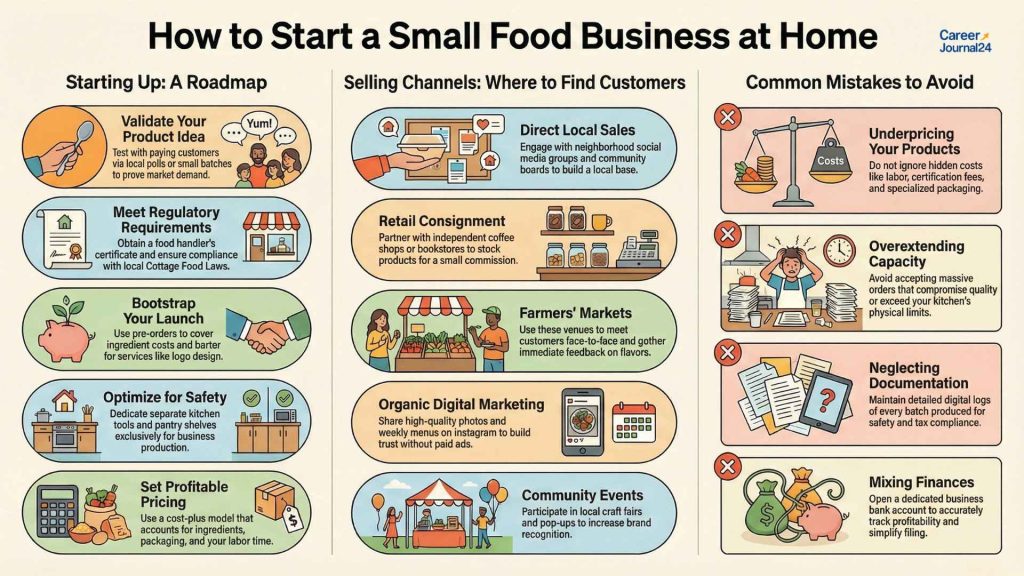
Selling Channels: Where to Find Customers
Home-based food businesses thrive on local connections, as word-of-mouth referrals have a 30% higher conversion rate than generic digital ads, per HubSpot data. Focus on these high-impact, low-cost sales channels:
Direct Local Sales
Engage with local neighborhood groups, community boards, and local parent networks to promote your products. Many customers prefer to buy directly from home-based operators to support local small businesses.
Consignment with Local Businesses
Partner with independent coffee shops, bookstores, or farmers markets to stock your products on consignment. This means the retailer takes a small cut of each sale (typically 15-25%) but you do not pay upfront for shelf space.
Farmers’ Markets
These are invaluable for home-based food businesses. They allow you to meet your customers face-to-face, offer samples, and gather immediate feedback on your flavors.
Organic Digital Marketing
Use Instagram to share high-quality, unfiltered photos of your products, post consistent weekly menus, and respond promptly to customer inquiries. Avoid paid ads initially; focus on building trust with local customers through genuine engagement.
Community Events
Participate in local craft fairs, holiday markets, or food pop-ups to reach new customers and build brand recognition. These events are often low-cost to attend and provide an opportunity to sample your products to potential repeat customers.
For more targeted local marketing strategies, review HubSpot’s guide to low-cost local marketing for small businesses.
Common Mistakes to Avoid
Even with a great plan, the road is paved with potholes. Here are the traps that kill home food businesses.
Underpricing Your Products
Many new operators underestimate their total costs, only accounting for ingredients and ignoring labor, packaging, and hidden fees like food handler certification or kitchen inspection costs. This leads to thin or negative profit margins, making it impossible to reinvest in the business or scale over time. To avoid this, create a detailed spreadsheet to track all expenses, including your hourly wage for production time.
Overextending Capacity Too Quickly
It is tempting to accept every large order that comes your way when your business starts to grow, but this can compromise product quality and lead to missed deadlines. For example, the Ohio confectioner once received an order for 100 boxes of burfi for a corporate event, but realized she could not produce that quantity in her small kitchen without rushing. Instead of turning down the order, she offered to produce 50 boxes and referred the remaining 50 to a local home baker she had met at a cottage food fair, maintaining customer trust and building a professional network.
Neglecting Food Safety Documentation
Most regulatory bodies require detailed records of batch production, ingredient sources, and sales. Failing to maintain these records can result in fines or temporary business closure. Use a simple digital log to track every batch you produce, including the date, ingredient quantities, and any customer feedback related to food safety.
Failing to Separate Personal and Business Finances
Mixing personal and business funds can make it difficult to accurately measure profitability, simplify tax filing, or prove compliance with local regulations. Open a dedicated business bank account to track all income and expenses related to your food business. This also helps you build a business credit history if you choose to scale in the future.
Conclusion
Starting a food business from home is a marathon, not a sprint. It requires patience, thick skin, and a calculator. It is about taking the love you put into your family dinners and monetizing it with discipline.
The path of how to start a small food business at home is paved with flour, late nights, and sticky counters, but it leads to something incredible: owning your time and your talent. You do not need a massive loan. You do not need a restaurant degree. Also, you just need to start. Bake the batch. Sell the jar. Reinvest the profit. Repeat. Your customers are waiting.