How to Manage Gen Z at the Workplace
The modern workforce is undergoing a seismic shift as Gen Z rapidly becomes the largest generational cohort entering professional environments. Born between 1997 and 2012, Generation Z now constitutes over 20% of the global workforce and brings distinct expectations, values, and work styles that differ markedly from preceding generations. For leaders, colleagues, and entrepreneurs, mastering how to engage this cohort isn’t merely advantageous; it’s essential for sustained growth, innovation, and retention. This article explores who Gen Z are, why they feel different at work, evidence‑based strategies for managing Generation Z in the workplace, the core drivers behind what motivates Gen Z at the workplace, and the tangible business benefits they deliver.
Who Is Gen Z at Work
Generation Z generally includes individuals born between the late 1990s and early 2010s. They are the first generation to grow up fully connected to the internet, smartphones, and social media. This constant digital exposure shaped how they learn, communicate, and solve problems. At work, they often demonstrate strong technical adaptability and comfort with remote collaboration tools.
However, they also entered adulthood during economic and global disruptions, making them cautious about job security and income stability. They value workplaces that support growth and well-being. Understanding this background helps leaders align workplace expectations with the realities young professionals bring into modern organizations.
How to work with Gen Z at the workplace effectively?
Success involves shifting toward transparency, flexibility, and purpose-driven leadership. Managers should prioritize regular, real-time feedback over annual reviews, offer hybrid work options, and focus on outcome-based performance. By fostering an inclusive culture and providing clear paths for rapid learning, organizations can successfully engage this digital-native generation and drive long-term innovation.
Why Gen Z Feels Different at Work
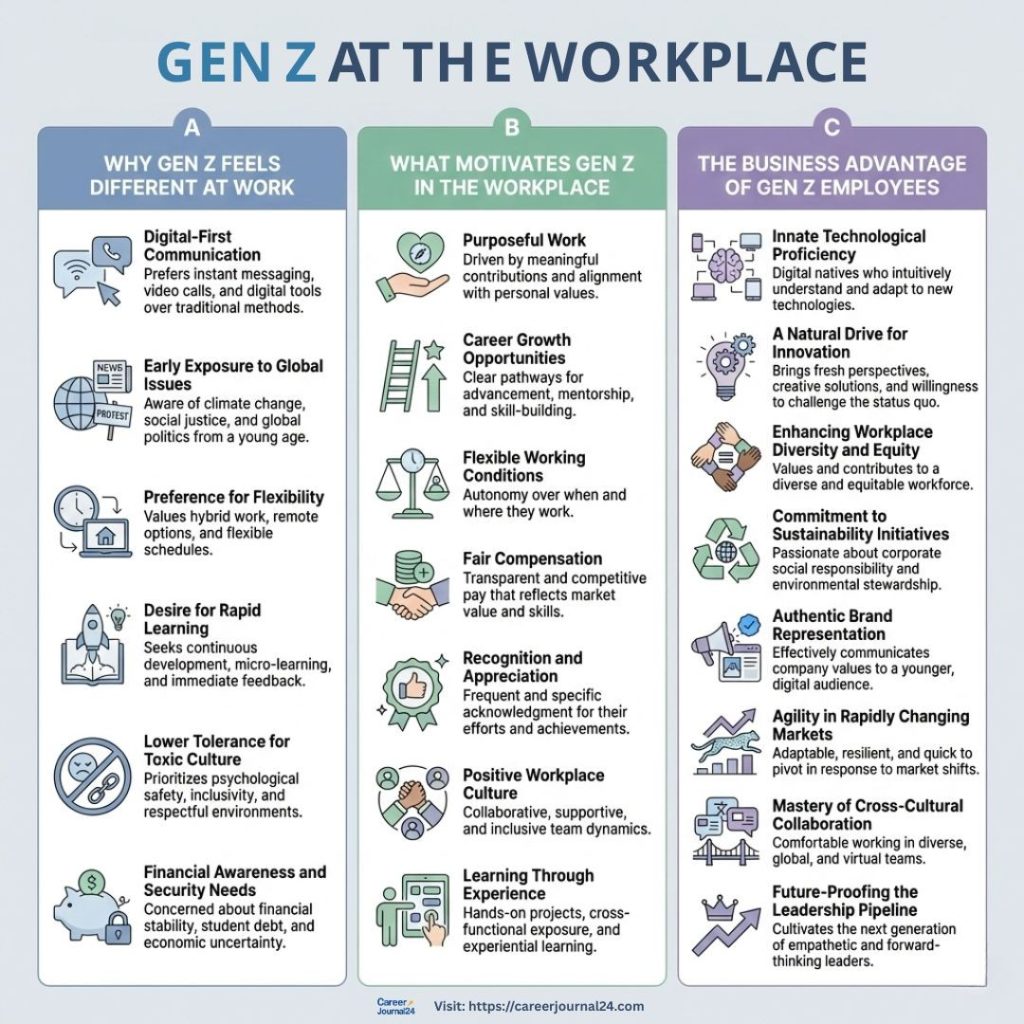
Many managers and senior professionals feel that Gen Z employees approach work differently compared to previous generations. Their expectations, communication styles, and career priorities often challenge traditional workplace norms. However, these differences are rooted in the social, technological, and economic environment in which they grew up. Understanding why Gen Z behaves differently at work helps organizations reduce misunderstandings and build stronger collaboration. This section explores the key factors shaping their workplace attitudes so leaders and teams can work with them more effectively instead of viewing these differences as workplace problems.
1. Digital-First Communication
Gen Z employees grew up communicating through messaging apps, online platforms, and social networks. As a result, they often prefer quick, direct communication rather than long email exchanges or formal meetings. Managers sometimes misinterpret this as informal behavior, but it reflects efficiency rather than disrespect. When workplaces adapt by using collaborative digital tools and encouraging concise communication, productivity often improves. Teaching professional communication expectations while respecting their comfort with digital channels creates a balanced approach that supports teamwork without forcing outdated communication styles on younger employees.
2. Early Exposure to Global Issues
Unlike previous generations, Gen Z grew up constantly exposed to global challenges such as economic crises, climate discussions, and social justice debates through online media. This awareness influences their workplace expectations. They prefer organizations that demonstrate social responsibility and ethical practices. Employees feel more engaged when they believe their company contributes positively to society. Employers who communicate company values and social impact clearly often earn stronger loyalty from young employees. Transparency and responsibility are no longer optional expectations but important elements influencing career choices and workplace satisfaction among younger professionals.
3. Preference for Flexibility
Many Gen Z employees question rigid work schedules because they witnessed remote work and flexible arrangements become normal during their formative years. They often believe productivity should be measured by outcomes rather than physical presence in an office. Companies that insist on strict schedules sometimes struggle to retain young talent. Flexible work arrangements allow employees to balance commuting challenges, personal responsibilities, and productivity rhythms. Organizations that offer hybrid or adaptable working structures frequently see higher employee satisfaction and engagement, proving that flexibility can support both performance and employee well-being.
4. Desire for Rapid Learning
Gen Z employees expect fast learning opportunities because digital platforms conditioned them to access information instantly. Waiting years for career growth feels outdated to them. They want exposure to projects, skill development, and real responsibilities early in their careers. Employers who provide training, mentorship, and diverse assignments often experience higher retention among young staff. Learning opportunities not only motivate Gen Z employees but also accelerate skill development within organizations. Companies that support continuous learning create a workforce that evolves quickly with industry demands.
5. Lower Tolerance for Toxic Culture
Young professionals today are more willing to leave workplaces that feel unhealthy or disrespectful. Online communities and career platforms make job transitions easier and provide transparency about company culture. Gen Z employees value psychological safety, inclusion, and respectful management practices. Organizations ignoring employee well-being often face high turnover. Creating open communication channels and addressing workplace concerns proactively builds trust. Healthy workplace environments benefit all generations, but they are especially important for attracting and retaining Gen Z talent, who prioritize positive work culture over long-term job loyalty.
6. Financial Awareness and Security Needs
Despite stereotypes, Gen Z employees often show strong concern for financial stability. Growing up during economic uncertainty influenced their career decisions. They value competitive salaries, financial growth opportunities, and clear career progression paths. Companies offering transparent compensation structures and development opportunities gain stronger commitment from young employees. Financial security combined with learning opportunities motivates Gen Z professionals more effectively than perks alone. Employers who recognize these priorities can better align compensation strategies with workforce expectations while maintaining organizational performance goals.
How to Manage Gen Z at the Workplace
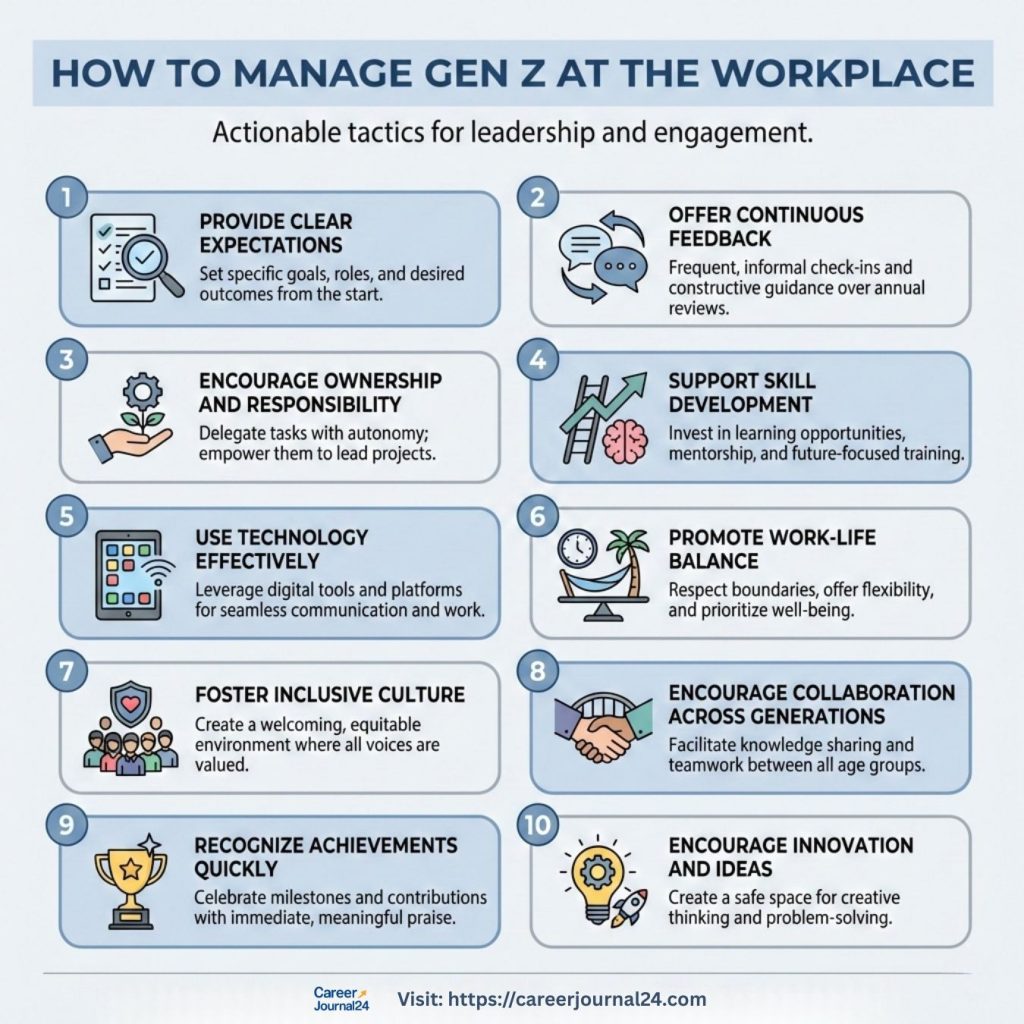
Managing Gen Z employees successfully requires adapting leadership styles to match modern workforce expectations. Traditional command-and-control management approaches often fail to engage younger professionals who value autonomy, learning, and open communication. Leaders who understand how to guide, support, and motivate Gen Z employees can unlock high productivity and loyalty within their teams. Here, we will focus on practical management approaches that help organizations build trust, improve performance, and create environments where young professionals feel empowered to grow while contributing meaningfully to organizational success.
1. Provide Clear Expectations
Gen Z employees perform best when expectations are transparent. Vague instructions often lead to confusion and frustration. Managers should clearly define goals, deadlines, and expected outcomes. When employees understand their responsibilities and how their work contributes to broader objectives, they feel more confident and productive. Clear communication also reduces mistakes and unnecessary revisions. Providing structured guidance at the beginning of tasks allows employees to develop independence while maintaining accountability, creating a productive balance between autonomy and direction in professional environments.
2. Offer Continuous Feedback
Annual performance reviews feel too infrequent for many young employees accustomed to regular feedback. Managers should provide consistent, constructive input that helps employees improve in real time. Quick check-ins and informal performance discussions encourage growth and reduce anxiety. Positive reinforcement also increases motivation. Employees who receive feedback regularly feel supported and develop stronger engagement with their roles. Continuous feedback creates a learning environment where improvement becomes part of daily work culture rather than an occasional evaluation process.
3. Encourage Ownership and Responsibility
Gen Z employees appreciate opportunities to take responsibility for projects rather than performing repetitive tasks only. Managers should allow young employees to manage small projects or client interactions under supervision. Ownership builds confidence and accountability while accelerating learning. When employees see direct results of their work, motivation increases. Trust encourages innovation and initiative. Managers who empower employees instead of controlling every detail often see higher engagement and faster professional development across their teams.
4. Support Skill Development
Providing learning opportunities significantly improves retention among younger employees. Companies should encourage participation in workshops, online courses, and internal training programs. Skill development benefits both employees and organizations by preparing teams for evolving industry demands. Managers who actively support employee growth demonstrate long-term investment in their workforce. Employees who feel their employer supports career advancement are more likely to remain loyal and motivated, reducing turnover and strengthening organizational knowledge over time.
5. Use Technology Effectively
Gen Z employees adapt quickly to digital tools. Managers should leverage modern collaboration platforms and automation systems to improve productivity. Technology can streamline communication and project management, aligning with the working style of younger employees. However, organizations should also provide guidance to ensure technology enhances productivity rather than causing distractions. Balanced technology usage allows teams to remain efficient while maintaining personal interaction where necessary, creating a hybrid environment that suits modern workplace expectations.
6. Promote Work-Life Balance
Burnout risks affect all generations, but Gen Z employees openly prioritize mental health and personal time. Managers should encourage realistic workloads and flexible scheduling where possible. Employees who maintain healthy work-life balance show greater long-term productivity and job satisfaction. Supporting employee well-being improves morale and reduces absenteeism. Organizations that respect personal time attract talent seeking sustainable career growth rather than short-term success at the cost of personal health.
7. Foster Inclusive Culture
Gen Z employees value diversity and inclusion in the workplace. Managers should create environments where all employees feel respected and heard. Inclusive leadership encourages innovation by welcoming diverse perspectives. Transparent policies and respectful communication foster collaboration. Employees working in inclusive environments demonstrate stronger engagement and teamwork. Managers who promote equality and fairness help build workplaces where employees feel comfortable expressing ideas and contributing fully to organizational success.
8. Encourage Collaboration Across Generations
Intergenerational collaboration benefits both younger and older employees. Managers should facilitate teamwork where experienced employees share industry knowledge while younger staff contribute technological insights. Such collaboration builds mutual respect and improves problem-solving. Learning flows in both directions, strengthening organizational capabilities. Cross-generational mentorship programs also help bridge communication gaps and improve teamwork. Companies that encourage knowledge exchange between generations build stronger and more adaptable teams.
9. Recognize Achievements Quickly
Recognition motivates employees across all generations, but Gen Z employees often respond strongly to immediate acknowledgment. Managers should celebrate achievements through meetings, internal communications, or team discussions. Recognition builds confidence and encourages continued effort. Employees who feel appreciated are more engaged and loyal. Recognition does not always require financial rewards; simple acknowledgment of contributions can significantly improve morale and teamwork within organizations.
10. Encourage Innovation and Ideas
Young employees often bring fresh perspectives and creative solutions. Managers should encourage idea-sharing and experimentation within reasonable limits. Allowing employees to suggest improvements or try new approaches promotes innovation. Even unsuccessful experiments provide learning opportunities. When employees feel their ideas matter, engagement increases. Organizations benefit from continuous improvement driven by diverse viewpoints and creativity encouraged through supportive leadership practices.
What Motivates Gen Z in the Workplace
This generation is driven by a combination of competitive pay, work-life balance, and alignment with corporate values. Beyond financial security, they are motivated by opportunities for continuous upskilling, social impact initiatives, and a supportive culture that prioritizes mental health. Authentic recognition and a sense of ownership in their projects are the primary keys to their professional satisfaction and retention. This section examines the main factors influencing Gen Z motivation at work, helping managers and employers design workplaces that inspire performance while supporting career development and personal well-being.
1. Purposeful Work
Gen Z employees seek roles that provide meaning beyond routine tasks. They want to understand how their work contributes to organizational goals or societal impact. Managers who connect tasks to larger objectives increase engagement. Employees motivated by purpose often demonstrate stronger commitment and productivity. Explaining the broader value of projects helps employees feel connected to organizational success rather than performing isolated duties.
2. Career Growth Opportunities
Young professionals prioritize rapid learning and career progression. Organizations offering clear advancement pathways attract ambitious talent. Training programs, mentorship, and skill-building assignments motivate employees to stay longer. Career stagnation leads to disengagement and turnover. Managers who actively discuss career development create trust and long-term commitment among employees seeking professional growth.
3. Flexible Working Conditions
Flexibility remains a major motivator. Remote or hybrid work arrangements improve satisfaction and productivity for many employees. Flexible schedules help employees manage personal responsibilities and reduce commuting stress. Organizations offering adaptable work structures attract talent seeking modern work environments that support both professional and personal needs.
4. Fair Compensation
Competitive pay remains a fundamental motivator. Employees expect compensation aligned with their responsibilities and market standards. Transparent salary structures improve trust. Fair compensation combined with development opportunities creates stronger loyalty. Employers recognizing financial motivations alongside professional growth build stable, motivated teams.
5. Recognition and Appreciation
Employees feel motivated when their contributions are acknowledged. Managers who regularly appreciate employee efforts improve morale and engagement. Recognition creates positive reinforcement and encourages consistent performance. Appreciation strengthens relationships between employees and leadership.
6. Positive Workplace Culture
Supportive environments motivate employees to perform better. Respectful communication, teamwork, and psychological safety improve job satisfaction. Employees thrive in workplaces where collaboration replaces competition. Positive culture increases retention and productivity.
7. Learning Through Experience
Gen Z employees prefer practical experience over theoretical instruction. Exposure to real projects and responsibilities accelerates learning. Managers who provide hands-on opportunities motivate employees seeking rapid development and professional confidence.
The Business Advantage of Gen Z Employees
Organizations that successfully integrate Gen Z employees into their workforce often gain significant competitive advantages. This generation brings strong digital skills, adaptability, and fresh perspectives that support innovation and modern business practices. Rather than viewing generational change as a challenge, forward-thinking companies recognize it as an opportunity to improve processes and connect with evolving markets. This part highlights how businesses benefit from Gen Z talent and why investing in this generation can strengthen long-term organizational growth and future leadership development.
1. Innate Technological Proficiency
The most obvious advantage of hiring Gen Z is their ability to navigate and implement new technologies. They often act as unofficial IT support and innovation consultants for their teams. In 2026, where AI and automation are integrated into every workflow, having a workforce that is not intimidated by these tools is a massive competitive edge. They can find ways to do tasks in half the time by utilizing the latest digital resources. This efficiency saves the company money and allows the team to focus on high-value creative and strategic work that drives real growth.
2. A Natural Drive for Innovation
Gen Z’s tendency to question the status quo is a goldmine for innovation. They are not satisfied with doing things a certain way just because “that’s how we’ve always done it.” They are constantly looking for better, faster, and more ethical ways to achieve goals. This fresh perspective can prevent a company from becoming stagnant. By encouraging their input, businesses can discover new product ideas, more efficient processes, and creative marketing strategies. Their willingness to experiment and take risks can lead to the kind of breakthroughs that keep a company ahead of its competitors.
3. Enhancing Workplace Diversity and Equity
By bringing in Gen Z talent, companies naturally become more diverse and inclusive. This generation’s insistence on equity pushes organizations to improve their hiring practices and internal policies. This leads to a wider range of perspectives at the decision-making table, which is proven to lead to better business outcomes. Diverse teams are more creative, better at problem-solving, and more representative of the global customer base. The push for equity that Gen Z brings helps to create a fairer and more successful corporate culture that attracts talent from all walks of life.
4. Commitment to Sustainability Initiatives
As businesses face increasing pressure to be environmentally responsible, Gen Z employees can lead the charge. They are often the most passionate advocates for sustainability within an organization. They can help identify ways to reduce waste, lower energy consumption, and source more ethical materials. Their commitment to the planet aligns with the growing expectations of consumers and regulators. By leveraging their passion, companies can build more sustainable business models that are not only better for the environment but also more resilient to the long-term impacts of the global climate crisis.
5. Authentic Brand Representation
In a world that values authenticity, Gen Z employees are the best ambassadors for your brand. They understand how to communicate with their peers in a way that feels genuine and unscripted. They can help the company navigate social media trends and avoid marketing blunders that could damage the brand’s reputation. Their presence ensures that the company’s voice remains relevant and relatable to the younger demographic. This authenticity builds trust with customers, who are increasingly looking for brands that share their values and speak their language in an honest and transparent way.
6. Agility in Rapidly Changing Markets
The fast-paced nature of Gen Z’s upbringing has made them incredibly adaptable. They are comfortable with change and can pivot quickly when market conditions shift. This agility is vital in the modern business world, where disruptions are frequent and unpredictable. Whether it is a shift in consumer behavior or the emergence of a new competitor, Gen Z employees can help the organization respond with speed and creativity. Their ability to stay calm and productive during periods of transition makes them invaluable assets for any company looking to survive and thrive in a volatile economy.
7. Mastery of Cross Cultural Collaboration
Because they grew up in a globalized world connected by the internet, Gen Z is naturally adept at working with people from different cultures and time zones. They are comfortable using collaborative tools to bridge geographic gaps and are generally more aware of global issues. This makes them excellent candidates for roles in international companies or teams that handle global clients. Their cross-cultural competence reduces misunderstandings and fosters a more inclusive and effective global working environment. They bring a “global-first” mindset that is essential for any business with international aspirations in 2026 and beyond.
8. Future Proofing the Leadership Pipeline
Hiring and developing Gen Z talent today is the best way to ensure the long-term success of the company. These are the leaders of tomorrow. By investing in their growth now, you are building a pipeline of skilled, tech-savvy, and value-driven professionals who will eventually take the reins of the organization. They will bring their unique perspectives to senior management, ensuring that the company continues to evolve and adapt to the needs of future generations. This long-term thinking is the key to building a legacy that lasts for decades rather than just years.
How should companies manage Gen Z employees?
Companies can manage Gen Z employees effectively by providing clear expectations, regular feedback, flexible work arrangements, and opportunities for rapid learning. Young professionals respond positively to supportive leadership, transparent communication, and workplaces that encourage innovation and inclusion. Managers who balance guidance with autonomy often achieve higher engagement and retention among Gen Z teams.
Final Thoughts
As we look toward the remainder of 2026, it is clear that Gen Z at the workplace is more than just a passing trend; they are the architects of a new era of professional life. The challenges of managing a multi-generational workforce are real, but the rewards of successfully integrating this cohort are immense. By focusing on transparency, purpose, and flexibility, companies can unlock the incredible potential of these young professionals. They are not just the workforce of the future; they are the catalyst for a better, more human, and more innovative way of working today. Embracing this change is not optional for those who wish to lead in the modern age.