
How Excellent Leaders Develop Loyal Followership

Leadership is often discussed in terms of vision, authority, and decision-making power. Yet, leadership only becomes effective when people willingly choose to follow. This is why understanding how excellent leaders develop followership is essential for anyone in a leadership role. Followership is not about hierarchy or obedience. It is about trust, credibility, and shared purpose.
In modern workplaces, people no longer follow leaders simply because of job titles. They follow leaders they respect, believe in, and feel supported by. Excellent leaders recognize this shift and focus deliberately on building followership through consistent behavior, clear communication, and genuine human connection. This article explores what followership truly means, how leaders can develop loyal followership in practical ways, and why strong followership creates a lasting impact for organizations and teams.
The True Meaning of Followership
Before we dive into the mechanics, we need to redefine what we mean by a follower. In a modern workplace, a follower is a proactive partner. Think of a high-end restaurant kitchen. The head chef has the vision, but the line cooks are the ones who turn that vision into a reality. If the line cooks don’t trust the chef, the service falls apart. Understanding the specific characteristics of a good follower is the first step in recognizing how these roles mirror the skills needed for top-tier leadership.
Building followership is the process of creating that trust. It is about moving away from “I tell you what to do” toward “We are achieving this together.” When people follow you because they want to, rather than because they have to, you have unlocked the highest level of leadership.
How Excellent Leaders Develop Loyal Followership
The path to how to develop good followership in leadership is paved with intentionality. It requires a leader to step outside their own ego and view the organization through the eyes of their subordinates. Here are ten practical strategies that excellent leaders use to cultivate a loyal and engaged following.
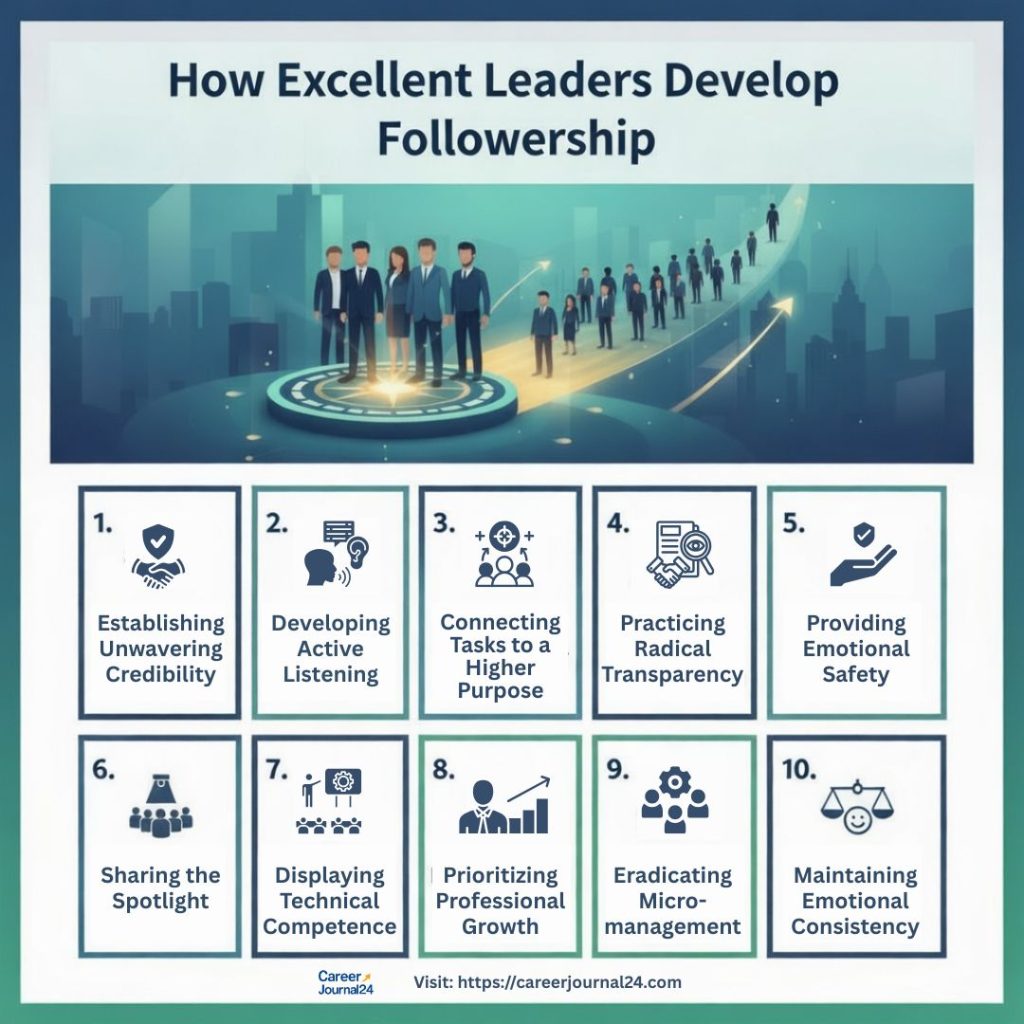
1. Establishing Unwavering Credibility
Trust is the currency of leadership. To understand how to develop good followership, you must first be willing to be vulnerable and authentic. Employees today are highly intuitive; they can spot a corporate mask quickly. Excellent leaders build trust by being consistent. If you say you value work-life balance but send emails at 3:00 AM, you are creating a disconnect. Consistency between your words and your actions creates a psychological safety net.
2. Developing Active Listening
We often think of communication as a leader speaking to a group. However, excellent leaders spend more time listening than talking. If you want to master the art of followership, you need to master the active feedback loop. In everyday situations, this looks like asking open-ended questions during a one-on-one meeting. Instead of asking if a project is on track, ask what the biggest roadblock is and how you can help move it.
3. Connecting Tasks to a Higher Purpose
People don’t follow goals; they follow purposes. A goal is to increase revenue by 10%. A purpose is becoming the most customer-centric service in the industry. To implement this, try to connect every mundane task to a larger outcome. When an entry-level employee sees how their work allows the sales team to respond faster to clients, their commitment levels skyrocket.
4. Practicing Radical Transparency
One of the most effective ways to foster loyalty is through transparency. You don’t need to share every financial spreadsheet, but sharing the reasoning behind a difficult decision goes a long way. When people understand the “why,” they feel respected and included in the company’s journey. This is a foundational pillar for anyone looking to improve team cohesion.
5. Providing Emotional Safety
A leader who ignores the human element will struggle with long-term retention. Empathy in leadership means recognizing that your team members have lives outside the office. It means offering flexibility when a family emergency arises or celebrating a personal milestone. When a leader shows they care about the person, the person will care about the work.
6. Sharing the Spotlight
Excellent leaders develop followership by being “multipliers.” This means using your position to amplify the smarts and capabilities of the people around you. When a project succeeds, give the credit to the team publicly. When a project fails, take the responsibility privately. This shielding behavior makes people feel protected and willing to take the risks necessary for innovation.
7. Demonstrating Technical Competence
While “soft skills” are vital, people generally find it difficult to follow someone they don’t respect professionally. You don’t need to be the best coder or accountant in the room, but you must demonstrate a deep understanding of the challenges your team faces. Leading by example in the trenches proves that you aren’t asking your team to do anything you wouldn’t do yourself.
8. Prioritizing Professional Growth
Show your team that you care about their career path, even if it eventually leads them away from your current department. By investing in their training and development, you prove that you value them as an asset, not just a cog in a machine. Supporting long-term goals builds incredible short-term loyalty.
9. Eradicating Micro-management
Nothing kills followership faster than micro-management. When you hover over an employee’s shoulder, you are signaling a lack of trust. Excellent leaders set the “what” and the “why,” but they let the team decide the “how.” By giving people autonomy, you are giving them ownership, which naturally leads to higher engagement.
10. Maintaining Emotional Consistency
Imagine a captain who changes direction every time a small wave hits. The crew would quickly become exhausted. To develop good followership, a leader must be a steady hand. Reliability builds a reputation, and a good reputation is the strongest magnet for followers. People want to follow someone who is reliable because it reduces their own anxiety about the future.
The Long-Term Impact of Strong Followership
When you focus on the mechanics of followership, you are doing more than just hitting your KPIs. You are building a culture that can survive turnover, market shifts, and economic downturns. A team that believes in its leader and in each other is resilient.
High followership levels lead to increased retention, lower recruitment costs, and a more innovative environment where employees feel safe to share “outside the box” ideas. For further reading on effective workplace communication and team dynamics, Harvard Business Review and Psychology Today offer great insights into how these bonds are formed over time.
Conclusion
Excellent leaders know that their legacy isn’t a list of individual accomplishments; it’s the people they empowered. By shifting your focus from “leading” to “building followership,” you create a self-sustaining ecosystem of success. It is a marathon, not a sprint, requiring patience, humility, and a genuine interest in the well-being of others. However, the reward, a high-performing, loyal, and motivated team, is the ultimate hallmark of a great leader.






One Comment