
How to Deal with a Difficult Coworker: 15 Strategies That Actually Work
The modern workplace is a melting pot of diverse personalities, work styles, and communication habits. While this diversity often leads to innovation, it can also result in friction. Understanding how to deal with a difficult coworker is a critical competency for any professional aiming to maintain high levels of productivity and workplace harmony. When interpersonal conflicts arise, they do not merely affect the individuals involved; they can disrupt the flow of an entire department and impact the company’s bottom line. Developing a systematic approach to navigating these challenges ensures that the focus remains on organizational objectives rather than personal grievances.
Interpersonal friction is an inevitable part of career progression. Regardless of whether the issue is rooted in work ethic differences, personality clashes, or toxic actions, maintaining composure and professionalism is a defining quality of effective leaders. Most workplace difficulties can be resolved or at least managed through strategic communication and emotional intelligence. By approaching the situation with a growth mindset, an employee can transform a potentially negative experience into an opportunity to refine negotiation and conflict-resolution skills.
Understand the Why Behind the Behavior
Before implementing any corrective strategies, it is beneficial to analyze the underlying causes of a colleague’s challenging behavior. Very few individuals enter the office with the explicit intention of being disruptive. More often, difficult behaviors are defense mechanisms or reflections of external pressures. For instance, a colleague who micromanages may be struggling with deep-seated insecurities regarding their own job security or performance. Recognizing that the behavior is often a reflection of the other person’s internal state rather than a personal attack allows for a more objective response.
Psychological factors often play a significant role in workplace dynamics. Research from organizations like theAmerican Psychological Association suggests that chronic stress, lack of clear role definitions, and poor organizational support can exacerbate negative personality traits. When a person feels overwhelmed or undervalued, they may resort to aggression, passivity, or obstructionism. Identifying these triggers helps in tailoring a response that addresses the root cause rather than just the symptoms. It shifts the perspective from seeing a person as a villain to seeing them as an individual who is currently failing to cope with their environment.
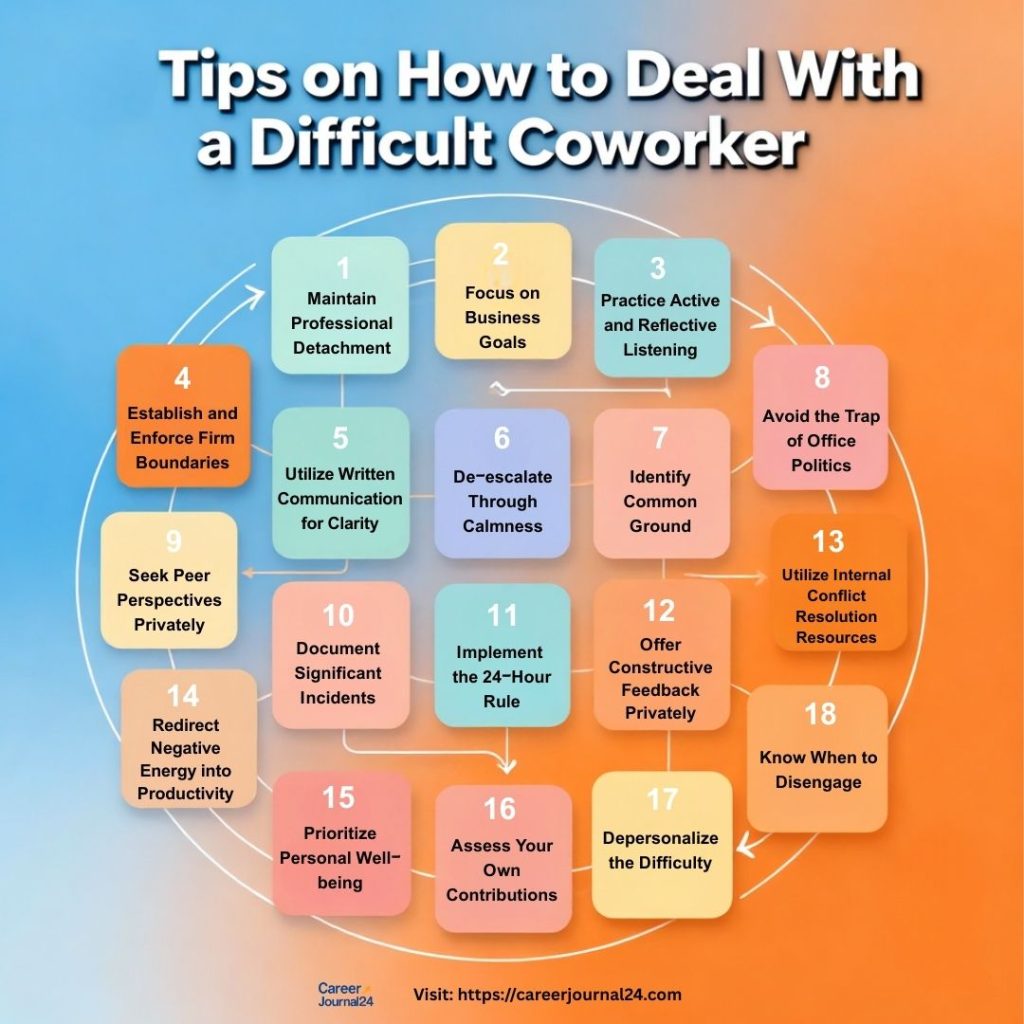
15 Tips on How to Deal With a Difficult Coworker
Implementing a systematic approach to workplace conflict is essential for maintaining individual performance and team cohesion. These strategies provide a professional framework for navigating interpersonal challenges, focusing on emotional intelligence, tactical communication, and the principles of effective followership to preserve career integrity. These methods are designed to transform a potentially disruptive environment into a manageable and productive space.
1. Maintain Professional Detachment
One of the most effective ways to handle a challenging colleague is to maintain a level of emotional distance. When an individual allows the actions of a coworker to dictate their emotional state, they lose control of their own workday. By viewing the difficult behavior as an external obstacle rather than a personal affront, it becomes easier to remain calm. Professional detachment involves acknowledging the behavior without absorbing the negativity associated with it. This approach preserves mental energy for actual work tasks.
2. Focus on Objective Business Goals
Keeping every interaction centered on work objectives prevents conversations from devolving into personal conflict. When a difficult coworker attempts to steer a discussion toward gossip or personal complaints, redirecting the focus back to the project at hand is essential. Using language that emphasizes deadlines, deliverables, and team goals creates a professional boundary. This technique makes it difficult for the other party to sustain a personal argument, as the conversation remains anchored in the shared mission of the organization.
3. Practice Active and Reflective Listening
Many workplace conflicts arise from simple misunderstandings. By practicing active listening, an employee can ensure they fully comprehend a colleague’s perspective before responding. This involves paraphrasing what the other person has said to confirm accuracy. For example, stating that the understanding of the situation is that the current timeline is concerning helps clarify the issue. Reflective listening often disarms a difficult person because it demonstrates that their voice is being heard, which can reduce the need for them to act out.
4. Establish and Enforce Firm Boundaries
Boundaries are the foundation of a healthy work relationship. If a coworker has a habit of interrupting or shifting their workload onto others, it is necessary to set clear limits. Communicating these boundaries should be done in a neutral and firm manner. Explaining that current priorities do not allow for taking on additional tasks provides a valid reason for declining a request. Consistency is key; when boundaries are enforced regularly, the difficult coworker eventually learns to respect those limits.
5. Utilize Written Communication for Clarity
In situations where a coworker is prone to changing their story or misremembering agreements, written communication becomes an invaluable tool. Following up on meetings with a summary email ensures that everyone is on the same page regarding responsibilities and timelines. This creates a paper trail that can be referenced later if disputes arise. Written records reduce the likelihood of “he-said, she-said” scenarios and provide a factual basis for accountability within the team.
6. De-escalate Through Calmness
Reacting to aggression with more aggression only serves to inflame a situation. When a colleague loses their temper or uses a condescending tone, responding with a low, steady voice can help de-escalate the tension. Maintaining a neutral facial expression and controlled body language signals that the behavior is not having the intended effect. Often, the person displaying the difficult behavior will mirror the calmness of the other party, leading to a more rational discussion.
7. Identify Common Ground
Even the most difficult relationships can find some points of agreement. Identifying a shared goal, such as the successful launch of a product or the completion of a quarterly report, can bridge the gap between two clashing personalities. Emphasizing the shared desire for the team to succeed can create a sense of unity. When both parties realize they are working toward the same outcome, the interpersonal friction often begins to dissipate in favor of collaborative effort.
8. Avoid the Trap of Office Politics
Engaging in gossip or taking sides in office drama only complicates the process of dealing with a difficult coworker. It is important to remain neutral and avoid speaking poorly of the individual to other colleagues. Complaining about a coworker to peers can damage one’s own reputation and may even reach the ears of the person in question, further straining the relationship. Maintaining a reputation as someone who stays above the fray is a significant professional asset.
9. Seek Peer Perspectives Privately
Sometimes, it is helpful to consult with a trusted mentor or a neutral peer to gain a fresh perspective on the situation. This should not be a venting session, but rather a strategic discussion. Asking how others have successfully managed similar personalities can provide new insights. A third party may notice patterns or suggest solutions that were not previously considered. This external viewpoint helps in determining if the difficulty is unique to one relationship or a broader behavioral issue.
10. Document Significant Incidents
If a coworker’s behavior crosses the line into harassment, sabotage, or extreme unprofessionalism, documentation is mandatory. Keeping a log of dates, times, specific actions, and any witnesses provides a factual foundation for future action. This log should be kept in a private location and written in objective language. Documentation is not about being vindictive; it is about protecting one’s career and providing human resources with the necessary information if a formal intervention becomes necessary.
11. Implement the 24-Hour Rule
When a particularly frustrating interaction occurs, it is wise to wait 24 hours before responding to an email or addressing the issue. Immediate responses are often fueled by adrenaline and emotion, which can lead to statements that are later regretted. Allowing a day to pass provides the time needed for the prefrontal cortex to process the event logically. A response sent after 24 hours is almost always more professional and effective than one sent in the heat of the moment.
12. Offer Constructive Feedback Privately
If the relationship allows for it, providing direct but professional feedback can sometimes resolve the issue. This should always be done in a private setting to avoid embarrassing the individual. Using “impact statements” that describe how a specific behavior affects work output is more effective than criticizing a person’s character. For instance, explaining that late data submissions make it difficult to complete the final report on time focuses on the work process rather than the person.
13. Utilize Internal Conflict Resolution Resources
Many organizations have specific protocols and resources for managing workplace conflict. This may include mediation services provided by human resources or access to an Employee Assistance Program (EAP). These resources are designed to help employees navigate difficult interpersonal dynamics without necessarily escalating to a formal grievance. Utilizing these professional services shows a commitment to resolving the issue through established organizational channels.
14. Redirect Negative Energy into Productivity
One of the best defenses against a difficult coworker is high performance. When an employee focuses their energy on delivering exceptional results, the negative impact of a colleague’s behavior is minimized. Success often acts as a shield; it is difficult for a problematic coworker to undermine someone who is consistently providing value to the company. Redirecting the frustration into professional achievements ensures that career growth remains the primary focus.
15. Prioritize Personal Well-being
Dealing with a difficult person is taxing, and it is essential to engage in self-care to prevent burnout. Maintaining a healthy work-life balance and ensuring that work stress does not bleed into personal time is vital. Taking breaks, practicing mindfulness, or engaging in physical activity can help mitigate the physiological effects of workplace stress. A person who is well-rested and mentally healthy is much better equipped to handle the challenges of a difficult work environment.
The Importance of Professionalism in Conflict
Maintaining professionalism during a conflict is not just about the current situation; it is about long-term career reputation. Leaders and hiring managers often look at how an individual handles adversity when considering them for promotions. Those who can navigate complex social dynamics with grace and maturity are seen as more capable of leading teams. According to Harvard Business Review, the ability to work effectively with people we do not like is a key differentiator in career success.
Professionalism also involves knowing when a situation is beyond one’s control. If every strategy has been exhausted and the coworker’s behavior continues to be detrimental to one’s health or career, it may be time to consider a departmental transfer or a new opportunity. Recognizing that one’s environment plays a massive role in overall job satisfaction is a sign of professional maturity. The goal is always to find an environment where one can contribute fully without being hindered by unnecessary interpersonal strife.
The Role of Management in Resolving Friction
In a professional setting, individual efforts to manage conflict are sometimes insufficient, requiring the intervention of leadership to restore order and productivity. Management serves as the final authority in maintaining a culture of respect and ensuring that interpersonal issues do not impede organizational success. The following five points outline how leadership can effectively intervene and resolve friction within a team.
1. Facilitating Neutral Mediation
Leadership must serve as an impartial arbiter when interpersonal conflicts escalate beyond individual resolution. By providing a neutral space for structured dialogue, managers can help both parties voice concerns without the immediate threat of escalation or retaliation. This process focuses on finding a middle ground that restores a functional working relationship. Effective mediation ensures that the resolution is based on objective facts rather than personal biases, which helps in rebuilding trust across the department.
2. Establishing Clear Behavioral Standards
It is the responsibility of management to define and uphold the standards for acceptable professional conduct. When a coworker is consistently difficult, a manager can refer to established company values or behavioral codes to address the issue with objectivity. By setting clear expectations, leadership eliminates ambiguity regarding what is tolerated in the office. This framework provides a benchmark for holding individuals accountable and ensures that professional decorum is viewed as a non-negotiable part of the job description.
3. Strategically Adjusting Workflows
Managers have the authority to restructure teams or reassign specific tasks to minimize friction between conflicting employees. This might involve changing seating arrangements, altering reporting lines, or ensuring that the individuals are assigned to separate projects. Reducing the frequency of high-stress interactions can provide the necessary space for a professional reset. Strategic workflow adjustments allow the organization to continue functioning efficiently while the underlying interpersonal issues are addressed or neutralized.
4. Proactively Monitoring the Workplace Climate
Effective leadership involves identifying signs of tension before they manifest into major organizational disruptions. Regular check-ins and one-on-one meetings allow managers to gauge the morale of the department and address minor grievances in their early stages. This proactive stance prevents small misunderstandings from evolving into deep-seated resentment that could impact the entire team. By staying attuned to the workplace atmosphere, management can intervene subtly before formal disciplinary action becomes the only remaining option.
5. Providing Coaching and Professional Development
Often, difficult behavior is the result of a deficit in communication or conflict-resolution skills rather than intentional malice. Management can address these gaps by providing targeted professional development, such as emotional intelligence workshops or soft skills coaching. Investing in the growth of employees helps build a more resilient and harmonious work culture. When a manager provides the tools for an employee to improve their interpersonal interactions, it benefits the individual’s career and the overall health of the company.
Conclusion
Mastering the art of how to deal with a difficult coworker is a lifelong process that pays dividends in every stage of a career. It requires a combination of emotional intelligence, strategic communication, and firm boundaries. While it is impossible to control the actions of others, it is entirely possible to control the response to those actions. By staying focused on professional goals and maintaining a high standard of conduct, one can thrive even in the presence of challenging personalities.
Ultimately, the challenges posed by difficult colleagues serve as a catalyst for personal and professional growth. They teach resilience, patience, and the ability to find solutions in less-than-ideal circumstances. Those who can turn these obstacles into stepping stones will find themselves better prepared for the complexities of high-level management and entrepreneurship. In the end, the most successful professionals are not those who never face conflict, but those who handle it with such skill that it never stands in the way of their success.