How to Get a Remote Job in Today’s Competitive Market
The dream of waking up, grabbing a cup of coffee, and walking just a few steps to your home office is more attainable now than ever before. If you are wondering how to get a remote job, you are likely looking for more than just a paycheck; you are looking for freedom, better work-life balance, and the ability to design your day on your own terms. In 2026, the digital landscape has matured, and companies have moved beyond temporary setups to distributed models. Whether you are a seasoned professional or a total beginner, the path to a remote career requires strategy. It is a process of alignment. It also depends heavily on building a strong digital presence.
Understanding Remote Jobs First
Before diving into applications, it is vital to understand that “remote” is not a job title but a location. You can be a remote accountant, a remote teacher, or a remote software engineer. Remote work typically falls into two categories: synchronous and asynchronous. Synchronous roles require you to be online during specific hours, often mimicking a 9 to 5 schedule. Asynchronous roles focus on output rather than hours. They allow you to work when you are most productive. What matters is meeting deadlines, not fixed working hours. Understanding which style suits your personality will prevent burnout and help you target the right companies.
Is It Hard to Get Hired for a Remote Job?
One of the most frequent concerns is: is it hard to get hired for a remote job? The honest answer is that it is more competitive than a traditional office role, but not necessarily harder if you have the right strategy. When a company hires locally, they compete with businesses in a small radius. When they hire remotely, they are looking at a global talent pool. This means you are competing with experts from different cities and even different countries.
However, the difficulty often stems from using old-school tactics for a new-school environment. Recruiters today are looking for digital effectiveness. They want to see that you understand what is remote job etiquette and can communicate clearly without someone standing over your shoulder. They want to see that you can communicate clearly without someone standing over your shoulder. Additionally, they look for proficiency with collaboration tools. Most importantly, they want confidence that you have the discipline to meet deadlines autonomously. If you can prove these three things, the barrier to entry drops significantly.
How to Get a Remote Job
Landing a role requires a systematic approach that proves you are a “remote-ready” professional. Follow these seven steps to streamline your journey.
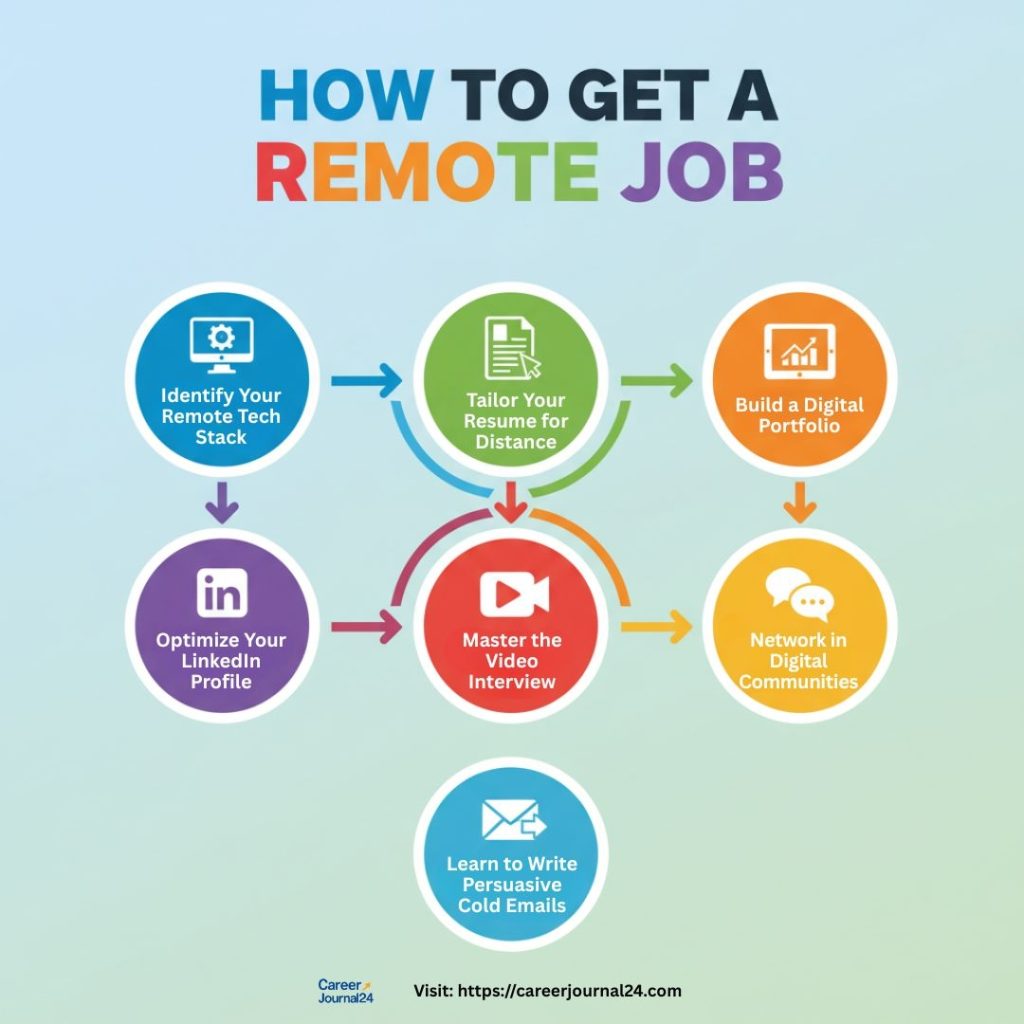
1. Identify Your Remote Tech Stack
You need to be deeply familiar with the digital tools that keep remote teams running. It is no longer enough to just know “Microsoft Office.” Remote-first companies rely on specific ecosystems to bridge the physical gap between employees. This includes communication platforms like Slack or Microsoft Teams, project management tools like Asana, Trello, or Monday, and document sharing via Google Workspace or Notion.
When you list these on your resume, don’t just put them in a skills cloud at the bottom. Mention them in your experience descriptions. For example, explain how you used Jira to track software bugs or how you organized a company wiki in Notion. This shows hiring managers that you won’t need basic technical training and that you can hit the ground running on day one without technical friction.
2. Tailor Your Resume for Distance
A remote resume should emphasize results and “self-management” over just daily duties. In a physical office, a manager can see that you are working hard. In a remote setting, they only see what you produce. Therefore, your resume needs to be an achievement-based document. Instead of saying you managed a team, explain how you managed a distributed team across four different time zones while maintaining high morale and meeting quarterly targets.
Highlight your ability to work independently and your history of meeting goals without direct physical supervision. Use keywords like “asynchronous communication,” “self-starter,” and “distributed collaboration.” These terms signal to the recruiter that you understand the unique challenges of working away from a central hub and that you have already mastered the art of staying productive in a home environment.
3. Build a Digital Portfolio
In the remote world, “show, don’t tell” is the gold standard for building trust quickly. Since you won’t be meeting the hiring manager for a coffee or an in-person tour, your online presence acts as your physical proxy. Proof of your work matters. This is true whether you are a developer with a GitHub repository, a writer with a collection of published articles, or a project manager with a set of case studies. Having a live link that demonstrates your capability is essential.
A digital portfolio provides the trust that a face-to-face meeting usually establishes. It allows a recruiter to see the quality of your work at 2:00 AM before they even decide to email you. If you don’t have a portfolio yet, you should start one now. Begin by documenting your best projects. You can even create “spec” work to demonstrate your thought process. A simple, clean website or even a well-organized Google Drive folder can serve as a powerful testament to your professional reliability.
4. Optimize Your LinkedIn Profile
Your LinkedIn profile is often the first place a remote recruiter will look after seeing your resume. To make it work for you, set your “Open to Work” preferences specifically to remote roles rather than a specific city. This tells the LinkedIn algorithm to suggest you to recruiters who are specifically looking for off-site talent.
Use keywords related to your industry and the word “Remote” directly in your headline, for example, “Senior Graphic Designer | Remote Specialist.” Your “About” section should also tell a story of your remote competency, mentioning how you stay organized and how you prefer to communicate. Recruiters use these specific filters daily to find talent. An optimized profile ensures that you show up in their search results. Without one, you might get lost in a sea of local-only candidates.
5. Master the Video Interview
The video interview is your only chance to show your personality and professional setup. Think of your camera frame as your new office. Ensure your lighting is positioned in front of you so your face is clear, your background is professional and uncluttered, and your audio is crisp with a dedicated microphone if possible.
Practice “camera eye contact” by looking at the lens rather than the screen. This small habit makes a massive difference in your presentation. It ensures you appear confident and engaged to a hiring manager. It mimics the feeling of real eye contact and builds a psychological connection that is often missing in digital calls. Always have a backup plan for your internet connection. A mobile hotspot is a great option to keep on hand. This shows that you are prepared for technical hiccups, which are inevitable in a remote career.
6. Network in Digital Communities
The “hidden job market” is arguably larger in the remote world than in the traditional one. Many remote roles are filled through word-of-mouth in digital enclaves before they are ever posted on a public job board. Join Slack channels, Discord servers, or Facebook groups dedicated to your industry.
Be an active participant by answering questions and sharing helpful articles. Engaging in discussions also helps you stand out. These actions put you on the radar of hiring managers who frequent these groups to find “natural” talent. When a job does open up, you won’t be a random name in a pile of 500 resumes; you will be the helpful person from the community. This type of organic networking often bypasses the initial screening phases and gets you directly to an interview.
7. Learn to Write Persuasive Cold Emails
Sometimes the perfect job for your lifestyle isn’t listed on any board. Reaching out to a department head at a remote-first company with a brief, value-driven message can open doors that didn’t exist yesterday. This isn’t about asking for a job; it’s about offering a solution.
Research a company you admire. Next, identify a potential gap in their current output. Finally, send a concise email explaining how your skills can help them bridge that gap. For instance, if you notice a company’s blog hasn’t been updated in months, reach out to their marketing lead with three fresh topic ideas and a link to your portfolio. This proactive approach proves you have the initiative required for remote work. In a remote environment, nobody is going to tell you exactly what to do every hour of the day.
Where to Find Real Remote Jobs
Knowing how to get a remote job for free involves using the right platforms without falling for “pay-to-play” schemes or expensive certification traps.
- Niche Job Boards: Websites like We Work Remotely and Remotive are specifically designed for listing legitimate, high-quality remote positions. These sites often vet their listings to ensure they are truly remote and not “hybrid” roles in disguise.
- Company Career Pages: Many famous remote companies like Zapier or Buffer post directly on their sites. Checking these regularly is a great way to find fresh openings before they are aggregated by larger search engines.
- LinkedIn and Indeed: Use the “Remote” filter in the location field. These platforms are free and allow you to set up daily email alerts so you are the first to apply when a new role goes live.
How to Get a Remote Job With No Experience
If you are just starting out, knowing how to get a remote job with no experience is about focusing on transferable skills and proving your character. Every person has skills that apply to remote work, even if they haven’t held a “remote” title before. Have you ever managed a busy family calendar? That is scheduling and operations. Have you ever moderated a Discord server for fun? That is community management.
Entry-level roles like Virtual Assistant, Customer Support Representative, or Data Entry Specialist are excellent entry points. To win these roles, emphasize your soft skills: reliability, clear written communication, and a fast learning curve. You can also take free online certifications from platforms like HubSpot Academy or Coursera to add “evidence” of your skill set to your resume. Volunteering to help a local non-profit with their digital tasks is another fantastic way to build a remote-friendly track record in a matter of weeks.
Daily Habits That Increase Remote Hiring Chances
Consistency is what separates those who find work from those who don’t. Incorporate these five habits into your daily routine to stay ahead of the competition.
- Set Up Alerts Early: Check job boards at the same time every morning. Remote roles receive hundreds of applications within the first 24 hours, so being in the first ten applicants is a massive advantage.
- Spend One Hour Upskilling: Dedicate time each day to learning a new tool, such as Figma for design or Python for data. This keeps your resume fresh and shows you have the “growth mindset” remote employers crave.
- Engage on Professional Social Media: Spend 15 minutes commenting on posts from leaders in companies you admire. This builds “passive familiarity” so they recognize your name if you eventually apply for a role.
- Refine One Application Daily: Instead of “spraying and praying” with dozens of generic resumes, spend time deeply tailoring one or two applications to fit a specific company’s culture and mission.
- Track Your Progress: Keep a simple spreadsheet of where you applied and when. This prevents you from losing track and helps you follow up at the one-week mark, which often doubles your chances of a response.
How to Get a Remote Job Immediately
If you are in a position where you need to know how to get a remote job immediately, you must pivot toward the gig economy and high-volume hiring sectors. These roles often skip the long-winded corporate interview process.
Companies in industries like AI data labeling, seasonal customer service, and online tutoring often hire in large batches with very fast turnaround times. Platforms like Upwork or Fiverr are the fastest ways to start earning. While these are freelance-based, they allow you to start working within days of setting up a profile. Another trick for immediate hiring is to look for “contract-to-hire” roles, which usually have a shorter interview process than permanent full-time positions because the “trial period” is built into the contract.
Common Mistakes to Avoid
Avoiding common pitfalls is just as important as doing the right things. Many candidates sabotage their own chances without even realizing it.
1. Sending a Generic Resume to Every Posting
One of the fastest ways to get rejected is by using a “one-size-fits-all” resume. In 2026, Applicant Tracking Systems (ATS) are highly sophisticated and will filter out any resume that doesn’t closely match the specific keywords in the job description. Beyond the software, human recruiters can tell within seconds if you have actually read the job post. Spend the extra fifteen minutes to tweak your bullet points so they mirror the language the company uses.
2. Neglecting Your Written Communication Quality
In a remote environment, your writing is your personality. If your introductory email, cover letter, or even your LinkedIn message is filled with typos and poor grammar, it sends a loud signal that you are not a professional communicator. Since a remote manager cannot walk over to your desk to clarify things, they need to know that your written messages will be clear and error-free. Always double-check your work with tools like Grammarly before hitting send.
3. Failing to Address Time Zone Requirements
Many job seekers apply for remote roles without checking where the company is actually located. If a company is based in New York and requires “core hours” overlap, but you are living in a timezone ten hours away, you must address this in your application. Failing to mention how you will handle the time difference makes a recruiter think you haven’t considered the practicalities of the role, leading to an immediate skip.
4. Having an Unprofessional Virtual Interview Setup
Your background during a video call tells a story about your ability to work from home. If you are sitting in a dark room with a messy bed behind you and dogs barking in the background, a hiring manager will worry that you don’t have a productive workspace. You don’t need a high-end studio, but you do need a quiet, well-lit corner that shows you take your remote professional life seriously.
5. Over-Promising on Your Technical Skills
It is tempting to list every software under the sun to get an interview, but in remote work, this is a dangerous game. If you claim to be an expert in project management software but struggle to navigate it during your first week, you create a massive burden for your distributed team. It is far better to be honest about your proficiency levels and express a high willingness to learn than to get hired under false pretenses and fail the trial period.
6. Forgetting the Power of the Follow-Up
Because remote hiring managers are often flooded with global applications, your resume can easily get buried. Many candidates assume that if they haven’t heard back in three days, the answer is no. This is a mistake. A polite, professional follow-up email sent one week after your application or interview can demonstrate your persistence and genuine interest, often being the very thing that pulls your name back to the top of the pile.
Final Thoughts
The journey to finding a remote career is about more than just finding a job; it is about finding a new way of living that prioritizes autonomy and results. By understanding the digital landscape, leveraging free resources, and building consistent daily habits, you can transition into a role that offers both professional growth and personal freedom. Remember that every “no” is simply a data point helping you refine your approach for the eventual “yes.” The remote world is vast and full of opportunity for those who are prepared to meet its unique demands with professionalism and persistence.