
How to Make a Lateral Move Successfully
Career growth is not always about climbing upward. Sometimes, the smartest move is sideways. The most successful professionals are no longer just climbing ladders; they are navigating a career lattice. Knowing how to make a lateral move successfully can open doors to new skills, stronger confidence, and long-term career stability without changing your job title or pay grade.
This blogpost will walk you through what a lateral move really means, how to decide if you should make a lateral move, how to do it well, and the long-term impact on career growth you should expect. Everything is broken down into simple, practical ideas you can apply in real life.
What a Lateral Move Really Means
A lateral move is a professional transition where an individual moves into a different role with similar pay, responsibility levels, and organizational status. Unlike a promotion, which moves you up the hierarchy, or a demotion, which moves you down, a lateral move is a horizontal shift. This could happen within your current department, between different departments in the same company, or even by moving to a new organization entirely. The goal isn’t an immediate change in your rank, but rather a change in your environment, daily tasks, or the specific skills you utilize. It is a strategic realignment of your professional assets.
Why People Choose a Lateral Move
Understanding the motivations behind a horizontal shift is the first step in realizing its value. People often choose this path to escape stagnation or to build a more robust professional foundation. It is rarely about the paycheck today and almost always about the opportunities of tomorrow.
1. Expanding Technical Skill Sets
Many professionals reach a point where they have mastered their specific niche but feel one-dimensional. Choosing a lateral move allows you to gain hands-on experience in a new functional area without the pressure of a senior leadership title. For instance, a software developer might move into a quality assurance or product role to understand the full lifecycle of a project. This expansion of technical ability makes you a more versatile contributor, ensuring that you aren’t pigeonholed into a single, potentially stagnating career path as the industry evolves over time.
2. Improving Work Life Balance
Burnout is a significant driver for horizontal transitions. Sometimes a vertical climb brings with it a level of stress or a travel schedule that is no longer sustainable for your personal life. By moving laterally to a different department or a company with a more flexible culture, you can maintain your professional standing while reclaiming your time. This move isn’t about doing less work, but rather doing work that fits better within the context of your lifestyle, mental health, and long-term well-being.
3. Dealing with Career Slowdowns
When there is no room for upward movement in your current team, staying put can lead to stagnation. If your manager isn’t going anywhere and there are no new senior roles being created, a lateral move becomes a bridge to a different part of the organization where the upward path is clearer. It keeps your momentum alive by placing you in a new environment where your “fresh eyes” and existing company knowledge can be viewed as a unique asset, eventually leading to the promotion that was blocked in your previous department.
4. Building a Stronger Network
Internal networking is often more valuable than external recruitment. By moving to a different department, you suddenly double your internal connections. You begin working with new stakeholders, different directors, and varied teams who may not have known your name previously. This broader visibility is essential for long-term success. When high-level leadership positions open up, having “champions” across multiple departments who can vouch for your versatility and collaborative spirit puts you at a distinct advantage over those who stayed within a single silo.
5. Testing a New Industry
If you are considering a total career pivot, jumping straight into a senior role in a new field is nearly impossible. A lateral move acts as a low-risk entry point. You can take your existing transferable skills, such as project management or sales, and apply them in a completely different sector like renewable energy or healthcare. This allows you to “test the waters” and see if the new industry aligns with your passions before you commit to the years of training required for a vertical jump in that specific field.
6. Escalating Cultural Alignment
Sometimes you love your job but realize the specific sub-culture of your team is a poor fit for your personality. Different departments within the same large corporation often have vastly different “vibes.” A lateral move allows you to find a tribe that matches your communication style and values. Perhaps your current team is overly competitive, but the marketing team is highly collaborative. Moving sideways lets you stay with a brand you believe in while surrounding yourself with people who help you thrive rather than just survive.
7. Enhancing Business Acumen
To reach the highest levels of management, you need to understand how the business makes money from every angle. A lateral move provides this “big picture” perspective. Working in both finance and operations, for example, gives you a unique understanding of how budget constraints impact daily productivity. This holistic view of the company is something that cannot be taught in a classroom; it must be experienced. Those who have sat in multiple seats at the table are often the ones eventually asked to lead the whole table.
How to Make a Lateral Move Successfully
The decision to move sideways should be a calculated risk based on a clear assessment of your current standing and future needs. It requires looking past your job title to evaluate the actual value you are adding to your professional toolkit each day. A step-by-step guide on how to make a lateral move successfully is as follows:
1. Assessing Your Current Learning Curve
The first step in deciding is to look at your daily tasks and determine if you are still learning anything new. If you have reached a “maintenance mode” where you can perform your duties with zero mental effort, your professional growth has likely stalled. A lateral move is a way to jumpstart that learning curve again. Ask yourself if the next year in your current role will look exactly like the last one. If the answer is yes, and that thought feels uninspiring, a sideways shift is a healthy way to challenge yourself.
2. Evaluating Your Long Term Goals
You must look at your five-year plan and identify the skills required to reach that destination. If your dream job requires a background in data analytics, but your current role is strictly creative, a lateral move into a more analytical department is a strategic necessity. Don’t think about the title you want; think about the resume you need to build to be the most qualified candidate for that title. Sometimes you have to go “out” to eventually go “up” in the direction of your ultimate ambition.
3. Checking the Market Demand
Research which skills are currently in high demand within your industry. If your current role relies on a legacy system or a declining methodology, you are at risk. A lateral move into a team that uses cutting-edge technology or modern frameworks is a form of career insurance. By aligning your daily work with what the market currently values, you ensure that your “horizontal” move actually increases your market value, even if your salary stays the same for the next twelve months while you are in the transition phase. You can often find current trends through resources like the U.S. Bureau of Labor Statistics Occupational Outlook Handbook to see which roles are expanding.
4. Analyzing Your Management Relationship
Consider the relationship you have with your current leadership. If you find that your manager is unsupportive of your growth or if there is a fundamental clash in management styles, your path upward is effectively blocked. In this scenario, a lateral move isn’t an escape; it’s a tactical relocation. Moving to a manager who is known for developing talent can change the entire trajectory of your career. It is often better to be a “lateral” hire under a great mentor than a “senior” hire under a poor one.
5. Reviewing Company Stability
If your current department is facing budget cuts or if the industry it serves is shrinking, a lateral move to a “growth” department within the same company can save your job. Look for where the company is investing its capital. If the organization is pouring money into a new digital division while cutting costs in your traditional sector, a lateral move to that digital division is a smart way to stay relevant and secure. You want to be where the resources and the future opportunities are being directed by leadership.
6. Quantifying Your Transferable Skills
Take an inventory of your skills that aren’t tied to your specific job title. Things like leadership, communication, budget management, and technical troubleshooting are valuable everywhere. If you realize that your best skills are underutilized in your current role, a lateral move to a position that prioritizes those strengths will make you feel more successful and energized. It is about finding the “sweet spot” where your natural talents and transferable skills meet the needs of the business, which often requires a bit of horizontal experimentation to get right.
7. Consulting with Trusted Mentors
Before making a final decision, speak with people who have a broader view of the professional landscape. A mentor can often see opportunities or red flags that you might miss because you are too close to the situation. They can help you weigh the risks of staying versus the potential rewards of moving. A lateral move should never be a reactive decision made in a moment of frustration; it should be a calculated step that has been vetted by someone whose professional judgment you trust and respect.
8. Measuring Your Level of Passion
While “following your passion” can be cliché advice, your level of interest in your work directly impacts your performance. If you find yourself deeply interested in a different part of the business, that passion will naturally lead to higher productivity and faster learning. A lateral move into an area that genuinely excites you will likely lead to a promotion much faster than staying in a role that bores you. Your energy is a finite resource, and it is best spent on work that you find inherently meaningful.
Signs a Lateral Move Makes Sense
Identifying the subtle cues in your environment can help you validate your desire to change roles. These signs often point to the fact that you have outgrown your current space and need a new context to continue your professional evolution.
1. You Have Completely Mastered Your Current Role
When your work feels predictable and you can handle tasks without much thought, it often means you have outgrown the role. While competence is a good thing, staying too long in a comfort zone can quietly limit your development. A lateral move at this stage allows you to challenge yourself again without waiting for a promotion that may not come soon. It helps you keep learning while using your existing strengths in a new way.
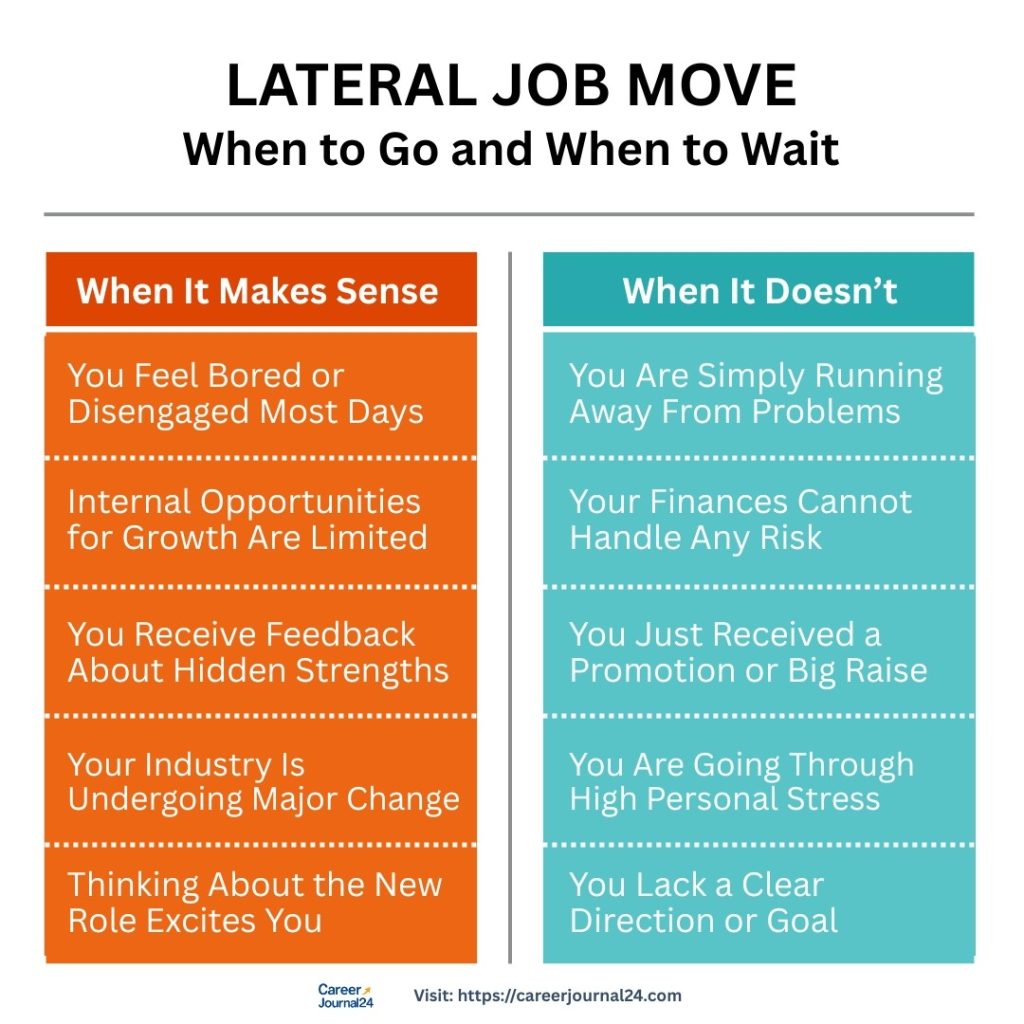
2. You Feel Bored or Disengaged Most Days
Occasional boredom is normal, but feeling disengaged most days is a warning sign. When work stops stimulating your curiosity, motivation tends to drop, and performance can follow. A lateral move can reintroduce novelty, fresh problems to solve, and a renewed sense of purpose. Often, it’s not work itself that people dislike, but repetition without growth.
3. Internal Opportunities for Growth Are Limited
Sometimes the issue is not your performance but the structure of the organization. If your team or department has no realistic upward movement for the next one or two years, staying in the same role may stall your career. A lateral move into another function or team can create momentum, expand your internal network, and keep your progress moving forward instead of waiting indefinitely.
4. You Receive Feedback About Hidden Strengths
When managers or colleagues consistently point out skills you rarely use, it’s worth paying attention. For example, being praised for communication, problem-solving, or strategic thinking while your role focuses on routine execution suggests a mismatch. A lateral move can place you in a role where those strengths are used daily, leading to better performance and higher job satisfaction.
5. Your Industry Is Undergoing Major Change
Industries evolve, and roles that were once secure can lose relevance quickly. New technologies, regulations, or business models can reshape job requirements. Making a lateral move into a growing or adjacent area allows you to adapt early. Instead of reacting to change later, you position yourself ahead of it, which strengthens long-term career security.
6. Thinking About the New Role Excites You
Logic matters, but emotions are important signals too. If imagining yourself in the new role genuinely excites you, that enthusiasm often translates into faster learning and stronger commitment. While excitement alone should not drive the decision, it is a powerful indicator when combined with practical benefits like skill growth and exposure.
7. You See Colleagues Succeed With Similar Moves
Seeing people in your network succeed after making lateral moves can reduce fear and uncertainty. It shows that sideways moves can lead to meaningful growth and recognition. These examples also provide insight into what works, what challenges to expect, and how such moves can open doors you might not see from your current position.
When a Lateral Move Might Not Be Right
A lateral move is not a magic solution for every career problem, and miscalculating your intent can lead to frustration. It is essential to recognize when staying the course is actually the more strategic choice for your long-term sanity and success.
1. You Are Simply Running Away From Problems
If your main reason for considering a lateral move is to escape a difficult manager, team conflict, or workplace tension, it’s important to pause. Problems tied to communication, boundaries, or expectations often reappear in new roles if they are not addressed first. In many cases, an honest conversation, a role adjustment, or a team change within the same function may solve the issue without the disruption of a move. A lateral move should be about growth, not avoidance.
2. Your Finances Cannot Handle Any Risk
Even when a lateral move keeps your title the same, financial uncertainty can still arise. There may be slower bonus cycles, delayed performance incentives, or unexpected costs during the transition. Without a financial buffer, stress can quickly overshadow the benefits of the move. If you do not have enough savings to comfortably manage a few months of uncertainty, waiting until your finances are stronger is often the safer choice.
3. You Just Received a Promotion or Big Raise
Timing matters in career decisions. Making a lateral move immediately after a promotion or significant raise can send mixed signals to leadership. It may raise questions about commitment, decision-making, or long-term focus. Staying in the role long enough to prove impact helps build trust and strengthens your professional credibility. Once your contribution is visible, future moves are easier to justify and support.
4. You Are Going Through High Personal Stress
Career changes require mental energy, focus, and emotional resilience. If you are already navigating major personal stress, such as health issues, family responsibilities, or life transitions, adding a lateral move can be overwhelming. In such periods, stability often provides the space needed to recover and regain clarity. Waiting does not mean giving up; it means choosing the right moment.
5. You Lack a Clear Direction or Goal
A lateral move without purpose can lead to frustration and regret. If you cannot clearly explain why the new role fits your long-term vision, the change may feel empty once the initial novelty fades. Taking time to reflect on your interests, strengths, and future goals helps ensure that any move you make adds meaning and direction to your career rather than creating confusion.
How to Make a Lateral Move Successfully Inside Your Company
Internal transitions are often the smoothest way to pivot because you already understand the organizational landscape. Success here depends on balancing your current obligations with your future aspirations while maintaining professional relationships across the board.
1. Maintain Peak Performance
Your current performance is the strongest currency you have when making an internal lateral move. Leaders in other departments almost always ask your manager about your work ethic, reliability, and attitude before considering you. If your performance drops after you start exploring a move, it can damage trust and close doors. Staying consistent until the very end shows professionalism and reassures everyone that you are leaving from a position of strength, not escaping underperformance.
2. Network Through Informational Interviews
Waiting for a role to be officially posted often puts you at a disadvantage. Informational interviews allow you to learn how other teams operate while quietly building visibility. A short conversation about goals, challenges, and skill needs helps leaders remember you when opportunities arise. These conversations also help you decide whether the role actually fits you, reducing the risk of making a move you later regret. You can find more tips on how to conduct these at resources like Forbes Career Advice.
3. Involve Your Manager Early
Internal moves work best when they are not surprises. Once you are confident about the direction you want to explore, having an open conversation with your manager builds trust. Explain what skills you want to develop and how the move aligns with your long-term contribution to the company. When managers feel respected and included, they are far more likely to support your growth rather than block it.
4. Identify Your Transferable Value
When approaching a new internal team, highlight what makes you uniquely valuable as an insider. You already understand the company’s culture, tools, processes, and customers. This reduces onboarding time and risk. Framing your experience in terms of how it solves their current problems helps decision-makers see you as an asset, not just someone looking for a change.
5. Create a Succession Plan
Helping your manager prepare for your departure demonstrates maturity and loyalty. By documenting processes, training a replacement, or proposing a transition timeline, you make the move easier for everyone involved. Leaving your current role in good shape protects your reputation and strengthens internal relationships, which often matter more than the move itself.
6. Formalize the Transition
Even though the move is internal, it should be treated with the same clarity as an external job change. Clearly define your new responsibilities, expectations, and reporting structure. Document any changes in workload, hours, or growth opportunities. This prevents confusion and ensures you are fully stepping into the new role rather than being pulled back into old responsibilities during the transition.
How to Make a Lateral Move Successfully to a New Company
Leaving your current organization for a similar role elsewhere requires a different kind of branding. You must convince a new employer that your existing skills are exactly what they need, even if the context is completely different.
1. Research the Company Culture Deeply
When making a lateral move to a new company, understanding the culture is just as important as understanding the role. Company websites often show an ideal version of reality, so look deeper. Reading employee reviews, following leadership on social media, and paying attention to how teams communicate in interviews can reveal how decisions are actually made. A role that looks perfect on paper can feel uncomfortable if the culture does not match your working style.
2. Utilize LinkedIn for Warm Introductions
Cold applications often disappear into crowded inboxes. Reaching out to people inside the company increases visibility and credibility. A short, thoughtful message asking about their experience or team can open doors. Even a brief interaction helps your name stand out when your application is reviewed. Warm introductions also give you insider insight that helps you prepare better for interviews.
3. Rewrite Your Resume Around Transferable Skills
When moving laterally, your resume should focus on what carries over, not what changes. Instead of listing duties, highlight outcomes and skills that apply to the new role, such as problem-solving, stakeholder management, or data analysis. Focusing on transferable skills in a resume helps recruiters quickly see how your experience fits, even if your previous job title looks different from the one you are applying for.
4. Prepare Strong Stories for Behavioral Interviews
Behavioral interviews are especially important during lateral moves because employers want proof that you can adapt. Prepare clear examples that show how you handled challenges, learned new skills quickly, or worked across teams. Focus on the situation, the action you took, and the result. Strong stories help interviewers imagine you succeeding in the role.
5. Negotiate Beyond Salary
Lateral moves do not always come with large pay increases, but that does not mean you have no room to negotiate. Learning opportunities, access to mentorship, flexible work arrangements, or an earlier performance review can add long-term value. These elements often matter more for growth than a small salary bump and can accelerate your progress in the new company.
6. Plan a Smooth Transition and Onboarding
How you leave your current role matters. Giving proper notice, finishing key projects, and creating a clear handover shows professionalism and protects your reputation. At the same time, preparing for onboarding in the new company helps you start strong. Reviewing tools, processes, and expectations early allows you to contribute faster and build trust from day one.
The Long-Term Impact on Career Growth
A horizontal shift is an investment in your future self that pays dividends over decades. While the immediate results may seem subtle, the cumulative effect of diverse experiences creates a professional profile that is nearly impossible to compete with.
1. Developing Executive Perspective
One of the most significant impacts of moving laterally is the development of a “general manager” mindset. By seeing how different departments operate, you learn to anticipate how a change in one area affects the whole business. This holistic view is a prerequisite for reaching the C-suite or executive leadership.
2. Building a Resilient Career
In an economy where entire industries can be disrupted overnight, being a multi-skilled professional is the best form of job security. If one sector of your industry faces a downturn, your lateral experiences give you the ability to pivot into a related field without starting from the bottom.
3. Increasing Future Salary Potential
While a lateral move may not offer a raise today, it often removes the “salary ceiling” of a narrow specialty. A professional with a background in both sales and product development is often worth significantly more to a company than someone who has only ever done one or the other.
4. Creating a Massive Network
Every lateral move essentially doubles your professional network. Instead of just knowing people in your specific niche, you gain advocates and mentors across the entire business landscape. These connections are the primary source of high-level job referrals and partnership opportunities later in life.
5. Preventing Mid Career Burnout
Doing the same job for twenty years can lead to “autopilot” syndrome. Lateral moves keep your professional life interesting by providing new challenges and fresh perspectives. This mental stimulation helps maintain your passion for your work, ensuring you remain a high-value contributor well into your senior years.
6. Improving Cross Functional Leadership
The most difficult part of management is getting different teams to work together. Because you have “walked in the shoes” of different departments, you become a natural bridge-builder. This makes you the ideal candidate for leading large, complex projects that require high levels of collaboration and empathy.
7. Future Proofing Against Automation
As AI takes over more specialized, repetitive tasks, the value of human workers who can “connect the dots” between different functions increases. A lateral career path emphasizes synthesis, strategy, and complex human interaction, skills that are much harder to automate than narrow technical tasks. Organizations like the World Economic Forum frequently publish reports on how these “soft” and cross-functional skills will define the future of work.
Common Mistakes to Avoid
Even the most well-intentioned lateral moves can fail if you aren’t careful about the execution. Learning from the errors of others can help you navigate the transition without damaging your reputation or slowing your progress.
1. Failing to Do Daily Task Research: Many people move into a new department because they like the “idea” of it, only to find the daily work is not a fit. For example, moving into marketing because you like creativity, only to realize your specific role is 90% data entry and spreadsheet analysis.
2. Burning Bridges on the Way Out: It is a small world, and your previous manager might be your future client or peer. Neglecting your duties during your final weeks in your old role or speaking poorly of your former team is a mistake that can haunt your professional reputation for years.
3. Neglecting to Negotiate: Just because the move is lateral doesn’t mean you shouldn’t negotiate. Whether it is a slightly better title, a more flexible working arrangement, or a “signing bonus” for the new skills you are bringing to the table, always look for ways to improve your total package.
4. Skipping the Onboarding Process: Internal hires often make the mistake of assuming they “already know” how things work. Every department has its own “unwritten rules” and communication styles. Treating your first 90 days with the same intensity as a brand-new job is essential for a successful transition.
5. Moving Too Frequently: While the lattice career is modern, moving every twelve months can make you look “flighty” or like you are unable to master a craft. Ensure you stay in each role long enough to show measurable results and a clear contribution before looking for your next horizontal shift.
6. Ignoring the Emotional Weight: Changing roles is stressful, even if your pay stays the same. Many people underestimate the “ego hit” of being a beginner again or the fatigue of building new relationships. Give yourself grace and time to adjust to the new environment without expecting instant perfection.
Conclusion
Mastering how to make a lateral move successfully is about recognizing that a career is a marathon, not a sprint. Sometimes, you have to move to the side of the track to find a clearer path or to grab a bottle of water before the next big incline. By focusing on your long-term impact on career growth and being intentional about why you are shifting, you turn a sideways step into a powerful strategic advantage. Don’t be afraid of the lattice; embrace the opportunity to learn, grow, and diversify your skills, and you will find that the top of the mountain is much easier to reach when you have explored every side of it.