How to Respond to a Rejection Email for a Job: With Examples & Templates
Getting rejected after applying for a job hurts more than most people admit. You invest time, energy, and hope into an application, only to receive a short message saying the company has decided to move forward with another candidate. In that moment, many people delete the email and move on. But learning how to respond to a rejection email can quietly become one of the smartest career moves you make.
A thoughtful reply does more than show good manners. It protects your professional reputation, builds relationships, and sometimes opens doors you did not even know existed. In this piece of content, you will learn how to respond to a rejection email for a job in a way that feels natural, confident, and genuinely useful for your long-term career.
Why You Should Always Reply to a Rejection Email
It may feel pointless to reply to a rejection email, especially when you are disappointed or frustrated. However, this small action plays a much bigger role in your career than most people realize. How you handle rejection says a lot about your professionalism, emotional intelligence, and long-term mindset. A short, thoughtful response can strengthen your personal brand, keep relationships alive, and quietly create future opportunities. In many cases, replying is not about this job, but about the next one that may come from the same recruiter or company.
It Shows Professionalism
Replying to a rejection email is a quiet but powerful way to demonstrate professionalism. Recruiters notice how candidates behave when things do not go their way. A respectful response shows that you understand workplace etiquette and can handle difficult situations with maturity. This quality matters just as much as technical skills in many roles.
It Strengthens Your Personal Brand
Every interaction you have with an employer shapes your personal brand. A thoughtful reply reinforces the image of someone who is emotionally intelligent, respectful, and serious about their career. Over time, these small signals build a reputation that follows you across companies and industries.
It Keeps You on the Recruiter’s Radar
Most candidates never reply after rejection. When you do, your name stays visible in the recruiter’s mind and inbox. This small act increases the chance that they will remember you when a similar role opens or when another team needs a candidate with your background.
It Creates a Chance for Feedback
A polite follow-up gives you a rare opportunity to ask for constructive feedback. Even a short comment can help you understand where you need to improve. If you aren’t sure how to phrase this request without sounding defensive, you can look into specific guides on how to ask for feedback after a job rejection Email to ensure your message hits the right note. This turns rejection into a learning moment instead of a dead end.
It Opens Doors for Future Opportunities
Hiring decisions change more often than people realize. Candidates decline offers, budgets shift, and new roles appear unexpectedly. When that happens, recruiters look for familiar, professional candidates they can trust. A gracious reply makes it easier for them to think of you first.
Sample Responses to a Rejection Email for Different Scenarios
Customizing your reply to the situation makes it feel authentic. Here’s how to adapt how to respond to a rejection email for a job based on context. These examples are templates; personalize them with details from your experience.
The Classic Gracious Reply (Most Recommended)
This is the safest and most effective version for 90% of situations.
Subject: Thank You – [Position] Role
Hi [Recruiter’s Name],
Thank you so much for letting me know and for the opportunity to interview for the [Position] role. I really enjoyed our conversations and learning more about [Company].
While I’m naturally disappointed, I completely understand your decision. I’d be grateful if you’d keep me in mind for future opportunities that might be a better fit.
Wishing you and the team all the best!
Best regards,
[Your Name]
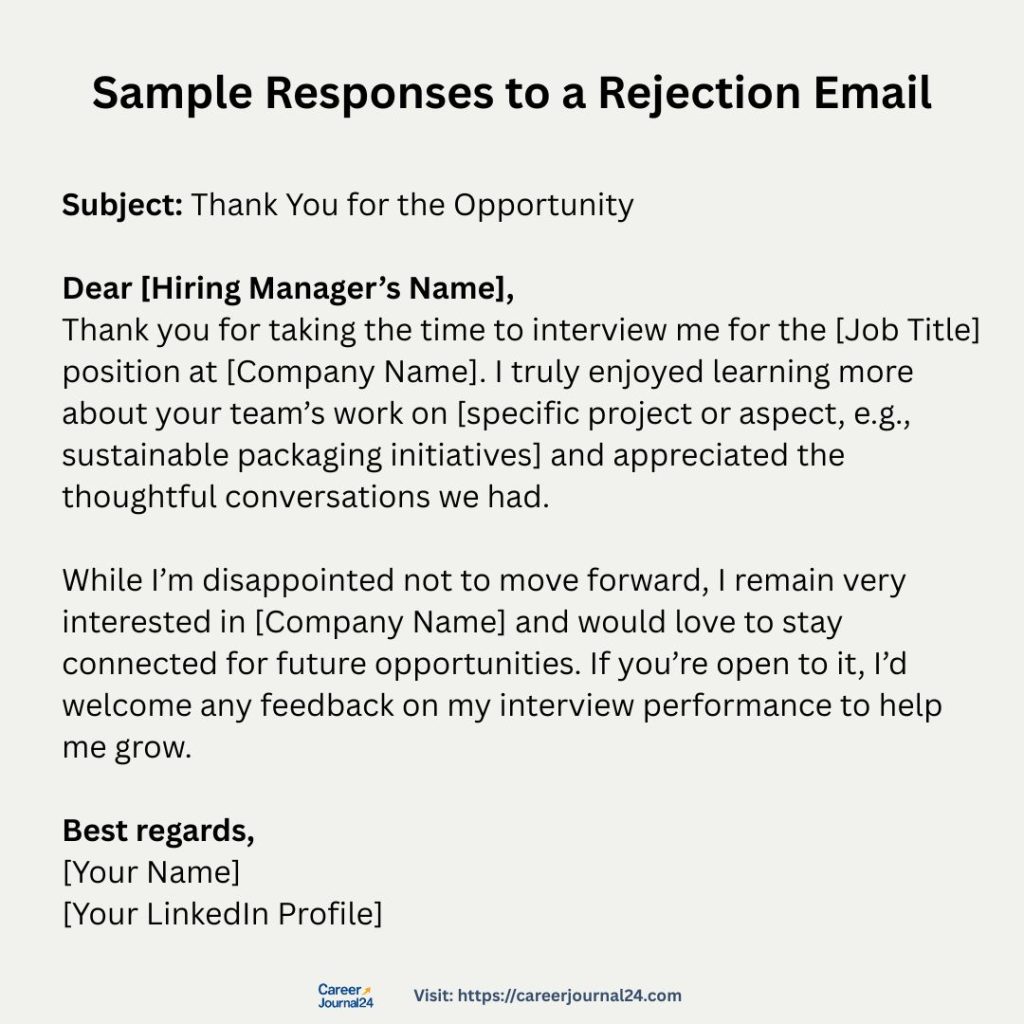
If You Had a Strong Interview Process
Subject: Thank You for the Opportunity
Dear [Hiring Manager’s Name],
Thank you for taking the time to interview me for the [Job Title] position at [Company Name]. I truly enjoyed learning more about your team’s work on [specific project or aspect, e.g., sustainable packaging initiatives] and appreciated the thoughtful conversations we had.
While I’m disappointed not to move forward, I remain very interested in [Company Name] and would love to stay connected for future opportunities. If you’re open to it, I’d welcome any feedback on my interview performance to help me grow.
Best regards,
[Your Name]
[Your LinkedIn Profile]
This response is ideal when the process was thorough. It shows you valued the interaction without dwelling on the outcome. In my experience, replies like this have led to referrals for other roles.
If You’re Seeking Feedback
Subject: Re: [Job Title] Application Update
Hi [Hiring Manager’s Name],
Thanks so much for letting me know about your decision regarding the [Job Title] role. I appreciate the opportunity to apply and learn about [Company Name]’s innovative approach to [industry-specific goal].
I’d be grateful for any feedback you could share on my application or interview, what stood out positively, and where I might improve for similar positions in the future. Regardless, I’m eager to apply again if another suitable role opens up.
Warmly,
[Your Name]
This works well for early-career candidates. It’s direct but polite, making it easy for them to respond without pressure. Fact: According to LinkedIn data, candidates who ask for feedback are 20% more likely to get referred elsewhere.
If It’s a Mass Rejection (No Interview)
Subject: Thank You
Dear [Hiring Team],
Thank you for considering my application for the [Job Title] at [Company Name]. I admire your company’s commitment to [value, e.g., diversity and inclusion] and was excited to contribute my skills in [your key skill].
I hope to keep the door open for future roles and would appreciate being notified of any positions that match my background.
Sincerely,
[Your Name]
Short and sweet for quick rejections. It’s low-effort but high-impact, maintaining a positive impression.
If You Want to Network Post-Rejection
Subject: Staying Connected
Hi [Hiring Manager’s Name],
I wanted to thank you again for the chance to interview for the [Job Title] position. Your insights into [Company Name]’s culture were inspiring, and I’m glad we had the opportunity to connect.
Though I won’t be joining this time, I’d love to stay in touch via LinkedIn. Please feel free to reach out if you know of other opportunities in [your field].
Best,
[Your Name]
[LinkedIn Link]
This is great for building long-term relationships. I once used a similar note after a rejection and ended up with an informational interview that led to a different job.
Key Elements of a Strong Rejection Response
A great response to a rejection email is concise, positive, and forward-looking. Aim for 3-5 short paragraphs. Keep it under 200 words to respect the recipient’s time. The goal is to thank them, express interest in future roles, and optionally ask for feedback. Here are some key elements of a strong rejection email response:
Keep It Brief and Respectful
A strong response to a rejection email should be concise and to the point. Aim for 3-5 short paragraphs, staying under 200 words. This shows respect for the hiring manager’s time and keeps the focus on gratitude rather than dwelling on the setback. Think of it as a quick, professional note, like following up after a meeting, where brevity signals efficiency and maturity.
Lead with Gratitude
Start by thanking them for their time and consideration. This sets a positive tone and demonstrates emotional intelligence. Phrases like “Thank you for the opportunity to interview” acknowledge their effort without immediately expressing disappointment. It’s a simple gesture that makes you memorable in a sea of applications, much like thanking a host after a dinner party.
Show Genuine Interest in the Company
Reaffirm your enthusiasm for the organization by mentioning something specific you admired. Whether it’s their innovative product, collaborative culture, or recent achievements, this proves you’ve done your homework. Avoid generic compliments; instead, reference a detail from the job description or interview. This personal touch shows you’re not just mass-applying and keeps the door open for future roles.
Request Feedback Thoughtfully
If it feels appropriate, ask for insights to improve your approach. Phrase it gently, such as, “I’d appreciate any feedback on my application or interview performance.” Not every hiring manager will respond, but those who liked you often will, providing valuable guidance. This step turns rejection into a learning opportunity, helping you refine your skills for the next opportunity.
End with an Open Door
Close by expressing interest in staying connected or applying for future positions. Include a link to your LinkedIn profile or portfolio to make it easy for them to reach out. A line like “I look forward to potential opportunities down the road” leaves a positive impression and encourages ongoing networking. It’s a forward-looking finish that positions you as resilient and proactive.
Avoid Common Pitfalls
Steer clear of negotiating the decision, badmouthing the company, or over-apologizing, these can damage your professional reputation. Don’t vent frustration or send a rushed, error-filled reply. Instead, keep the tone natural and human, as if chatting with a colleague. For deeper insights into workplace etiquette, explore resources from the Harvard Business Review on effective communication. Keep It Brief and Respectful
A strong response to a rejection email should be concise and to the point. Aim for 3-5 short paragraphs, staying under 200 words. This shows respect for the hiring manager’s time and keeps the focus on gratitude rather than dwelling on the setback. Think of it as a quick, professional note, like following up after a meeting, where brevity signals efficiency and maturity.
Common Mistakes to Avoid When Responding
When responding to a rejection email, even well-meaning efforts can backfire if you’re not careful. This section highlights the most frequent pitfalls, like venting frustration or being too vague, that can damage your professional image or close doors for future opportunities. By steering clear of these errors, you’ll maintain a positive reputation and keep networking channels open. Think of it as a quick checklist to ensure your reply reinforces your strengths rather than undermining them.
Don’t Vent Your Frustration
It’s natural to feel disappointed after a rejection, but avoid expressing anger or frustration in your response. Emails can be forwarded or saved, so venting might harm your professional reputation. Instead, keep the tone positive and composed. This protects your personal brand and shows maturity, turning a potential negative into a neutral or even positive impression.
Be Specific, Not Vague
Generic replies like “Thanks for the update” lack impact and can seem disinterested. Tailor your response by referencing a specific part of the interview or job description, such as a project you discussed. This demonstrates genuine engagement and sets you apart from other candidates. Specificity builds a bridge for future opportunities and makes your reply more memorable.
Mind Your Timing and Follow-Ups
Respond within 48 hours to stay relevant without seeming desperate. If emotions are running high, wait a day to compose a thoughtful message. Avoid sending multiple follow-ups; one response is sufficient unless the recruiter invites further conversation. Prompt but measured timing shows professionalism and respect for their schedule.
Proofread for Errors
Typos or grammatical mistakes in a rejection reply can amplify awkwardness and undermine your credibility. Always read your email aloud or use a tool like Grammarly before sending. A polished response reflects attention to detail, a key trait employers value. It’s a small step that prevents a big misstep.
Align with Company Culture
Tailor your tone to the organization’s style. For a startup, a casual, enthusiastic note might fit; for a corporate role, stick to formal language. Research the company on sites like Glassdoor or their social media to gauge their communication vibe. This cultural fit in your response can make you seem like a natural extension of their team.
Handle Poor Fits Gracefully
Not all rejections are about your qualifications; sometimes it’s a mismatch in experience or expectations. If you’re overqualified or the role isn’t aligned, acknowledge it subtly in your reply. For example, mention how your skills might better suit another area. This positions you for better matches and keeps the door open for more suitable opportunities.
Final Thoughts on Rejection Email Responses
Knowing how to respond to a rejection email transforms a low point into a high-value skill. It’s about empathy, for yourself and the recruiter, and strategic thinking. By focusing on how to respond to a rejection email for a job with gratitude, curiosity, and openness, you’re not just closing a door; you’re building a hallway of possibilities.
Job hunting is a marathon, not a sprint. Rejections are mile markers, not finish lines. Stay persistent, keep refining your craft, and remember: Every “no” brings you closer to the right “yes.” Your next opportunity is waiting; respond to it with the same professionalism you’ve practiced here.