
Lateral Job Move: What Is It and Is It Right for You?
A lateral job move is one of the most misunderstood career decisions in the workplace. Many professionals assume that career growth only happens through promotions and higher titles. But in reality, some of the most strategic career progress happens sideways, not upward. If you have ever wondered what is a lateral move in a job, or questioned whether a lateral move in a job can truly help your future, you are not alone. Employees across industries consider lateral moves when they feel stuck, curious, or ready for change without leaving their organization.
In this blog post, we will explore what a lateral job move really means, why people choose it, the key aspects of a lateral move, and most importantly, is a lateral job move worth it for your long-term career. The goal is to keep everything practical, simple, and easy to apply to real work situations.
What Is a Lateral Move in a Job?
A lateral move in a job is a formal transition to a position at the same organizational level, with comparable responsibility and remuneration, but within a different functional area or team. It constitutes a change in role rather than rank. For example, a marketing manager might move to a product management role, or a financial analyst might transition to a strategic planning function. The core characteristic is the exchange of one set of duties for another at an equivalent hierarchical tier. This move is distinct from a promotion, which involves increased authority and compensation, or a demotion. Organizations often facilitate lateral transfers to retain talent, fill internal skill gaps, and foster cross-functional understanding. For the individual, it represents a calculated career decision focused on long-term growth over immediate title or financial gain.
In everyday terms, a lateral move is not about climbing the ladder. It is about widening your career base.
Key Aspects of a Lateral Move
Understanding the mechanics of this transition is vital. Here are the defining characteristics that make up the Key Aspects of a Lateral Move.
1. Equivalent Compensation Structure
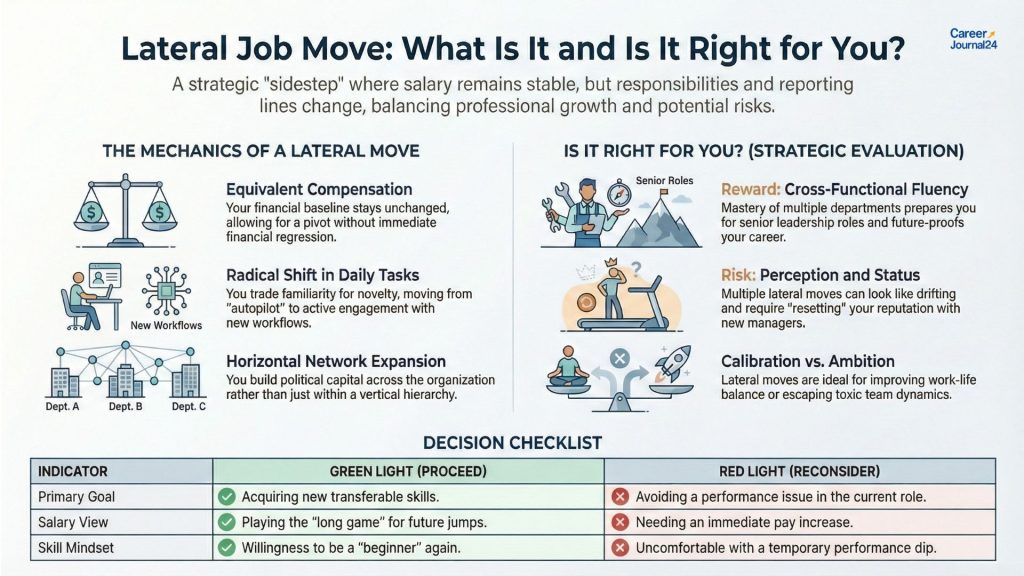
One of the most defining features of a lateral move is that your financial baseline remains largely unchanged. Since you are not ascending the corporate hierarchy, the salary bands for the new role usually mirror your current one. For many professionals, this provides a safety net; you get to explore a new career avenue without the financial regression that often accompanies a complete industry change. While you might not see a significant pay bump immediately, maintaining your current salary while acquiring new, marketable skills acts as a form of deferred investment. The value here isn’t in the immediate paycheck, but in the preservation of your lifestyle while you pivot.
2. Shift in Daily Responsibilities
While your paycheck stays the same, your calendar will look drastically different. A primary aspect of a lateral move is a fundamental shift in what you do every day. You are trading familiarity for novelty. If you move from marketing to product management, you stop worrying about ad spend and start worrying about user stories and technical debt. This complete change in tasks is what stimulates professional growth. It forces you to abandon the “autopilot” mode that often sets in after years in the same role, requiring you to actively engage with new problems, new workflows, and new success metrics.
3. Change in Reporting Lines
A lateral move almost always involves changing who you report to. This is a subtle but profound aspect of the transition. Moving to a new manager means adapting to a new leadership style, new expectations, and a new method of performance evaluation. It offers you the chance to reset your reputation within the company. If you were pigeonholed in your old team, a new manager offers a blank slate. Furthermore, exposure to different leadership styles helps you refine your own management philosophy, as you learn what works and what doesn’t from a variety of mentors across the organization.
4. Requirement for New Hard Skills
Unlike a promotion, where you usually do more of what you are already good at, a lateral move often requires you to learn entirely new technical skills. You might be an expert in Excel but now need to learn Salesforce, or a master of copywriting who now needs to understand data analytics. This steep learning curve is a key feature. It bridges the gap between being a specialist and a generalist. The willingness to return to a “beginner mindset” and acquire these hard skills is what differentiates a successful lateral mover from someone who is just drifting between departments.
5. Horizontal Networking Expansion
Vertical moves build relationships with those above and below you; lateral moves build relationships across from you. When you switch functions, you naturally integrate into a new social and professional circle within the company. You stop interacting solely with your immediate team and start collaborating with colleagues you previously only saw in passing. This horizontal networking is crucial for getting things done in complex organizations. By understanding the personalities and drivers of different departments, you become a connector, someone who can bridge gaps between siloed teams because you have “lived” in both worlds.
6. Preservation of Institutional Knowledge
A unique aspect of an internal lateral move is that while your job changes, your company knowledge remains relevant. You already know the company culture, the unspoken rules, the software systems, and the brand values. This gives you a distinct advantage over an external hire. You can apply your deep understanding of the organization’s history to your new role, allowing you to identify efficiencies or problems that an outsider would miss. You are bringing the context of your old department into the new one, which often leads to immediate process improvements and better cross-departmental alignment.
7. Strategic Positioning for Future Growth
Finally, a lateral move is often a setup for a future leap. It is rarely the end goal in itself; rather, it is a tactical positioning move. By rounding out your experience, you are removing the “but” from your future performance reviews (e.g., “She is great at sales, but she doesn’t understand operations”). This aspect involves viewing the move as a puzzle piece. You are collecting the necessary experiences that will eventually qualify you for a General Manager or C-suite role, where understanding the interplay between different business functions is mandatory, not optional.
Reasons for a Lateral Move
Why would a high-performing employee choose to step sideways? The reasons for a lateral move are often rooted in long-term strategy and personal well-being.
1. Better Alignment with Personal Interests
Careers are long, and people change. What you loved at 22 might bore you at 30. A lateral move offers the benefit of realignment. It allows you to migrate toward work that interests you now, not work that interested you five years ago. This alignment between your daily tasks and your genuine interests leads to higher job satisfaction. You are no longer fighting against your own nature; you are working in a role that fits your current strengths and passions.
2. Development of a Transferable Skills Portfolio
A lateral move forces you to adapt and apply your transferable skills, like project management, data analysis, or leadership, in a completely new context. This proves the transferability and robustness of those skills. Simultaneously, you add new, complementary skills to your portfolio. This diversified skill set significantly enhances your marketability and career resilience. If your original function becomes obsolete or downsized, you possess proven abilities in another area, reducing professional vulnerability and opening a wider array of future opportunities both inside and outside the company.
3. Overcoming Career Stagnation
Boredom is a silent career killer. When you have mastered every aspect of your current role, engagement drops, and performance often follows. One of the primary reasons professionals seek lateral moves is to reignite their intellectual curiosity. The challenge of the unknown acts as a stimulant. By placing yourself in a position where you have to learn to swim again, you eliminate the complacency that comes with being the resident expert. This renewal of energy can extend your tenure at a company significantly, preventing the need to leave the organization entirely just to find something new and interesting to do.
4. Escaping a Toxic Team Dynamic
Sometimes, the job isn’t the problem; the environment is. You might love the company’s mission and your benefits, but struggle with a difficult manager or a toxic team culture. A lateral move allows you to divorce the team without divorcing the company. It provides an elegant exit strategy that preserves your seniority and tenure while removing you from a daily source of stress. This is often a smarter play than quitting, as it allows you to retain your vesting stock options and accumulated vacation time while finding a psychological fresh start in a healthier department.
5. Gaining Cross-Functional Fluency
In today’s complex business world, the most valuable leaders are those who speak multiple “languages.” A common reason for moving laterally is to learn the language of a different department. A marketer who moves into sales learns the reality of closing deals, which makes them a better marketer in the future. An engineer who moves into product learns why features are prioritized, making them a more strategic coder. This cross-functional fluency is highly prized. Professionals do this to transform themselves from narrow specialists into versatile operators who understand the business ecosystem as a whole.
6. Improving Work-Life Balance
Not all lateral moves are about ambition; some are about calibration. A valid and common reason for a lateral switch is to find a role that better aligns with a changing personal life. Perhaps your current role requires 50% travel, and you have just started a family. Moving to a role with similar pay but zero travel is a massive upgrade in lifestyle quality, even if the title doesn’t change. It allows you to sustain your income while adjusting the intensity or logistics of your workload to fit your current life stage.
7. Job Security in Volatile Times
Smart employees keep an eye on internal trends. If you notice that your department is shrinking, losing budget, or becoming obsolete due to automation, a lateral move can be a survival tactic. Moving from a declining department (like legacy hardware support) to a growing one (like cloud services) ensures your longevity at the company. It is a preemptive strike against layoffs. By transferring your skills to a revenue-generating or strategic growth area of the business, you anchor yourself in a safer harbor before the storm hits your original team.
8. Expanding Internal Network
Networking isn’t just about collecting business cards; it’s about building political capital. Professionals often move laterally to increase their visibility across the organization. When you work in multiple departments, you gain advocates in different corners of the building. This widespread support network becomes invaluable when you eventually apply for a promotion. Instead of just one manager rooting for you, you have three previous managers and dozens of colleagues across the business who can vouch for your work ethic and adaptability. It creates a broad base of support for your future ascent.
9. Testing a New Career Path Risk-Free
Changing careers entirely is risky. You might find out you hate the new industry after giving up everything to join it. A lateral move acts as a “beta test” for a career pivot. It allows you to try out a new profession (like moving from HR to Operations) with the safety net of your current employer. If you hate it, it is much easier to transition back or move elsewhere within the company than it would be if you had resigned and joined a new firm. It is the safest way to answer the “what if” questions in your career.
10. Renewed Motivation and Energy
The “honeymoon phase” of a new job is real and powerful. A lateral move triggers a spike in dopamine and engagement. The excitement of mastering new challenges can cure the cynicism that often develops after years in the same seat. This renewed energy often translates into higher performance ratings. Instead of coasting in your old job, you are striving in your new one. This revitalization can save a stalling career and prevent the workplace burnout that leads to rash resignations.
Everyday Examples of Lateral Moves
Theory provides the framework, but seeing everyday examples of lateral moves in action brings the concept to life. Whether it is swapping sales for marketing or moving from the field to headquarters, these real-world scenarios illustrate how professionals strategically pivot to unlock new growth without changing their hierarchy.
1. From Software Engineer to Product Manager
A senior software engineer with excellent technical skills and a strong understanding of user needs transitions into a Product Manager role. They move from writing code and implementing features to defining product strategy, writing requirements, and prioritizing the engineering backlog. They retain their seniority and compensation band but now spend their days in cross-functional meetings with marketing, sales, and design instead of in deep technical work. Their deep technical knowledge becomes a unique asset in communicating with the engineering team and making realistic trade-off decisions.
2. From Regional Sales Manager to Marketing Operations Lead
A successful sales manager, adept at understanding customer pain points and using CRM data, moves to the marketing department to lead operations. They apply their frontline customer insights to improve lead qualification processes, campaign targeting, and sales-marketing alignment. Their compensation, tied to management level, remains similar, but their performance metrics shift from quarterly revenue targets to marketing-sourced pipeline generation and conversion rate efficiency. This move broadens their understanding of the full customer acquisition funnel.
3. From Financial Controller to Head of Strategic Planning
A controller with a deep mastery of budgets, forecasting, and financial reporting moves to the corporate strategy team. They leverage their analytical rigor and understanding of financial drivers to model growth scenarios, evaluate potential acquisitions, and develop long-range strategic plans. They exchange the cycle of month-end closes and audit management for ad-hoc, project-based work focused on future growth. This move positions them to understand the strategic “why” behind the financial numbers they once solely reported.
4. From HR Business Partner to Learning & Development Director
An HRBP skilled at coaching managers and diagnosing team issues moves to lead the Learning & Development function. They use their intimate knowledge of organizational pain points to design targeted training programs that address real skill gaps. Instead of working with a specific business unit, they now create resources for the entire organization. Their success is measured by program engagement, skill application rates, and impact on performance metrics, rather than resolution of individual employee relations cases.
Risks and Challenges
To provide a balanced view, we must discuss is a lateral job move worth it? question by analyzing the potential downsides.
1. Feeling Stuck in Your Career
The most obvious risk is optics. To an external recruiter or a traditional hiring manager, a resume with three different jobs at the same level might look like a lack of ambition or an inability to get promoted. If you don’t craft your narrative carefully, it can look like you are drifting rather than climbing. You run the risk of being labeled as a “steady eddy” rather than a “high flyer.” It is crucial to have a clear story about why you made these moves to counter this perception.
2. Loss of Seniority and Social Capital
When you move to a new team, you reset your “political clock.” In your old team, you were the veteran; people trusted you, and you had shortcuts to get things done. In the new team, you are the rookie. You have to prove yourself all over again to a new manager and new peers. This loss of status can be jarring for the ego. You no longer have the answers, and you have to ask for help, which can feel like a step backward in your professional maturity.
3. The “Permanent Pivot” Trap
There is a danger of becoming a chronic lateral mover, someone who jumps ship every time things get difficult or boring. If you move sideways too many times without ever moving up, you can get stuck in the middle management layer forever. You become a “Jack of all trades, master of none.” You need to ensure that your lateral moves are stepping stones, not just a way to avoid the increased responsibility and pressure that comes with vertical progression.
4. Performance Dip During Transition
No matter how smart you are, there will be a ramp-up period. During the first few months of a lateral move, your productivity will likely drop as you learn the ropes. If your company undergoes a round of layoffs during this transition period, you might be vulnerable. You are the newest member of the team with the least output at that specific moment. This timing risk is real; you are trading a secure, high-performance position for a temporary period of inefficiency.
5. Mismatched Expectations
You might think the grass is greener, but sometimes it’s just painted green. You might move to a new department expecting a better culture or more interesting work, only to find that the new team has its own set of dysfunctions. The “dream role” might turn out to be tedious administrative work disguised as strategy. Unlike a new job at a new company, if a lateral move fails, it can be awkward to see your old team every day in the cafeteria while you regret leaving.
6. Delayed Salary Growth
While you keep your current salary, you often miss out on the raise that would have come with a promotion. By staying at the same level for two or three more years, you are effectively flattening your earning curve for that period. While this pays off in the long run if it leads to a massive jump later, in the short term, you are technically losing out on potential compounding income. You have to be comfortable with playing the long game regarding your finances.
7. Competency Struggles
There is a risk that you simply might not be good at the new job. You might be an excellent writer who thinks they want to be a data analyst, only to realize you hate SQL and struggle with statistics. Failing in a lateral move is more visible than failing in a new company because your failure happens in front of people who knew you as a success. This can damage your internal confidence and your reputation within the organization.
Conclusion
A lateral job move is not a retreat; it is a strategic repositioning. In a world where career paths are no longer linear, the willingness to move sideways is a superpower. It allows you to build a unique combination of skills, expand your influence across the organization, and find renewed passion for your work. While it comes with risks, like the temporary loss of status and the challenge of learning new systems, the long-term payoff of becoming a versatile, well-connected, and knowledgeable leader often outweighs the short-term plateau.
If you are feeling stuck, stop looking up for a moment and start looking around. The breakthrough you are looking for might not be on the next rung of the ladder; it might be right next to you.






One Comment