
Taking a Pay Cut for a New Job: A Practical Guide to Making the Right Choice
We are often taught that success is measured by a steady upward line on a graph. You start at an entry-level salary, you get a raise, you get a promotion, and you make more money every single year. So, when the idea of taking a pay cut for a new job enters your mind, it can feel like a failure. It feels like stepping backwards. You might worry about what your friends will think, how you’ll explain it to your family, or if you’ll ever catch up to your previous earning potential.
However, the modern workplace is shifting. We are realizing that a salary is just one currency; the other currencies are time, mental peace, and job satisfaction. Sometimes, the highest-paying job costs you more than it pays you. In this blog, we are going to look at the reality of reducing your salary to gain your life back. We will explore what is a pay cut, how to calculate if taking a pay cut for sanity is worth it, and ultimately, how much pay cut is too much.
What Is a Pay Cut?
Before we dive into the emotional and financial strategy, let’s ground ourselves in the definition. What is a pay cut exactly? In the simplest terms, it is a reduction in your gross or net income. This usually happens when you move from one employer to another, and the new offer comes with a lower number attached to it than your current role.
However, a pay cut isn’t always just about the base salary. It can also manifest through reduced bonuses, fewer stock options, or a lower hourly rate if you are moving from salaried to hourly work. It is important to distinguish between a voluntary pay cut, which is a strategic choice you make for a better lifestyle, and an involuntary pay cut, which happens when an employer reduces wages due to budget cuts or demotion.
When we talk about this topic in the context of changing careers, we are almost always referring to the voluntary choice. You are choosing to leave money on the table. But why would a rational person do that? Usually, it is because the “cost of living” in your current job has become too high, not in terms of rent, but in terms of your emotional energy.
Reasons to Take a Pay Cut
So, why would anyone willingly choose to earn less? The reasons are as varied as the individuals making these choices, but they often boil down to a quest for something more valuable than a higher number on a paycheck. This is where the idea of taking a pay cut for sanity truly comes into play.
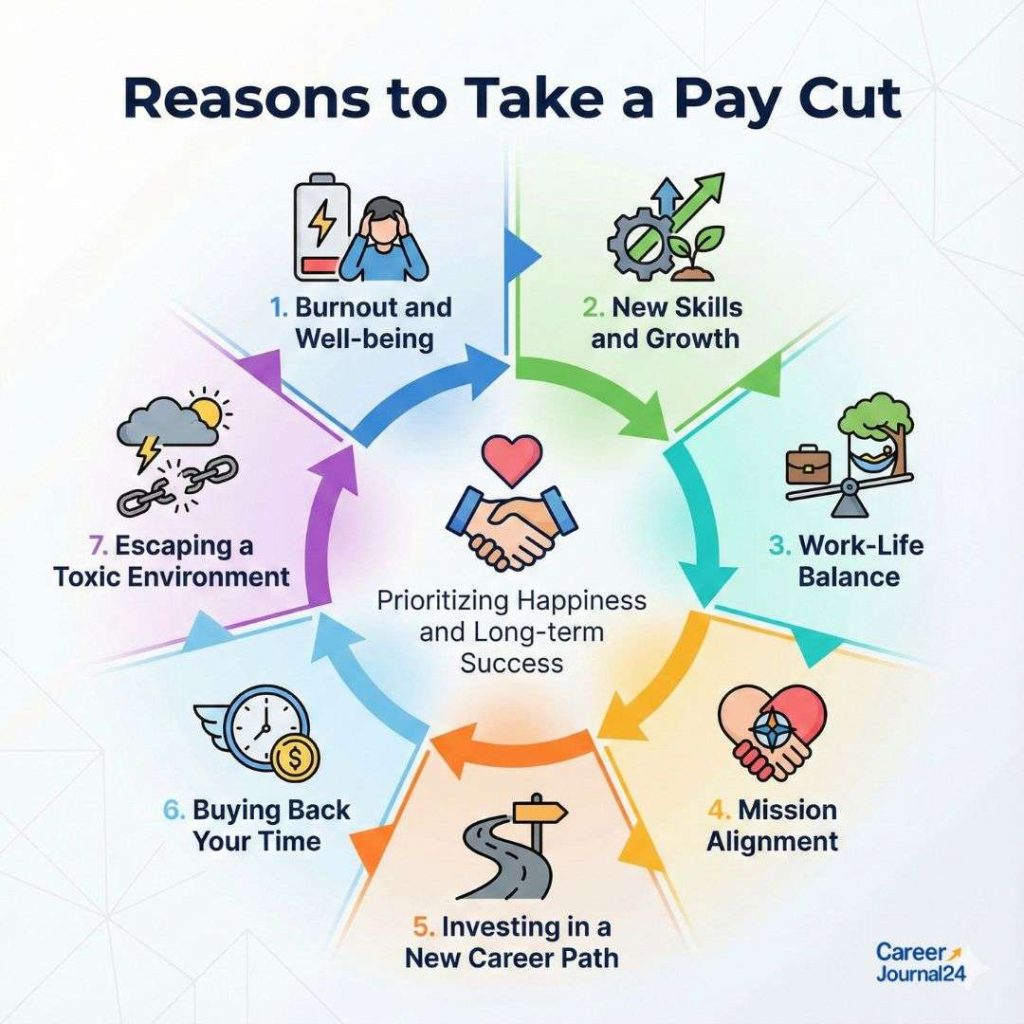
1. Burnout and Well-being
Imagine dragging yourself out of bed every morning, dreading the day ahead. Your current job might pay well, but it’s draining your energy, eating into your personal life, and perhaps even affecting your physical health. The stress could be chronic, leading to anxiety, sleepless nights, or a constant feeling of being overwhelmed. In such scenarios, the “golden handcuffs” of a high salary can feel more like shackles.
For many, a significant factor in considering a pay cut is the overwhelming desire to escape burnout. This isn’t just a buzzword; it’s a serious condition recognized by the World Health Organization as an occupational phenomenon characterized by feelings of energy depletion, increased mental distance from one’s job, and reduced professional efficacy. If your job is literally making you sick or miserable, the cost of staying put can far outweigh the financial implications of a smaller paycheck. A new role, even if it pays less, could offer a healthier environment, a lighter workload, or simply a job that doesn’t constantly demand every ounce of your being. It’s an investment in your mental and physical health, which are arguably priceless.
2. New Skills and Growth
Sometimes, your current role has hit a ceiling. You’ve learned all you can, and there’s no clear path for advancement or acquiring new, valuable skills. While comfortable, this stagnation can be detrimental to your long-term career prospects. You might realize that the industry is shifting, or that you need to pivot to stay relevant.
A pay cut can be a strategic move to enter a new field, gain experience in a different department, or acquire a highly sought-after skill set. Think of it as going back to school, but instead of paying tuition, you’re taking a temporary salary hit. For example, a marketing manager might take a lower-paying entry-level role in data analytics to become proficient in a high-demand area. Or a seasoned professional might join a smaller startup at a reduced salary for the opportunity to wear many hats and learn across different functions, accelerating their development in ways a large corporate environment couldn’t. This short-term financial sacrifice can lead to significantly higher earnings and more fulfilling opportunities down the line. It’s a calculated risk for future growth.
3. Work-Life Balance
The elusive work-life balance is another powerful motivator. A high-paying job often comes with long hours, frequent travel, and an “always-on” expectation. This can make it incredibly difficult to dedicate time to family, hobbies, personal development, or simply to recharge. Parents might seek a role with more predictable hours to be present for their children. Individuals might want more flexibility to pursue a passion project, care for an elderly parent, or improve their physical fitness.
A lower-paying job might offer that much-needed flexibility, perhaps a fully remote option, fewer hours, or a company culture that genuinely respects boundaries. The “pay” here isn’t monetary; it’s time, autonomy, and peace of mind. Many people find that having more control over their time and energy enriches their lives in ways that extra zeros in their bank account never could. It’s about optimizing for overall life satisfaction, not just financial maximization.
4. Mission Alignment
Imagine working for a company whose values clash with your own, or whose products/services you don’t genuinely believe in. This disconnect can be incredibly demoralizing, leading to a feeling of emptiness despite financial success. Conversely, working for an organization whose mission deeply resonates with you can be profoundly motivating and fulfilling.
For some, taking a pay cut for a new job is about aligning their work with their personal values, contributing to a cause they care about, or working for an ethical company. This might mean moving from a high-paying corporate role to a non-profit, a B-Corp, or a socially conscious startup. The satisfaction derived from knowing your work has a positive impact, or that you are contributing to something meaningful, can be a powerful antidote to a smaller salary. This form of “psychic income” can be a tremendous motivator and a source of deep personal satisfaction that money simply cannot buy.
5. Investing in a New Career Path
Sometimes you have to go backward to go forward. If you are looking to switch industries, for example, moving from a high-paying sales role to an entry-level graphic design position, you almost have to expect a pay cut initially. In this scenario, the lower salary is essentially the cost of tuition for your new career. You are trading immediate cash for long-term potential. If the new industry has a higher ceiling or better job security, that temporary dip in pay is an investment that will pay off significantly in five or ten years.
6. Buying Back Your Time
There is an old saying that time is money, but in reality, time is often worth more than money because you can always make more money, but you can never make more time. High-paying jobs in fields like investment banking, law, or executive management often demand 60-hour workweeks. If you take a job that pays 20% less but guarantees a strict 40-hour workweek, you are effectively buying back 10 hours of your life every single week. That is time you can spend with your family, working on a hobby, or simply resting. For many parents or caregivers, those extra hours are non-negotiable and worth far more than the extra cash.
7. Escaping a Toxic Environment
We often underestimate the physical and mental toll of a toxic workplace. A high salary doesn’t protect you from the stress of a micromanaging boss, a culture of bullying, or an unethical company environment. If your current job is causing you anxiety, insomnia, or physical illness, the “cost” of that salary is your health. Taking a pay cut to move to a company with a supportive culture and kind colleagues is a form of preventative healthcare, and leaving a toxic work environment is often the first step to reclaiming your life. The peace of mind you gain from not dreading Monday mornings is a tangible benefit that improves your quality of life every single day.
Taking a Pay Cut for Sanity
There is a silent epidemic in the modern workforce: burnout. We have all been there. It’s the Sunday night dread, the physical nausea when your boss’s name pops up on your phone, or the feeling that you are running a race you can never win. This is where the concept of taking a pay cut for sanity becomes a valid financial strategy.
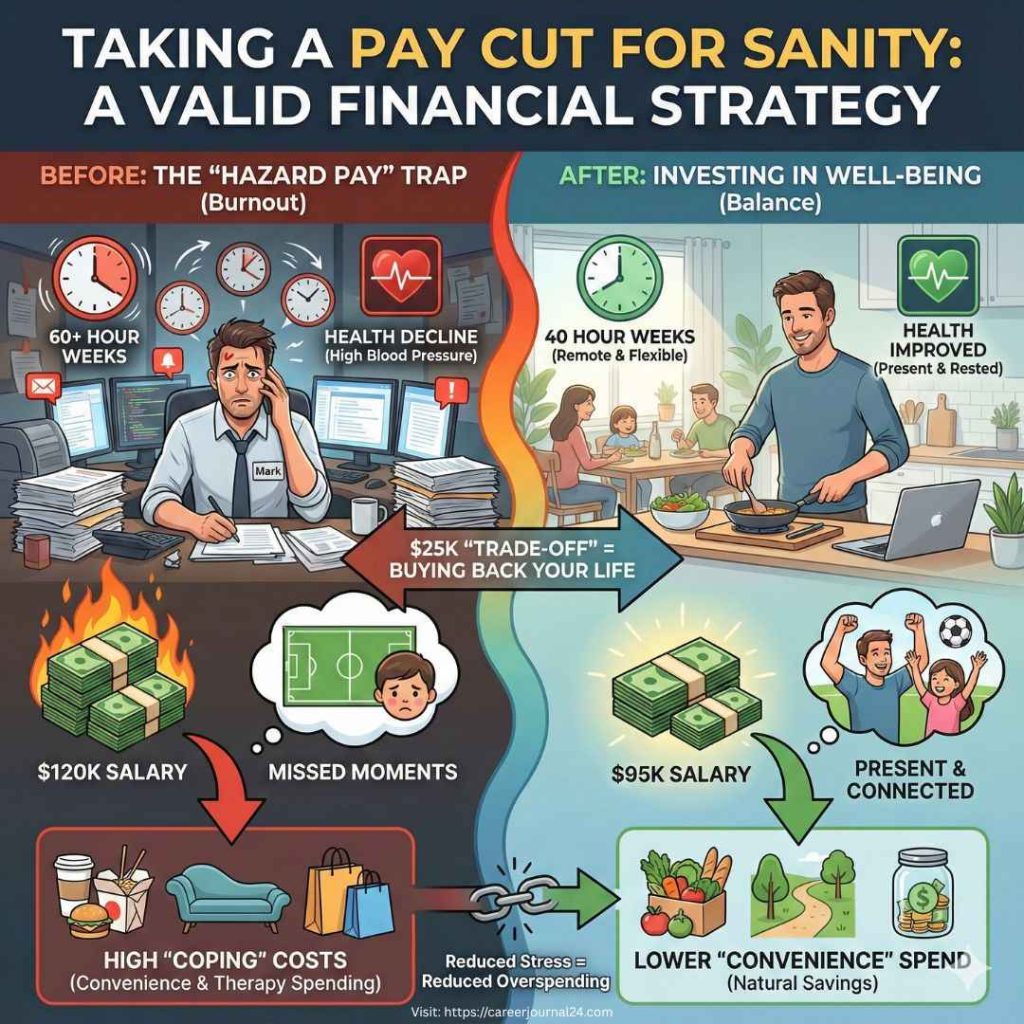
Consider the story of “Mark.” Mark was a senior project manager at a high-growth tech firm. He was making $120,000 a year. On paper, he was winning. In reality, he was working 60-hour weeks, his blood pressure was rising, and he missed every single one of his daughter’s soccer games. He realized that his high salary was essentially “hazard pay” for his deteriorating mental health. He was spending his money on therapy and takeout because he was too exhausted to cook or engage with his family.
Mark took a new job for $95,000. It was a significant drop. But the new role was 40 hours a week, fully remote, and had a culture that respected time off. Within six months, Mark’s health improved, he started cooking again, and he was present for his family. The $25,000 he “lost” was effectively spent on buying back his life.
When you are miserable, you tend to spend more on “convenience” and coping mechanisms. You might overspend on weekends away, expensive dinners, or retail therapy just to feel a spark of joy. By lowering your stress levels, you often naturally lower your unnecessary spending.
Should You Take a Pay Cut for a New Job?
This is the million-dollar question, and there’s no one-size-fits-all answer. Deciding whether to embrace a lower salary requires careful consideration of your personal circumstances, financial stability, and long-term career aspirations. It’s a strategic calculation, not a knee-jerk reaction.
Assessing Your Financial Runway
Before you even consider a pay cut, you absolutely must get a clear picture of your current financial situation. This is your “financial runway” – how long you can comfortably support yourself and your obligations with reduced income.
- Create a detailed budget: List all your monthly expenses: rent/mortgage, utilities, food, transportation, loan payments, insurance, subscriptions, and discretionary spending. Be brutally honest.
- Identify essentials vs. non-essentials: What can you cut or reduce if necessary? Can you forgo daily lattes, eating out often, or expensive vacations for a period?
- Check your savings: How much do you have in an emergency fund? Ideally, you should have 3-6 months of living expenses saved. If you plan to take a pay cut, having more saved offers a greater buffer and reduces stress.
- Evaluate debt: High-interest credit card debt or substantial loan payments can make a pay cut much riskier. Can you consolidate or pay down some debt before making the move?
- Calculate the impact: If you take a 15% pay cut, what does that mean for your monthly take-home pay? Can you realistically live on that amount without constant worry or dipping into savings?
You need to feel confident that you can meet your financial obligations without undue stress. If the numbers don’t add up, a pay cut, no matter how appealing the new role, might not be feasible right now. Financial stability is the bedrock upon which you can build a more satisfying career. For more insights on smart budgeting, consider resources like NerdWallet’s guide to creating a budget.
How Much Pay Cut Is Too Much?
This is the most critical question. We’ve established that sanity is important, but you still have to pay the mortgage. How much pay cut is too much? While there is no magic number for everyone, financial experts often suggest trying not to exceed a 10% to 15% reduction if possible.
If you take a cut larger than 20%, it can significantly impact your ability to save for retirement and handle emergencies. However, “too much” is relative to your safety net. If you have six months of expenses saved in an emergency fund, you can afford to take a bigger risk than someone living paycheck to paycheck.
To figure out your limit, you need to look at your “bare bones” budget. What is the absolute minimum you need to survive and service your debts? If the new salary covers that comfortably, the cut is manageable. If the new salary puts you in a position where one flat tire ruins your month, the cut is too much.
The Hidden Math of a Lower Salary
When evaluating a pay cut, you must look beyond the base salary. There is a concept called “fringe benefits” or “hidden salary” that can make a lower-paying job actually more profitable.
For example, if your current job requires a 90-minute commute each way, you are spending 15 hours a week in your car. That is 750 hours a year. If your new job pays $5,000 less but is a 15-minute walk from your house, you are effectively “earning” more when you factor in the gas, car maintenance, and wear and tear you save.
Furthermore, consider the cost of food. Many high-paying corporate jobs expect you to eat lunch out every day and maintain a specific wardrobe. A lower-paying job that is casual and allows you to work from home eliminates these costs.
Let’s look at a quick breakdown of how a $10,000 pay cut might actually only be a $4,000 cut in reality:
- Salary Difference: -$10,000
- Commuting Costs Saved (Gas/Train/Car): +$3,000
- Lunch Costs Saved (Cooking at home vs. Buying out): +$2,000
- Wardrobe Costs Saved (Suits/Dry cleaning vs. Casual): +$1,000
- Total Real Difference: -$4,000
When you do the math this way, the decision becomes much clearer. You are trading a small amount of disposable income for a massive increase in free time and reduced daily stress.
The Long-Term Impact on Career Growth
Another factor to consider when taking a pay cut for a new job is the long-term impact on your career. Will this move stunt your growth, or will it unlock a new path?
Sometimes, we get stuck in a “golden handcuff” situation. We stay in a high-paying job because we are afraid to lose the income, but the skills we are using are becoming obsolete. Taking a pay cut to join a startup or a smaller company might give you the opportunity to wear multiple hats and learn new skills that will make you highly employable in the future.
On the other hand, if you take a pay cut to move into a dead-end role with no room for advancement, you might find yourself in a difficult spot five years down the road. You want to ensure that the new role offers skill development, networking opportunities, or a title change that will help you bounce back to your previous salary range eventually.
Making the Decision: A Practical Checklist
If you are currently staring at a job offer with a lower salary than you currently have, here is a practical checklist to help you decide.
1. Audit Your Budget:
Can you live on the new number? Be honest. Don’t assume you will “cut back later.” Look at your last three months of bank statements.
2. Evaluate the “Why”:
Are you running toward something (a better culture, a passion, more time) or running away from something (a bad boss, a toxic environment)? Running toward something is usually a healthier motivation.
3. Check Your Resume Strategy:
If you are currently unemployed or planning to quit to find this better role, you might have a gap in your history. Ensure you know how to frame this positively by looking at an employment gap resume sample for inspiration.
4. Negotiate:
Just because the offer is lower doesn’t mean it is final. You can negotiate for a signing bonus to bridge the gap, or ask for a salary review in six months rather than one year.
5. Trust Your Gut:
We often ignore our intuition because of societal pressure to earn more. But if you feel a sense of relief at the thought of leaving your high-paying job, listen to that feeling.
Conclusion
Taking a pay cut for a new job is one of the bravest and most counter-cultural financial decisions you can make. It requires you to redefine what “wealth” means to you. If wealth means having a peaceful Sunday, being there for your children, and having the energy to pursue hobbies, then a lower salary might actually make you richer.
However, it is not a decision to be made lightly. You must understand what is a pay cut, calculate the real cost, and ensure that taking a pay cut for sanity doesn’t lead to financial ruin. By carefully assessing how much pay cut is too much and factoring in the hidden benefits of a better lifestyle, you can make a choice that supports both your bank account and your soul.
Ultimately, should you take a pay cut for a new job? If the new job offers you a sustainable path to happiness and financial security, then the answer is a resounding yes. Your career is a marathon, not a sprint, and sometimes you have to slow down to ensure you actually enjoy the run.