
20 Teacher Transferable Skills That Will Get You Hired
The modern workforce is undergoing a significant transformation. As industries prioritize agility, emotional intelligence, and complex problem-solving, the professional environment is shifting away from rigid hierarchies toward dynamic, multifaceted roles. In this context, teacher transferable skills have emerged as some of the most valuable assets in the global economy. Educators are no longer viewed solely as academic instructors; they are recognized as highly capable project managers, negotiators, and strategists.
For professionals looking to transition from education to corporate, non-profit, or entrepreneurial sectors, understanding the value of transferable skills for teachers is the first step toward a successful transition. The classroom is effectively a microcosm of the modern office, a high-pressure environment requiring constant adaptation, diverse stakeholder management, and measurable outcomes. Consequently, the transferable skills from teaching are not merely “soft skills” but hard-won competencies that solve real-world business problems.
This article provides a comprehensive analysis of these competencies, moving beyond the cliché of “patience” to explore the operational, strategic, and interpersonal advantages educators hold.
The Professional Value of Educators
The perception of teaching is often limited to the delivery of content. However, the reality of the role involves managing complex logistics, analyzing performance data, and navigating high-pressure environments. When analyzing transferable skills from teaching, it becomes evident that educators are essentially functioning as project managers, data analysts, and communications directors simultaneously.
Corporations often struggle to find employees who possess strong soft skills combined with organizational rigor. Teachers bridge this gap effectively. They are trained to operate with limited resources, meet strict deadlines, and manage diverse personalities. These are not just “soft skills”; they are essential business competencies that drive revenue and operational efficiency.
Comprehensive List of 20 Teacher Transferable Skills
To successfully make the move, it is crucial to identify specific competencies. This detailed list of transferable skills highlights the capabilities that resonate most with corporate recruiters and hiring managers.
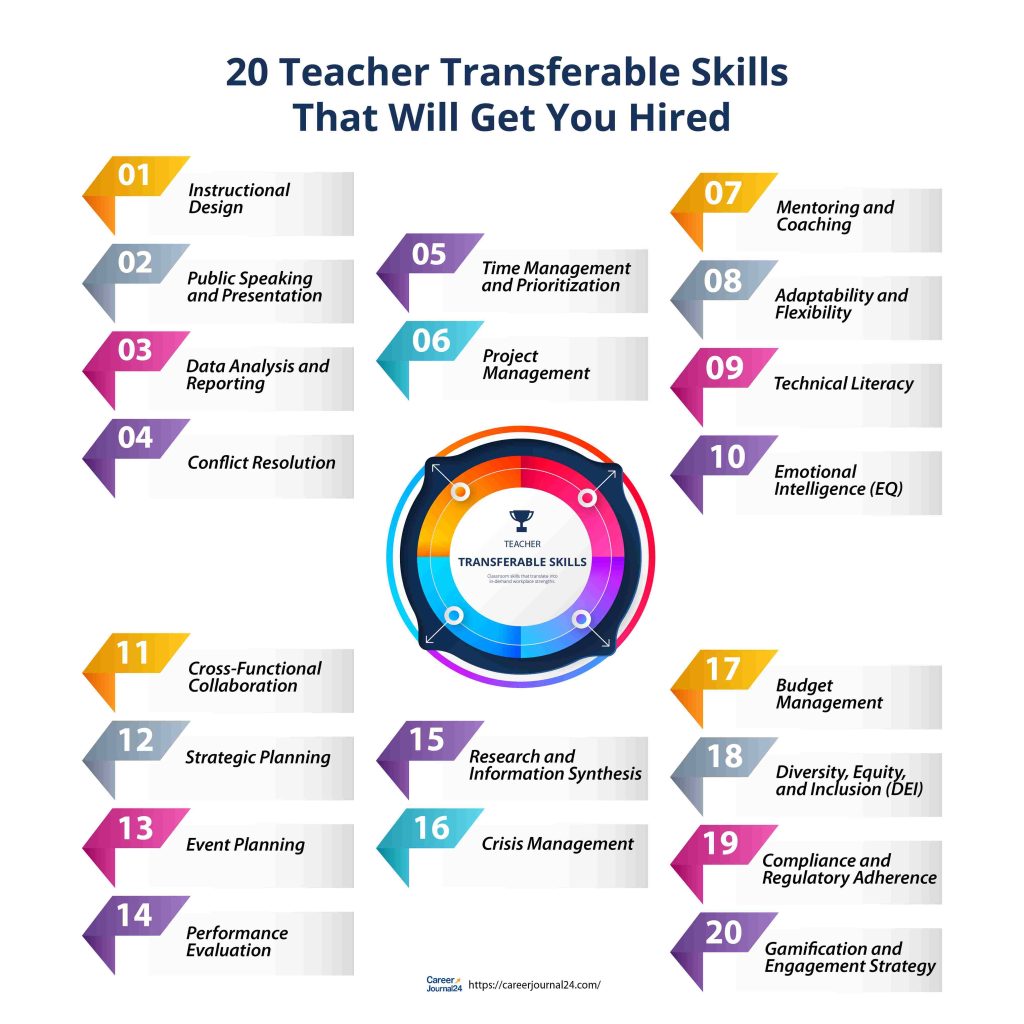
1. Instructional Design
This involves the systematic creation of learning experiences and materials. Teachers do this every time they create a lesson plan, slide deck, or worksheet. In the corporate sector, this skill is vital for creating training manuals, onboarding processes, and e-learning courses.
2. Public Speaking and Presentation
Few professionals are as comfortable commanding a room as a teacher. Whether presenting to a Board of Education or a classroom of teenagers, educators possess the ability to engage an audience, manage pacing, and utilize visual aids effectively.
3. Data Analysis and Reporting
Teachers track attendance, grades, behavioral trends, and learning outcomes. Translating this to the business world involves proficiency in tracking KPIs (Key Performance Indicators), creating progress reports, and using data to justify strategic decisions.
4. Conflict Resolution
Mediating disputes between students or navigating difficult conversations with parents requires immense diplomacy. This skill is directly applicable to Human Resources, where professionals must navigate employee disputes and maintain company culture.
5. Time Management and Prioritization
Educators live by the bell. They must execute a lesson, check for understanding, and handle administrative tasks within a strict timeframe. This rigorous adherence to schedules translates well to roles requiring strict deadline management.
6. Project Management
From organizing field trips to managing a year-long curriculum, teachers oversee complex projects with multiple moving parts. They handle logistics, budget compliance, and risk management, which are core components of formal Project Management roles.
7. Mentoring and Coaching
Teachers naturally mentor students and often peer-mentor new colleagues. This experience is essential for management roles or Learning and Development (L&D) positions, where the primary goal is helping employees grow and improve performance.
8. Adaptability and Flexibility
The classroom is unpredictable. Technology fails, drills occur, and lesson plans fall flat. The ability to improvise and maintain productivity during chaos is a critical asset in the fast-paced tech and startup sectors.
9. Technical Literacy
Modern educators are proficient in Learning Management Systems (LMS), interactive displays, and various educational software. This technical aptitude allows for a smooth transition into roles involving SaaS (Software as a Service) products or EdTech sales.
10. Emotional Intelligence (EQ)
Reading the room is a teacher’s superpower. Understanding non-verbal cues and managing the emotional climate of a group is invaluable in sales, leadership, and team management.
11. Cross-Functional Collaboration
Teachers rarely work in isolation; they collaborate with special education departments, administration, counselors, and grade-level teams. This mirrors the cross-functional collaboration required in business when marketing, sales, and product teams must align.
12. Strategic Planning
Developing a long-term scope and sequence for a subject requires foresight and strategic thinking. Teachers plan months in advance, setting milestones and objectives, a skill necessary for business development and operations.
13. Event Planning
Organizing school assemblies, science fairs, or parent nights involves vendor management, scheduling, and promotion. These logistics skills are directly transferable to corporate event planning or office management.
14. Performance Evaluation
Grading is essentially performance review. Teachers provide constructive feedback to help individuals improve. This is identical to the performance review cycles managers conduct with their direct reports.
15. Research and Information Synthesis
Teachers must research content to ensure accuracy and then synthesize that information for a specific audience. This skill is critical for content marketing, copywriting, and market research roles.
16. Crisis Management
Teachers act as first responders in the classroom, managing medical emergencies, lockdowns, or severe behavioral outbursts while maintaining calm. This high-pressure experience is vital for Operations Managers or Safety Compliance Officers.
17. Budget Management
Many educators manage departmental budgets, grant funds, or fundraising accounts for extracurriculars. This experience with allocation, tracking, and resource maximization is a key financial skill for any management role.
18. Diversity, Equity, and Inclusion (DEI)
Teachers are experts at differentiation, adapting content to meet the needs of diverse learners with different cultural backgrounds and abilities. This expertise is increasingly in demand for Corporate HR and DEI Coordinator roles.
19. Compliance and Regulatory Adherence
Educators strictly follow legal frameworks, such as Individualized Education Programs (IEPs), 504 plans, and privacy laws (FERPA). This attention to legal detail is perfectly suited for roles in Compliance, Quality Assurance, or Contract Administration.
20. Gamification and Engagement Strategy
Teachers are masters of engagement, often turning mundane tasks into games to motivate students. This ability to incentivize behavior and drive engagement is highly valued in Product Design, User Experience (UX), and App Development.
Translating the Resume: From Edu-Speak to Corp-Speak
The most significant challenge in securing a new role is rarely a lack of ability; rather, it is a lack of linguistic translation. Corporate recruiters and Applicant Tracking Systems (ATS) are programmed to look for specific business terminologies. They may overlook the profound value of “differentiated instruction” simply because they do not recognize the term. To rank highly in recruitment databases and capture the attention of hiring managers, educators must rename their experiences using industry-standard terminology.
This process involves shifting the focus from the educational task to the business outcome. Below is an organized guide on how to rebrand common classroom experiences into high-value professional competencies.
a) Strategic Resume Translation Table
| Traditional Teaching Term | Corporate/Professional Rebrand | Business Impact |
| Lesson Planning | Curriculum Development & Strategic Implementation | High-level organization and strategic roadmapping. |
| Grading & Assessment | Performance Metrics & Data Analysis | Shift from marking papers to analyzing KPIs and outcomes. |
| Classroom Management | Team Leadership & Organizational Culture | Ability to lead groups and maintain compliance with norms. |
| Parent-Teacher Meetings | External Stakeholder Relations | Managing client expectations and maintaining brand image. |
| Differentiated Instruction | Personalized User Experience (UX) or Customization | Adapting products or services to meet diverse needs. |
| Individualized Education Plan (IEP) | Case Management & Regulatory Compliance | Working within strict legal and administrative frameworks. |
| Professional Learning Community (PLC) | Cross-Functional Team Collaboration | Contributing to inter-departmental goals and innovation. |
| Behavioral Intervention | Conflict Resolution & Crisis Management | De-escalating high-pressure situations effectively. |
b) Shifting the Narrative
When an educator describes their work, they must speak the language of the industry they are entering. For instance, instead of listing “Lesson Planning” on a resume, a candidate should use “Curriculum Development & Strategic Implementation.” This phrasing implies a sophisticated level of design and execution that applies to any training or operational role.
Similarly, the act of “Grading Papers” should be framed as “Performance Metrics & Data Analysis.” This repositioning highlights the candidate’s ability to gather data, analyze results, and use those insights to drive future improvements. In the business sector, this is the foundation of “Continuous Improvement” or “Agile Methodology.”
Furthermore, “Classroom Management” is effectively “Team Leadership & Organizational Culture.” This highlights a candidate’s capacity to lead a group toward a shared objective while ensuring all participants adhere to established standard operating procedures (SOPs). Finally, “Parent Communication” is professionalized as “External Stakeholder Relations.” This signals to a hiring manager that the educator is capable of managing delicate client relationships, providing status reports, and representing the organization with professionalism.
By adopting this vocabulary, educators demonstrate that their transferable skills from teaching are not confined to a school building but are vital assets in any professional environment.
Top Industries for Former Teachers
Once the transferable skills from teaching are identified and the resume is polished, the next step is identifying the right industry. Several sectors have a high demand for the specific toolkit educators possess.
Corporate Training and Learning & Development (L&D) is the most natural transition. Companies invest heavily in training their workforce, and they need experts who understand pedagogy, the method and practice of teaching.
Customer Success is another booming field, particularly in the tech industry. Customer Success Managers (CSMs) ensure that clients achieve their desired outcomes while using a company’s product. This role requires patience, teaching ability, and strong relationship-building skills.
Sales and Account Management offer high earning potential for those with strong interpersonal skills. Teachers are accustomed to “selling” ideas to reluctant audiences, making them surprisingly effective in consultative sales roles.
EdTech (Educational Technology) companies specifically look for former teachers because they understand the end-user. Roles in sales, product implementation, and content creation are abundant in this sector.
Conclusion
The journey from the classroom to the corporate world is paved with valid, high-demand skills. By focusing on teacher transferable skills, educators can rewrite their professional narratives. The key lies in translation, taking the daily activities of teaching and expressing them in the language of business.
Whether it is project management, data analysis, or corporate training, the opportunities are vast. Teachers are not starting over; they are simply taking their extensive experience and applying it to a new set of challenges. The professional world is ready for the resilience and intelligence that educators bring; it is simply a matter of making the connection clear.






One Comment