
The Best AI Tools for Business in 2026
The conversation around digital transformation has shifted quickly, and today AI tools for business are becoming a practical necessity rather than a futuristic concept. Companies of every size are now using artificial intelligence to simplify operations, improve marketing results, and enhance customer experiences. What makes this shift important is accessibility. Even startups and local companies can now access powerful solutions that were once available only to large enterprises. This article explores why adoption is accelerating, which categories of tools matter most, how search optimization fits in, and how business owners can make smart decisions about AI adoption moving forward.
Why Businesses Are Rapidly Adopting AI
Artificial intelligence adoption is accelerating across industries as businesses seek smarter ways to improve efficiency, reduce operational costs, and deliver better customer experiences. Companies now face intense competition, rising customer expectations, and increasing pressure to operate faster with limited resources. AI solutions help organizations automate repetitive tasks, analyze data more effectively, and support better decision-making across departments. As technology becomes more accessible and affordable, even small businesses are integrating AI into daily operations. Understanding the main drivers behind this shift helps business leaders recognize why AI adoption is quickly becoming a competitive necessity rather than an optional innovation.
1. Rising Operational Efficiency
Financial sustainability is the goal of every entrepreneur, and artificial intelligence provides a direct path to leaner operations. By automating repetitive tasks like data entry and basic customer inquiries, businesses can save thousands of dollars every month on labor and lost time. These top ai tools for business 2026 allow for 24/7 productivity without the need for overtime pay or extra office space. The cost of entry for these technologies has dropped significantly, making it possible for even the smallest startup to access enterprise-level efficiency that was once reserved for the global elite. Every dollar saved through automation is a dollar that can be reinvested into innovation and customer acquisition, creating a compounding effect on profit margins.
2. Improved Customer Experience
Customer expectations have changed significantly in recent years. People expect fast responses, personalized experiences, and consistent service. AI tools help businesses meet these expectations through automated chat support, personalized product recommendations, and quicker service responses. For instance, online stores can instantly suggest products based on browsing history, improving customer satisfaction and sales conversions. Customers feel valued when interactions are smooth and relevant. Businesses adopting AI are seeing higher customer retention because their services feel more responsive and professional, even when teams are small. This competitive advantage pushes more companies toward AI adoption.
3. Data Driven Decision Making
Modern businesses generate enormous amounts of data, yet many struggle to use it effectively. AI tools analyze patterns in customer behavior, sales performance, and operational trends faster than manual analysis ever could. Managers can quickly identify what works and what needs improvement. For example, retailers can detect which products sell best during certain seasons and adjust inventory accordingly. Instead of relying on intuition alone, business decisions become backed by measurable insights. Companies increasingly adopt AI because data-driven decisions reduce risks and improve forecasting accuracy, leading to stronger long-term performance.
4. Cost Optimization Opportunities
Hiring additional employees or outsourcing tasks can be expensive for growing businesses. AI tools help reduce operational costs by handling repetitive administrative functions automatically. Tasks such as appointment scheduling, billing reminders, and document processing no longer require full-time human involvement. Small businesses especially benefit because they can maintain professional service levels without expanding payroll expenses. Savings can then be redirected toward growth initiatives such as marketing or product development. As businesses look for sustainable cost control methods, AI adoption becomes an attractive solution for maintaining profitability while scaling operations efficiently.
5. Competitive Pressure and Market Trends
As more companies adopt AI technologies, businesses that delay adoption risk falling behind competitors. Customers quickly notice faster services and better experiences offered elsewhere. Industry trends also influence decision-making, as technology adoption often becomes standard practice over time. For example, online retailers increasingly rely on automated recommendations and customer support systems. Businesses unwilling to modernize may appear outdated. Competitive pressure motivates companies to explore AI solutions simply to remain relevant. This growing market momentum continues accelerating adoption across industries, making AI tools part of mainstream business operations rather than optional experimentation.
Top AI Tools for Small Businesses You Should Use
AI tools now cover almost every major business function, from marketing and customer service to finance and operations. However, businesses often struggle to understand which solutions truly deliver value and which tools match their operational needs. Instead of chasing trends, companies benefit from understanding key tool categories that solve real challenges. Each category supports different parts of business growth, allowing organizations to improve productivity, customer experience, and decision-making step by step. The following categories represent practical AI solutions that businesses can implement to drive measurable improvements without overwhelming teams or complicating workflows.
1. Content Creation and Marketing Tools
Marketing success depends on consistent, high-quality content, yet many businesses struggle with time and creative resources. AI-powered content and marketing tools help teams generate blog posts, social media captions, ad copies, email campaigns, and visual content faster. These tools also help optimize messaging, maintain brand consistency, and improve campaign engagement. Small businesses benefit greatly because they can maintain professional marketing output without hiring large creative teams. Consistent communication improves brand trust, customer reach, and conversion rates while reducing marketing workload.
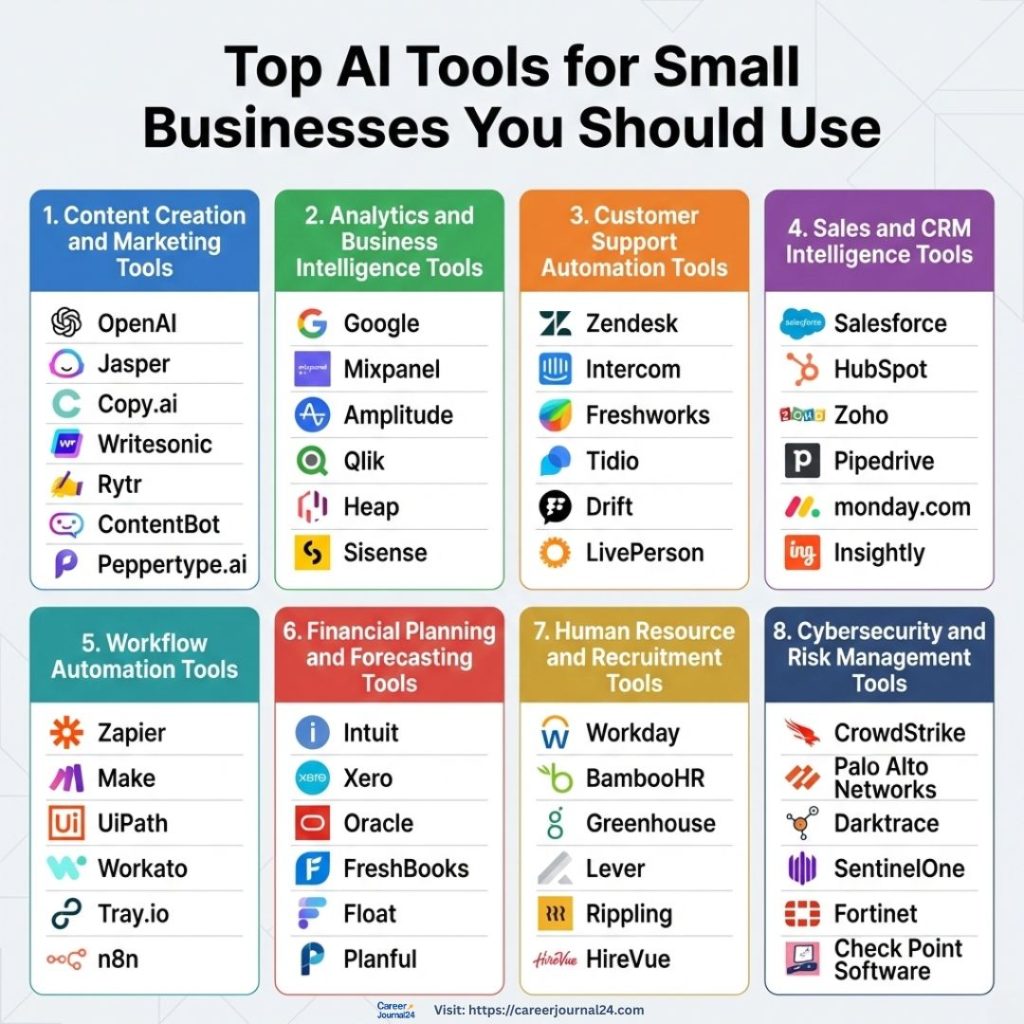
Popular tools include:
2. Analytics and Business Intelligence Tools
Modern businesses rely heavily on data, but interpreting large datasets manually is difficult. AI analytics platforms transform raw information into visual insights that support better decision making. Managers can track customer behavior, marketing performance, and operational efficiency in real time. Companies respond faster to market changes and improve strategies continuously. Analytics tools allow even small teams to operate with data intelligence similar to large corporations. Businesses adopting analytics solutions gain agility and competitive advantages, enabling smarter operational and strategic decisions.
Popular tools include:
3. Customer Support Automation Tools
Customer support teams often handle repetitive questions daily, which slows response times and increases staffing needs. AI support automation tools help businesses provide instant replies through chatbots and automated service workflows. Customers receive quicker assistance, while human agents focus on complex cases. Automated systems operate 24 hours, improving service consistency and customer satisfaction. Businesses benefit by reducing workload while maintaining professional service standards. Faster responses lead to better customer experiences, which directly influence loyalty and repeat purchases.
Popular tools include:
4. Sales and CRM Intelligence Tools
Sales success often depends on identifying the right prospects and managing relationships effectively. AI-enhanced CRM tools help businesses analyze customer interactions and predict purchase behavior. Sales teams can prioritize leads more accurately, improving conversion rates and reducing wasted effort. These systems also automate follow-ups and track customer engagement patterns. Companies benefit from smarter sales pipelines and improved retention strategies. Even small businesses can now operate with enterprise-level customer intelligence, helping them compete more effectively while strengthening long-term client relationships.
Popular tools include:
5. Workflow Automation Tools
Many operational processes repeat daily, from approvals and notifications to data transfers between apps. Workflow automation tools connect software systems and allow tasks to run automatically. Employees save time while reducing mistakes caused by manual work. Automation ensures consistency across departments, especially as companies grow. Businesses benefit by maintaining productivity without expanding administrative teams. Automation also improves transparency because processes follow defined workflows. Companies implementing automation tools often notice improved operational speed and smoother coordination between teams.
Popular tools include:
6. Financial Planning and Forecasting Tools
Financial decisions guide business survival and expansion. AI financial tools analyze historical data to forecast revenue trends, expenses, and cash flow patterns. Business owners gain clearer visibility into financial health and future risks. Retailers, for example, can predict seasonal demand and avoid overstocking or stock shortages. Financial forecasting tools also help businesses prepare budgets more accurately. Small companies particularly benefit because they gain financial intelligence without hiring large accounting teams. Better financial planning reduces risks and supports confident business growth decisions.
Popular tools include:
7. Human Resource and Recruitment Tools
Hiring and employee management require significant administrative effort. AI-driven HR tools automate resume screening, interview scheduling, and candidate evaluation. Businesses save time while improving hiring accuracy. Some tools also analyze employee engagement and predict turnover risks. Smaller companies without dedicated HR departments benefit greatly from automation. Recruitment becomes faster, and workforce management becomes more data-driven. Businesses can build stronger teams while minimizing manual administrative workload, improving both hiring efficiency and employee retention strategies.
Popular tools include:
8. Cybersecurity and Risk Management Tools
As companies digitize operations, security risks increase. AI cybersecurity tools continuously monitor systems to detect suspicious behavior and prevent data breaches. Early threat detection helps businesses avoid financial losses and protect customer information. Small businesses especially benefit because they often lack dedicated security teams. Automated protection ensures safer operations while maintaining customer trust. Security tools are increasingly important as cyber threats become more sophisticated. Companies investing in AI security systems strengthen operational resilience and reduce risks associated with digital business environments.
Popular tools include:
Why Use AI Search Optimization Tools for Your Business
Online visibility has become critical for business growth, and search engines often determine whether customers discover a company or its competitors. AI-powered search optimization tools help businesses understand how customers search online and how websites can rank better in search results. These tools simplify complex SEO processes by providing data-driven insights and automated recommendations. Companies using AI SEO solutions can improve website performance, attract organic traffic, and generate leads without relying solely on paid advertising. Understanding how AI improves search optimization allows businesses to build stronger digital presence and sustainable long-term marketing success.
1. Improved Keyword Discovery
AI-powered search optimization tools help businesses discover search terms customers actually use. Instead of guessing keywords, companies access real data showing search demand patterns. This improves website visibility because content aligns with customer intent. For example, small businesses can target location-specific search queries to attract nearby customers. Better keyword discovery leads to higher website traffic and improved conversion opportunities. Businesses that optimize content strategically gain consistent online visibility. AI tools simplify this process, allowing even non-technical entrepreneurs to compete effectively in digital search results without complex SEO expertise.
2. Smarter Content Optimization
Creating content that satisfies both human readers and search algorithms is a delicate balancing act that requires constant refinement. Modern optimization tools analyze your web pages to provide specific suggestions on how to improve readability, structure, and keyword placement without making the text feel robotic or over-optimized. These systems understand the nuance of language and can help you adjust your tone to better match what search engines are looking for in a top-ranking result. By following these automated recommendations, you can ensure that your expertise is presented in a way that is easily discoverable by your target audience. This is especially helpful if you are learning how to start an at-home business and need to build authority from scratch.
3. Competitor Analysis Advantages
Understanding competitor strategies helps businesses identify growth opportunities. AI SEO tools analyze competing websites, revealing ranking keywords and content gaps. Companies can then create improved content to capture audience attention. For example, an online store may discover competitors rank for product comparison guides and create better alternatives. Competitor analysis supports smarter marketing decisions rather than blind experimentation. Businesses using AI-driven analysis tools gain strategic advantage by targeting opportunities overlooked by others. This proactive approach improves search rankings and customer acquisition potential over time.
4. Performance Tracking Automation
SEO success requires continuous monitoring, which becomes time-consuming manually. AI tools automate performance tracking by monitoring keyword rankings, website traffic, and engagement metrics. Businesses receive regular insights showing progress or necessary adjustments. For example, declining rankings trigger alerts, enabling quick corrective action. Automated tracking prevents unnoticed performance drops. Companies benefit by maintaining consistent visibility in search results. AI simplifies complex SEO monitoring tasks, allowing business owners to focus on strategy rather than technical tracking details while ensuring long-term marketing effectiveness.
5. Local Search Optimization Support
Local businesses depend heavily on location-based search visibility. AI SEO tools help optimize business listings, reviews, and local search content automatically. Restaurants, clinics, and service providers benefit from appearing prominently in nearby searches. For instance, tools help maintain consistent business information across directories, improving credibility. Better local visibility increases customer foot traffic and inquiries. AI support simplifies local SEO management for small business owners who lack technical marketing knowledge. This advantage allows local companies to compete effectively with larger brands within their communities.
6. Continuous Optimization Insights
Search algorithms change frequently, making optimization complex. AI tools continuously analyze search performance and suggest improvements based on new trends. Businesses stay updated without manually studying algorithm updates. For example, content updates may be recommended to maintain rankings. Continuous optimization ensures websites remain competitive despite evolving search conditions. Companies using AI tools benefit from adaptive strategies that maintain online visibility over time. This ongoing improvement cycle supports long-term digital marketing success, making AI SEO tools increasingly valuable for businesses relying on organic search traffic.
How to Choose the Right AI Tools for Your Business
With countless AI tools available, selecting the right solutions can feel overwhelming for business owners and managers. Not every tool suits every organization, and poor choices often lead to wasted budgets and low adoption among employees. Successful AI implementation begins with understanding operational priorities, evaluating usability, and ensuring tools align with long-term business goals. Decision-makers must balance affordability, scalability, and measurable impact before investing. By approaching AI adoption strategically rather than impulsively, businesses can implement technology that delivers real value while supporting growth without disrupting existing workflows.
1. Define Specific Operational Needs
The market is currently flooded with flashy technology, making it easy to fall into the trap of over-subscription. Before looking at top ai tools for business, you must clearly define the problem you are trying to solve. Are you looking to save time on administrative tasks, or do you need to improve the quality of your marketing output? A tool that does not solve a documented pain point is simply a distraction that will eventually lead to wasted budget. Start by listing your top three weekly frustrations and look for a solution that specifically addresses those issues with minimal complexity. Focusing on utility over hype is the only way to build a functional tech stack.
2. Evaluate Ease of Implementation
Many businesses struggle with complex software requiring technical expertise. Choosing AI tools that integrate easily with existing systems reduces adoption resistance. Tools offering simple onboarding and minimal training requirements accelerate results. For example, marketing automation platforms that connect seamlessly with email systems reduce setup complications. Ease of implementation directly influences employee acceptance and operational efficiency. Businesses benefit from selecting solutions aligned with team capabilities rather than requiring major workflow changes. Practical adoption strategies ensure technology investments deliver value quickly without creating operational confusion or unnecessary technical dependencies.
3. Assess Cost Versus Value
Budget considerations remain critical for businesses exploring new technologies. Decision-makers should evaluate potential savings or revenue growth against tool costs. For example, automation tools reducing hiring needs may justify subscription expenses. Cost-benefit analysis ensures sustainable investment decisions. Businesses should avoid adopting tools purely because competitors use them. Instead, evaluating tangible business impact helps prioritize investments wisely. Companies balancing affordability with measurable value achieve better financial outcomes. Smart financial planning ensures AI adoption contributes positively to business growth rather than becoming an unnecessary operational expense.
4. Start With Scalable Solutions
Businesses evolve over time, and chosen tools should support growth rather than limit expansion. Scalable AI solutions accommodate increasing customer volumes and operational complexity without requiring replacement. For example, CRM systems capable of handling growing customer databases prevent migration challenges later. Companies benefit from selecting tools adaptable to future needs. Scalability protects technology investments while ensuring operational continuity. Businesses planning ahead reduce disruption caused by software limitations. Choosing scalable AI tools ensures long-term success while supporting evolving business goals and expansion opportunities.
5. Monitor Performance and Adjust
Adopting AI tools should not end with implementation. Businesses must regularly evaluate performance improvements and adjust usage strategies accordingly. Monitoring ensures tools deliver expected results and remain aligned with operational objectives. For instance, marketing automation effectiveness should be reviewed through engagement metrics. Continuous evaluation prevents dependency on underperforming solutions. Companies benefit by optimizing technology usage over time. Regular performance reviews encourage smarter decision-making and adaptation. This approach ensures AI adoption remains beneficial while supporting evolving business needs and maintaining operational effectiveness.
The Future of AI Tools for Small Business Owners
The future of AI tools for small business owners looks increasingly practical rather than complex. Emerging solutions are becoming easier to use, requiring minimal technical knowledge while delivering advanced capabilities. Voice-driven assistants, predictive analytics, and automated decision-making systems will soon become standard features in business operations. Small companies will gain access to tools once reserved for multinational corporations. As AI integrates deeper into daily workflows, business owners will spend less time managing operations and more time focusing on innovation and customer relationships. Those adopting AI early will gain competitive advantages that strengthen their long-term market position.
Conclusion
The rise of ai tools for business represents one of the most significant opportunities for entrepreneurs in the modern era. We have transitioned from a time of manual repetition to a time of strategic orchestration. By utilizing the categories and tools discussed, you can build a more resilient, efficient, and profitable organization that is ready for the challenges of 2026. The key is to start small, focus on solving real problems, and always keep the human element at the center of your strategy. The future is bright for those who are willing to pick up the tools and build it.