
The True Meaning of Constructive Criticism
We all face feedback at some point; at work, in relationships, or even from strangers online. But not all feedback hurts. Some of it actually helps us grow. That’s where understanding the constructive criticism meaning becomes important. In simple terms, constructive criticism is feedback that is meant to improve, not to insult. It highlights what can be better while still respecting the person receiving it.
Constructive criticism is feedback designed to help someone improve by offering specific, actionable suggestions alongside identifying areas that need work. Unlike vague complaints or personal attacks, it focuses on behaviors and outcomes rather than character traits, and it’s delivered with genuine care for the recipient’s development.
In this guide, we’ll explore what constructive criticism really means, how to give and receive it effectively, and why it’s one of the most valuable skills you can develop. Whether you’re looking to improve your teamwork, enhance your leadership, or simply grow as a person, learning to handle constructive criticism with grace and insight is essential. We’ll also look at the benefits of constructive criticism, how it differs from destructive criticism, and share real-life examples for peers to help you apply these ideas in everyday situations. Plus, we’ll wrap up with some quotes to inspire and guide your approach.
What Exactly Does Define Constructive Criticism?
To truly define constructive criticism, we need to break down its essential components. It’s not just about what you say, but how you say it and why you’re saying it.
Constructive criticism has four key elements:
First, it’s specific rather than general. Instead of saying “your presentations need work,” constructive criticism would sound like “your slides had great content, but adding more visual elements could help your audience stay engaged during longer sections.”
Second, it’s balanced. Good constructive criticism acknowledges what’s working while addressing what needs improvement. This isn’t about sugarcoating; it’s about giving an honest, complete picture.
Third, it’s actionable. The person receiving the feedback should walk away knowing exactly what they can do differently. Vague suggestions like “be better” don’t qualify as constructive.
Finally, it’s delivered with positive intent. The goal is genuinely to help someone grow, not to make them feel small or to prove how smart you are. According to research from Harvard Business Review, feedback delivered with genuine care is significantly more likely to result in actual behavioral change. When you combine these elements, you create feedback that feels like a gift rather than an attack; something that opens doors instead of closing them.
Constructive Criticism Examples for Peers
One of the trickiest situations is giving constructive criticism examples for peers; people who are your equals rather than your managers or subordinates. The power dynamic is different, and there’s often fear of damaging the relationship.
A. The Missed Deadline Scenario
Instead of: “You’re always late with your parts of the project, and it’s making everyone look bad.” Try:
“Hey, I noticed the design files came in a day later than we’d planned. It put us in a tight spot for the client deadline. Could we check in at the midpoint next time so we can troubleshoot any delays early?”
This approach acknowledges the problem without attacking the person, and it offers a concrete solution for future collaboration.
B. The Meeting Dominator
Instead of: “You talk way too much in meetings and never let anyone else contribute.” Try:
“You always have great insights in our team meetings. I think we’d benefit from hearing from some of the quieter team members too. Maybe we could try going around the table for input on major decisions?”
Here, you’re recognizing their contributions while gently pointing toward more inclusive behavior.
C. The Quality Issue
Instead of: “This report is sloppy and full of errors.” Try:
“I was looking at the quarterly report, and I found a few data points that don’t match our source documents. Want to grab coffee and review it together? I find a second set of eyes always catches things I miss in my own work.”
This frames it as a collaborative fix rather than a personal failing, and the acknowledgment that everyone makes mistakes reduces defensiveness.
D. The Communication Gap
Instead of: “You never communicate what you’re working on.” Try:
“I’ve realized I don’t always know what you’re focusing on until projects are almost done, which sometimes leads to duplicated effort. Would you be open to a quick weekly sync-up? Just 15 minutes to make sure we’re aligned?”
You’re identifying the impact of the behavior rather than making it about their character, and you’re proposing a specific solution.
E. The Vague Idea/Pitch
Instead of: “Your proposal was too vague; you need to do better research.” Try:
“That’s a truly exciting concept you pitched! To move it forward, I noticed we’re missing a clear timeline and a breakdown of the required resources. Could you spend some time adding specific milestones and an estimated budget to the document? That will make it easier for leadership to greenlight.”
This acknowledges the value of the idea first (the positive), then clearly states the missing components (the behavior), and explains why they are needed (the impact: easier approval), providing clear steps for refinement.
F. The Technical Oversight
Instead of: “You totally messed up the formatting on the website update.” Try:
“When I reviewed the new website copy, I noticed that the mobile version of the page has a formatting break that pushes the images out of alignment. Since most of our traffic is mobile, this really affects the user experience. Do you mind checking the CSS properties for that section? I can send you a screenshot of the issue if that helps!”
This uses specific, objective evidence (mobile formatting break) and directly connects the oversight to the business goal (user experience/traffic), making the feedback undeniable and technically focused rather than personal.
Constructive vs Destructive Criticism: Understanding the Difference
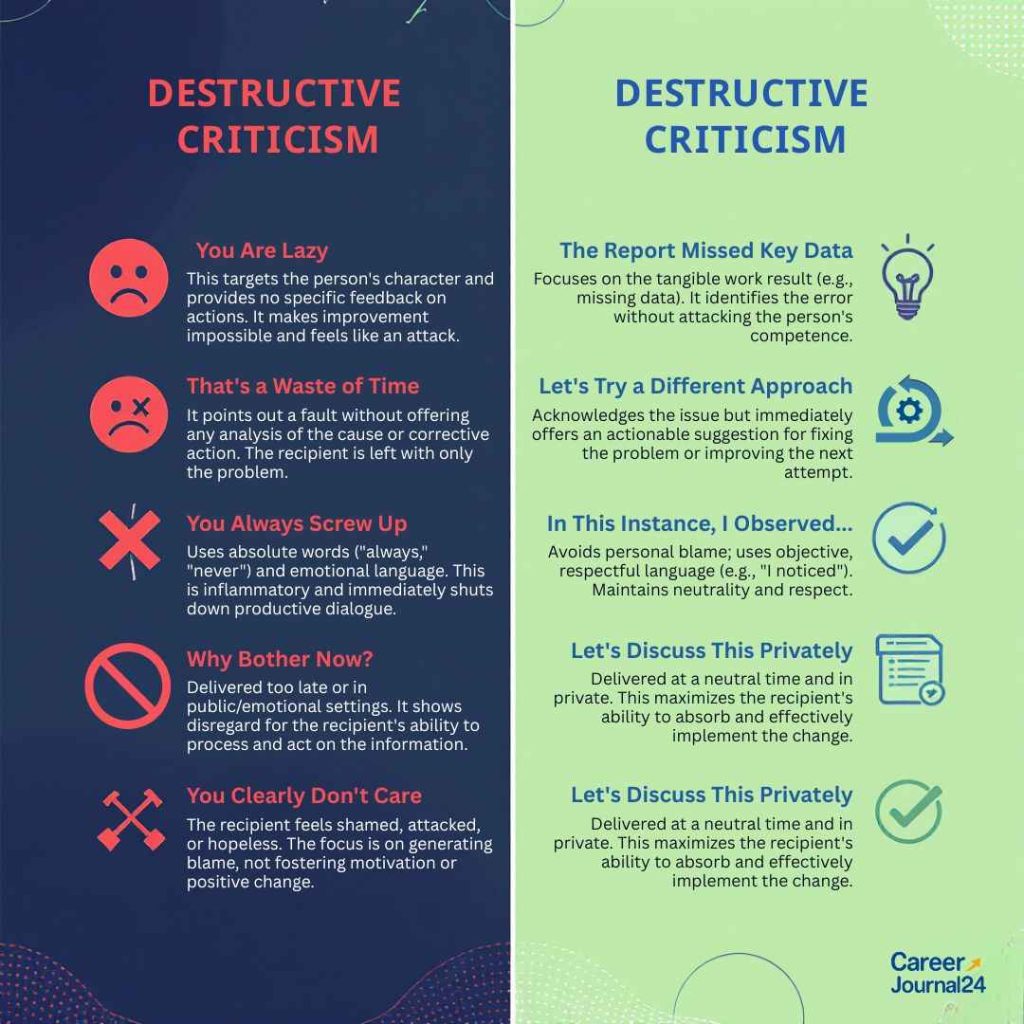
The line between constructive vs destructive criticism might seem obvious, but in practice, it can be surprisingly blurry. Understanding this distinction is crucial whether you’re giving or receiving feedback. Here are five key differences between constructive and destructive Criticism
a) Focus on Behavior vs. Character
Destructive criticism often targets who you are, using language that feels personal and judgmental. Phrases like “you’re lazy” or “you’re clueless” attack your character rather than the specific actions or outcomes. Constructive criticism, on the other hand, focuses on the specific behavior or result. Instead of saying “you’re bad at this,” it might say “the report missed several key data points that were essential for the client’s decision.”
b) Offer Solutions vs. Just Point Out Problems
One of the clearest indicators of destructive criticism is that it rarely offers any path forward. It’s all about pointing out what’s wrong without suggesting how to fix it. Constructive criticism, by definition, includes actionable suggestions. It doesn’t just say “this didn’t work”; it says “here’s how we could try a different approach next time.”
c) Tone and Language
Destructive criticism often uses emotionally charged language that feels harsh and personal. Words like “always,” “never,” or “you screw up” carry a tone of blame and judgment. Constructive criticism uses neutral, specific language that focuses on observations rather than personal attacks. It might say “in this instance” instead of “you always…”
d) Timing and Context
Destructive criticism often comes at the worst possible moments; delivered publicly, during moments of high emotion, or piled on long after the opportunity to change has passed. Constructive criticism respects the setting and the moment, recognizing that how we deliver feedback can matter as much as the content itself. It often comes at a neutral time, in private, and when the recipient is most likely to process and act on it.
e) Impact on the Recipient
This is perhaps the most telling difference. Destructive criticism typically leaves the recipient feeling defensiveness, shame, or hopelessness. It creates a sense of being attacked rather than helped. Constructive criticism, when delivered correctly, actually motivates the recipient to improve. It creates a sense of being supported and equipped to make positive changes.
The Benefit of Constructive Criticism
We often focus on the discomfort of receiving critique, overlooking the tremendous upside. Explain the benefit of constructive criticism by shifting the perspective from a threat to an opportunity. In our daily lives, whether at work, in a personal project, or even in a relationship, constructive feedback acts as a mirror, showing us blind spots we can’t see ourselves. Embracing this feedback loop is what separates those who plateau from those who experience continuous, upward growth.
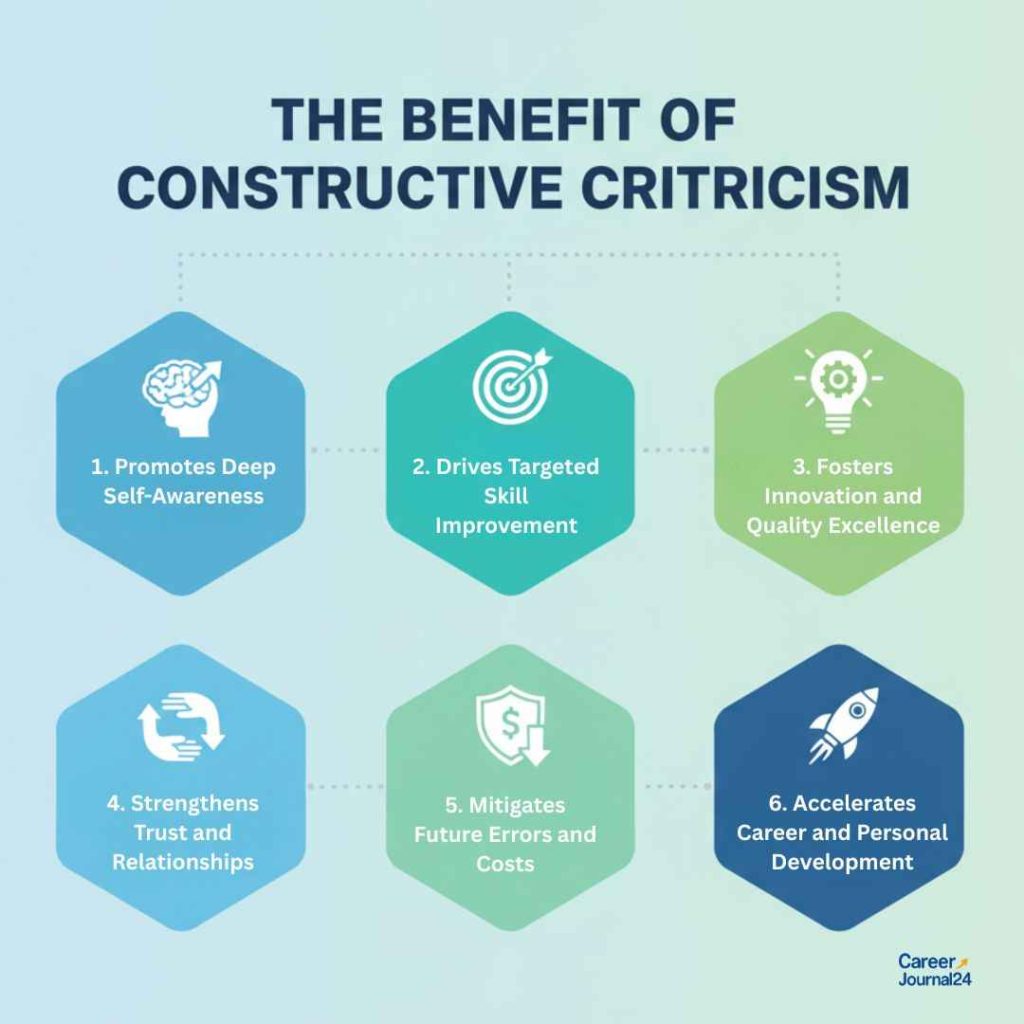
1. Promotes Deep Self-Awareness
It’s nearly impossible to see your own flaws, habits, or behavioral patterns when you’re caught up in the action. Constructive criticism acts as a crucial external perspective, illuminating your blind spots. For example, you might think your detailed emails are thorough, but a colleague’s observation that they are too long and cause readers to skim highlights a critical area for improvement in communication efficiency. This feedback isn’t a judgment on your intelligence; it’s an invaluable piece of self-knowledge that highlights specific behaviors or skills, like speaking speed, delegation, or time management, that are currently holding back your full potential. Without this outside view, true growth is limited.
2. Drives Targeted Skill Improvement
Vague goals like “be a better leader” or “improve my writing” rarely lead to concrete results. Constructive criticism transforms these ambiguous aspirations into direct, actionable items. Imagine you’re learning to code. An expert pointing out that your loops are inefficient and suggesting a specific optimization technique provides an immediate, measurable challenge. Similarly, if your manager says your meeting summaries lack clear next steps, that is a direct instruction to focus on the “Action Items” section of your notes. This process turns generalized desire into concrete, achievable steps, ensuring your energy is spent on fixing the root cause of the problem, not just the symptoms.
3. Fosters Innovation and Quality Excellence
No matter how brilliant an idea is, it can always be refined. When an individual or a team truly embraces constructive feedback, they stop settling for “good enough” and start aiming for excellence. Criticism, when channeled correctly, creates a culture where challenging the status quo is encouraged. If a designer receives feedback that their color palette doesn’t resonate with the target audience, that critique pushes them to research and innovate a better, more effective solution. It’s a mechanism for continuous quality control that ensures products, processes, and presentations are not only delivered but are delivered at the highest possible standard, keeping the team competitive and relevant.
4. Strengthens Trust and Relationships
When feedback is delivered with empathy and received with an open mind, it becomes a powerful relationship-builder. It signals that both parties are invested in the shared goal of success, whether that goal is completing a complex project deadline or maintaining a healthy partnership. Giving feedback shows the other person you care enough about them and the relationship to be honest. Receiving it well shows them you value their input and respect their perspective. This level of communication fosters psychological safety, which is the bedrock of high-performing teams, where people feel safe enough to take risks and admit mistakes without fear of retribution.
Consider checking out How to Deal With Gossip at Work Without Losing Your Peace for more on maintaining a healthy communication culture.
5. Mitigates Future Errors and Costs
Addressing a small issue today prevents a massive, costly disaster tomorrow. Constructive criticism is an early warning system. By catching flaws in a prototype, a process, or a pitch before it’s launched, you save significant resources; time, money, and reputation. For instance, receiving feedback from a client on a draft contract’s ambiguity is much better than dealing with a lawsuit later. This kind of preemptive critique is essentially risk management in action. It institutionalizes learning, ensuring that the same mistakes aren’t repeated across different projects or by different team members, leading to sustained operational efficiency.
6. Accelerates Career and Personal Development
Individuals who actively solicit and effectively apply constructive criticism are the ones who ascend the fastest. By treating feedback as a personal development plan, you demonstrate humility, resilience, and a powerful growth mindset; all key traits employers seek in leaders. If you consistently show that you can take negative input, process it maturely, and turn it into positive change, you build a reputation as someone who is highly coachable and deeply committed to continuous improvement. As one expert put it, “Feedback is a gift,” which truly captures the spirit of this interaction; accepting it is the key to unlocking the next level of your career.
How to Handle Constructive Criticism Professionally
Knowing how to handle constructive criticism is genuinely a superpower. It’s uncomfortable, there’s no getting around that, but your thoughtful response to feedback can determine your trajectory in almost any area of life, from your career to personal relationships.
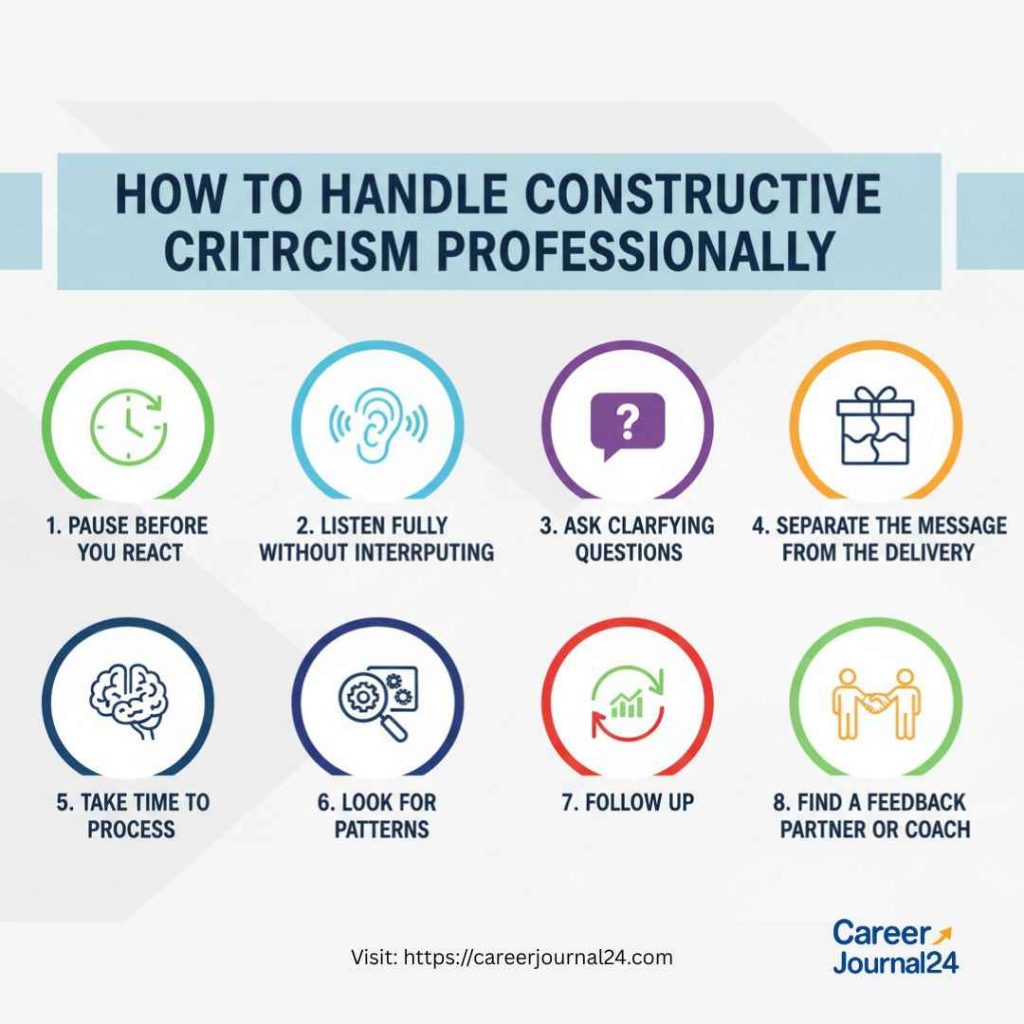
1. Pause Before You React
Your brain’s first response to criticism is often defensive; that’s normal human biology designed to protect your ego. The key is not letting that initial, knee-jerk reaction control your response. Take a breath. Count to three. This tiny, deliberate pause creates a critical psychological space between the feedback and your verbal reaction, allowing your rational, objective brain to catch up with your emotional one. Instead of firing back a justification, you give yourself the momentary grace required to shift into a receiving, learning mindset.
2. Listen Fully Without Interrupting
This is harder than it sounds. Most of us, while appearing to listen, are actually busy formulating our defense or planning a rebuttal before the other person even finishes talking. Resist that urge. Listen to understand, not to respond. Let the giver fully explain their perspective without interruption. If you’re in a meeting or receiving detailed verbal feedback, take notes. This physically occupies your nervous energy, signals that you are taking the feedback seriously, and provides an invaluable record for later processing, ensuring you don’t miss key details.
3. Ask Clarifying Questions
If something isn’t clear, you must ask. Confusing or vague feedback (“You need to be more proactive”) is impossible to act on. Asking clarifying questions is not a defensive maneuver; it’s a sign of maturity and a request for the specific, concrete information you need to actually improve. Ask: “Can you give me an example of when I did that?” or “What would success look like in this area?” and “What specific step do you suggest I take first?” These questions transform vague critiques into actionable items.
4. Separate the Message from the Delivery
Sometimes valuable feedback comes wrapped in clumsy, rude, or poorly timed packaging. Your manager might be stressed and deliver their critique with a harsh tone, but their underlying point about your tendency to overpromise and underdeliver might still be entirely valid. A poor delivery does not invalidate a worthy message. Try to mentally filter the helpful information from the unhelpful emotion or personal jabs. Your focus should be on extracting the useful kernel of truth that can drive your personal growth, even when the delivery isn’t perfect.
5. Take Time to Process
You don’t need to respond immediately, especially to written feedback. It’s completely acceptable to say, “Thank you for this feedback. I need some time to think about it, and I’ll follow up with you tomorrow.” This prevents defensive reactions and gives you space to consider the feedback objectively.
6. Look for Patterns
If you hear the same criticism from multiple sources, pay attention. One person might have a unique perspective or bias, but when three different people independently mention your tendency to miss deadlines, it’s probably worth addressing.
7. Follow Up
Circle back with the person who gave you feedback after you’ve had time to work on it. “Remember when you mentioned I should speak up more in meetings? I’ve been making an effort, and I wanted to check in, have you noticed any difference?” This shows you took their input seriously and reinforces the value of giving you honest feedback.
8. Find a Feedback Partner or Coach
Sometimes, the difficulty lies not in the quality of the feedback, but in the lack of a system to implement and track changes. Identify a trusted mentor, colleague, or coach who is committed to your growth. This person can act as a neutral third party to help you deconstruct tricky feedback, provide objective input on the validity of the critique, and hold you accountable for the changes you commit to making. Having a dedicated accountability partner transforms the lonely, defensive experience of receiving criticism into a team effort toward self-improvement.
Constructive Criticism Quotes to Remember
Sometimes a well-phrased thought can shift your entire perspective on feedback. Reflecting on constructive criticism quotes can change your mindset about receiving and giving feedback, distilling complex ideas into simple, motivational truths.
“Criticism, like rain, should be gentle enough to nourish a person’s growth without destroying their roots.” — Frank A. Clark
“I think it’s very important to have a feedback loop, where you’re constantly thinking about what you’ve done and how you could be doing it better.” — Elon Musk
“We all need people who will give us feedback. That’s how we improve.” — Bill Gates
“The greatest gift you can give someone is the gift of honest feedback delivered with care.” — Unknown
“The final wisdom of life is for us to be cured of madness by the criticism of a friend.” — Michel de Montaigne
“If you are not willing to receive criticism, you are not willing to be truly successful.” — Unknown
“We need constructive criticism, for it is the only way we will ever improve.” — H. H. Swami Tejomayananda
“You must be strong enough to accept constructive criticism and wise enough to disregard negative attack.” — Unknown
“Seek out strong criticism of your plans and ideas. The first principle is that you must not fool yourself, and you are the easiest person to fool.” — Richard Feynman
“The key to growth is the introduction of higher-order ideas into the system. Constructive criticism is that mechanism.” — W. Edwards Deming
Final Thoughts
Understanding the true constructive criticism meaning can change the way you experience feedback forever. When used with care and received with maturity, it becomes one of the most powerful tools for growth, confidence, leadership, and emotional intelligence.
We explored how to define constructive criticism, how to handle it without feeling attacked, how it differs from destructive criticism, its benefits, real-life examples for peers, and inspiring constructive criticism quotes. The next time feedback comes your way, pause before resisting it. There might be a powerful lesson hiding inside the discomfort.
FAQs
Constructive criticism is feedback that aims to help someone improve by offering specific, actionable suggestions alongside identifying areas that need work. Unlike vague complaints or personal attacks, it focuses on behaviors and outcomes rather than character traits, and it’s delivered with genuine care for the recipient’s development.
Good examples of constructive criticism are those that are specific, balanced, and actionable. For instance:
1. Instead of saying, “Your presentation was boring,” try: “Your slides had great content, but adding more visual elements could help your audience stay engaged during longer sections.”
2. Instead of saying, “You’re always late,” try: “I noticed you were 15 minutes late to our meeting today. Would setting a timer for your prep work help you stay on track?”
Five powerful words to use in constructive criticism are:
Specific – Focus on particular behaviors or outcomes rather than generalities.
Balanced – Acknowledge what’s working while addressing what needs improvement.
Actionable – Offer clear steps the person can take to make changes.
Respectful – Deliver feedback with kindness and consideration for the recipient’s feelings.
Supportive – Frame the feedback as a way to help, not to criticize or belittle.
The 3 C’s of constructive feedback are:
Clear – Be specific about what you’re addressing and why it matters.
Kind – Deliver feedback with empathy and respect, focusing on growth rather than blame.
Corrective – Offer concrete suggestions for how the person can improve.
To give constructive criticism without sounding harsh, focus on using “I” statements, avoid absolute words like “always” or “never,” and frame your feedback as an opportunity for growth. For example: “I felt the meeting could have been more engaging. What if we added a quick Q&A session to involve everyone?”
Avoid personal attacks, vague language, and public criticism. Don’t say things like, “You’re terrible at this,” or “Everyone noticed your mistake.” Instead, focus on specific behaviors, offer solutions, and deliver feedback in a private, appropriate setting.
To receive constructive criticism positively, stay calm, listen without interrupting, and ask clarifying questions. Separate the message from your ego, and view the feedback as an opportunity to grow. Remember, the goal is improvement, not perfection.