
Top 20 Skills You Need to Secure Your Place in the 2026 AI Economy
If you feel like the world is moving faster than you can keep up, you are not alone. By 2026, artificial intelligence will no longer be a shiny new toy; it will be the utility that powers our workdays, much like electricity or the internet. The skills for the 2026 AI economy are not just about learning to code or memorizing technical jargon. They are about becoming a “human-in-the-loop” who can lead, verify, and empathize in ways that algorithms cannot.
The good news is that you don’t need to become a machine to survive. You just need to become a better human. The most valuable employees in 2026 won’t be the ones who can do what AI does; they will be the ones who can do what AI can’t.
Here is your practical, future-proof toolkit to thrive in the coming years.
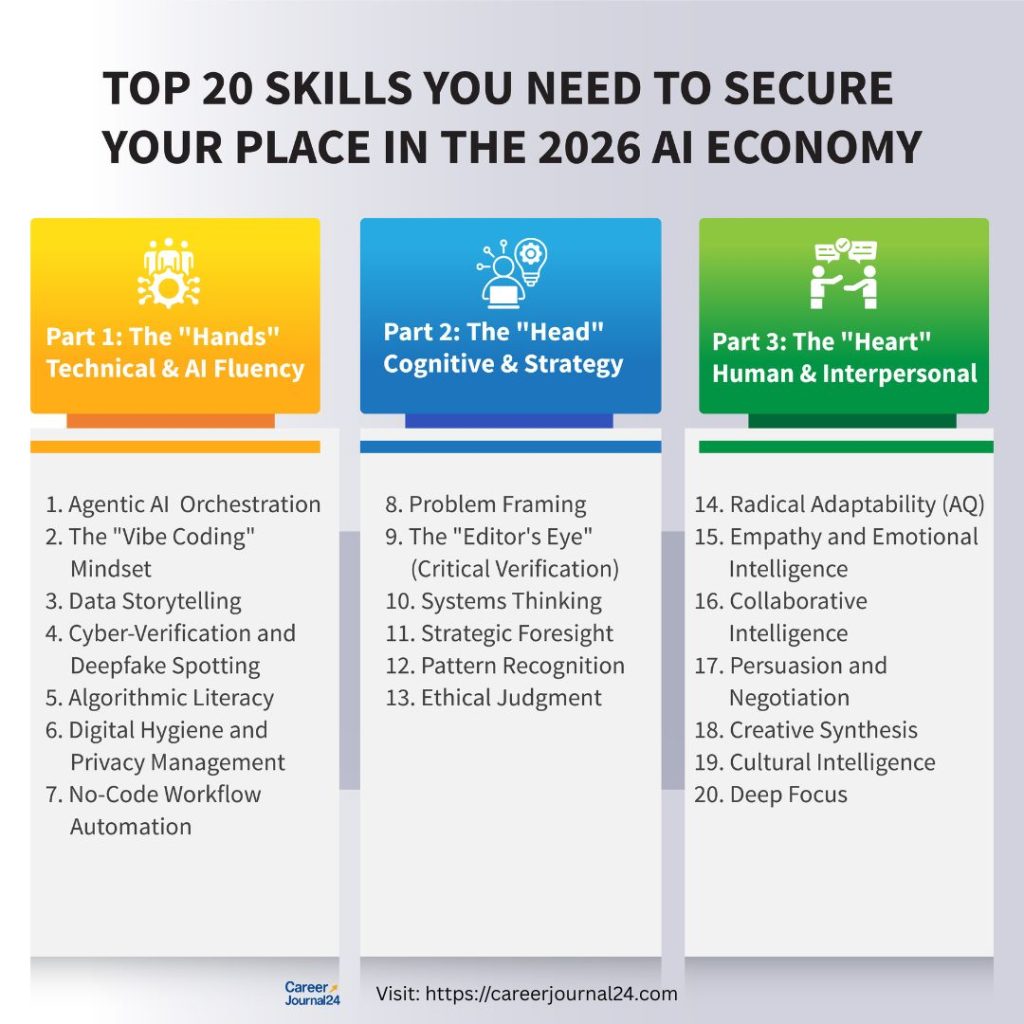
Part 1: The “Hands” – Technical & AI Fluency
These are the practical tools you need to operate the machinery of the future.
1. Agentic AI Orchestration
In the past few years, we learned “prompt engineering,” which involved asking a chatbot a single question and getting a single answer. By 2026, we will move to “Agent Orchestration.” This involves managing a team of autonomous AI agents, bots that can plan travel, write code, and answer emails all at once without you holding their hand. Your job will shift from doing the work to managing the digital workers. Think of yourself less as a writer or coder, and more as a project manager for a very fast, very literal intern. You need to know how to chain these agents together to complete complex workflows.
2. The “Vibe Coding” Mindset
You don’t need a Computer Science degree to build software anymore. “Vibe coding” is a rising trend where you use natural language to tell an AI what kind of app or automation you want, and it writes the code for you. The skill here isn’t syntax; it is clarity. Can you describe a problem so clearly that a machine can build the solution? This democratizes creation, meaning your ability to imagine a tool becomes more important than your ability to program it.
3. Data Storytelling
AI can crunch a million rows of data in seconds, but it often fails to tell you why it matters. Data storytelling is the ability to look at a complex spreadsheet and say, “Here is the insight, and here is what we should do about it.” It is the bridge between cold numbers and warm human decision-making. You must be able to visualize the data and narrate a story that stakeholders can understand, turning raw statistics into a compelling business case.
4. Cyber-Verification and Deepfake Spotting
As AI video and audio become perfect, trust will become the most expensive currency in business. You need the technical eye to spot phishing attempts, voice clones, and fake news before they cause damage. In 2026, being the person who says “Wait, let’s verify that source” will save your company millions. This involves understanding the hallmarks of synthetic media and knowing which cryptographic tools to use to verify the authenticity of a document or a person’s identity.
5. Algorithmic Literacy
You don’t need to know the complex math behind a neural network, but you must understand how it “thinks.” If you understand that AI works on probability (guessing the next word based on patterns) rather than absolute truth, you won’t be fooled when it confidently gives you a wrong answer. This literacy allows you to spot hallucinations and understand the limitations of the tools you use. It is the difference between being a passive user and being a master of the tool.
6. Digital Hygiene and Privacy Management
With AI agents reading your emails and calendar to help you, understanding data permissions is critical. You need to know exactly what data you are sharing, where it is being stored, and how to revoke access. It is about protecting your digital “house” when you have invisible guests working in it. This skill also covers managing your personal digital footprint to ensure that public AI models aren’t training on your private intellectual property.
7. No-Code Workflow Automation
This is the superpower of creating your own “easy buttons.” Tools like Zapier or Make allow you to connect your email to your to-do list or your CRM automatically. In 2026, if you are doing a repetitive task for more than 15 minutes, you are wasting time; you should be building a mini-bot to do it for you. Mastering these platforms allows you to build custom systems that fit your specific working style without waiting for the IT department to build them for you.
Part 2: The “Head” – Cognitive & Strategy
These are the thinking skills that prevent us from operating on autopilot.
8. Problem Framing
AI is an “answer engine,” but humans are the “question engines.” If you ask a generic question, you get a generic answer. The skill of 2026 is Problem Framing: the ability to diagnose the real issue before you even touch the keyboard. It is about asking “Why are we doing this?” before asking “How do we do this?” A well-framed problem is halfway solved, and AI cannot determine context or nuance well enough to frame complex business problems on its own.
9. The “Editor’s Eye” (Critical Verification)
We are entering an era of infinite content where emails, reports, and images can be generated instantly. The bottleneck is no longer creation; it is curation. You need to develop a ruthless editor’s eye. You must be the one who looks at an AI-generated strategy and says, “This looks plausible, but it lacks soul,” or “This fact is outdated.” Your value lies in your taste and your ability to separate high-quality signal from low-quality noise.
10. Systems Thinking
AI is often hyper-focused on one specific task or metric. Humans are needed to see the web of connections. Systems thinking is understanding that if you change a policy in the Marketing department, it might break a process in Customer Support. It is the ability to zoom out and see the whole board while the AI focuses on the individual pieces. This holistic view prevents “optimization traps” where fixing one thing accidentally breaks three others.
11. Strategic Foresight
The world is changing faster than ever, and relying on historical data is risky because the future looks nothing like the past. Strategic foresight is the practice of imagining multiple futures. Instead of planning for just one outcome, you ask, “What if our competitor uses AI to lower prices?” or “What if this regulation changes?” It is mental rehearsal for the unknown, allowing you to build resilient strategies that can survive different scenarios.
12. Pattern Recognition
AI is great at finding patterns in structured data, but humans are great at finding patterns in behavior and culture. You can sense when a client is hesitating, or when a team member is burnt out, simply by reading the room. This intuitive pattern recognition is something machines still struggle to replicate because they lack the full context of human history and emotion. You spot the trends that aren’t in the spreadsheet yet.
13. Ethical Judgment
An algorithm optimizes for efficiency, not fairness or morality. It might decide to fire an employee because their productivity dropped, without knowing they were sick or grieving. You need the courage and ethics to override the machine. In 2026, “Computer says no” is not an acceptable excuse for a bad decision. You must be the moral compass that ensures technology serves humanity, not the other way around.
Part 3: The “Heart” – Human & Interpersonal
These are the skills that cannot be automated. They are your competitive advantage.
14. Radical Adaptability (AQ)
Your IQ (Intelligence Quotient) matters less than your AQ (Adaptability Quotient). The tools you use today might be obsolete in six months. Can you unlearn your old habits without complaining? Radical adaptability means being comfortable with being a beginner, over and over again. It is the mental resilience to pivot your career path or learn a new workflow without succumbing to “change fatigue.”
15. Empathy and Emotional Intelligence
As machines handle the logic, the premium on emotion goes up. People want to feel heard and understood. Whether you are in sales, leadership, or support, your ability to connect with another person’s frustration or joy is your shield against automation. This is wheretransferable customer service skills become invaluable; the ability to de-escalate tension and actively listen is something a chatbot simply cannot fake authentically.
16. Collaborative Intelligence
The team of 2026 is a hybrid team: humans, remote workers, and AI agents all working together. Collaborative intelligence is the ability to facilitate smooth work between all these entities. It involves knowing when to invite a bot to the meeting to take notes, and when to kick the bot out so the humans can have a candid, private conversation. It is about maximizing the strengths of both biological and digital team members.
17. Persuasion and Negotiation
You can have the best data in the world, but you still need to convince a human to sign the check or approve the project. Persuasion is about trust, nuance, and reading the unspoken subtext of a conversation. AI can write a script, but it cannot read the room during a tense negotiation or know exactly when to pause for effect. The ability to influence others remains a uniquely human stronghold.
18. Creative Synthesis
AI is a remix engine; it combines existing ideas to create variations. Humans are synthesis engines; we combine disparate experiences, emotions, and random thoughts to create something entirely new. It is the ability to take an idea from a biology book and apply it to a business problem. This “cross-pollination” of ideas is where true innovation happens, and it requires a messy, wandering human mind to achieve it.
19. Cultural Intelligence
Work is increasingly global. You might be working with a colleague in Tokyo, a client in London, and an AI agent hosted in California. Understanding cultural nuances, how people communicate, respect hierarchy, and view time is a soft skill that prevents hard failures. An AI translation tool can translate words, but it cannot translate meaning or intent. You need cultural sensitivity to bridge those gaps.
20. Deep Focus
In an economy of distraction, focus is a superpower. With AI constantly pinging you with suggestions and notifications, the ability to disconnect and do “Deep Work” for four hours is rare and valuable. The hardest problems require sustained concentration, not multitasking. Cultivating the discipline to turn off the noise and think deeply is what will separate the leaders from the followers.
Conclusion: The “Unicorn” Employee of 2026
You do not need to master all 20 of these skills by next Tuesday. The goal is to shift your mindset. Stop trying to compete with the AI on speed or memory, you will lose. Instead, double down on your humanity.
The “Unicorn” employee of 2026 is the person who can use an AI agent to draft a report (Hands), verify the strategy for long-term risks (Head), and then present it to the client with genuine warmth and understanding (Heart).
The future isn’t about AI replacing you. It’s about you using AI to become the best version of yourself.

One Comment