
Top 50 Passive Income Ideas for Today, Tomorrow & Beyond
We live in a world where the traditional “9-to-5” is no longer the only path to financial security. You’ve likely heard the buzz, people waking up to notification bells that signal a new sale, a dividend payout, or a royalty check. This isn’t just luck; it’s the result of planting seeds today that grow into passive income ideas for the future.
Whether you are looking for passive income ideas 2026 to get ahead of upcoming trends, or just want a little extra cash flow to cover the bills, the goal is simple: disconnect your time from your money. In this piece of writing, we will explore practical, human-verified strategies tailored for everyone, from tech-savvy programmers to busy moms, so you can find the perfect fit for your lifestyle.
What Passive Income Really Is
The term “passive income” is frequently misunderstood, often conjuring images of effortless wealth. Let’s clarify its true meaning. At its core, passive income typically involves an initial period of intense effort, investment, or creation. Once established, however, it demands significantly less ongoing work to maintain and generate revenue compared to “active income”, where you directly trade your time for money, such as in a traditional job. Picture it like planting a fruit tree: you dedicate considerable effort to digging, planting, and nurturing it in the beginning. But once it matures, it consistently provides fruit with minimal additional care.
Active income, the mainstay for most working individuals, ceases the moment you stop working. Passive income aims to sever this direct correlation, establishing systems that continue to generate earnings even while you’re engaged in other activities. This crucial distinction is vital for setting realistic expectations and choosing strategies that genuinely align with your lifestyle and financial aspirations. It’s about building assets that appreciate and produce revenue, granting you greater control over your time and future.
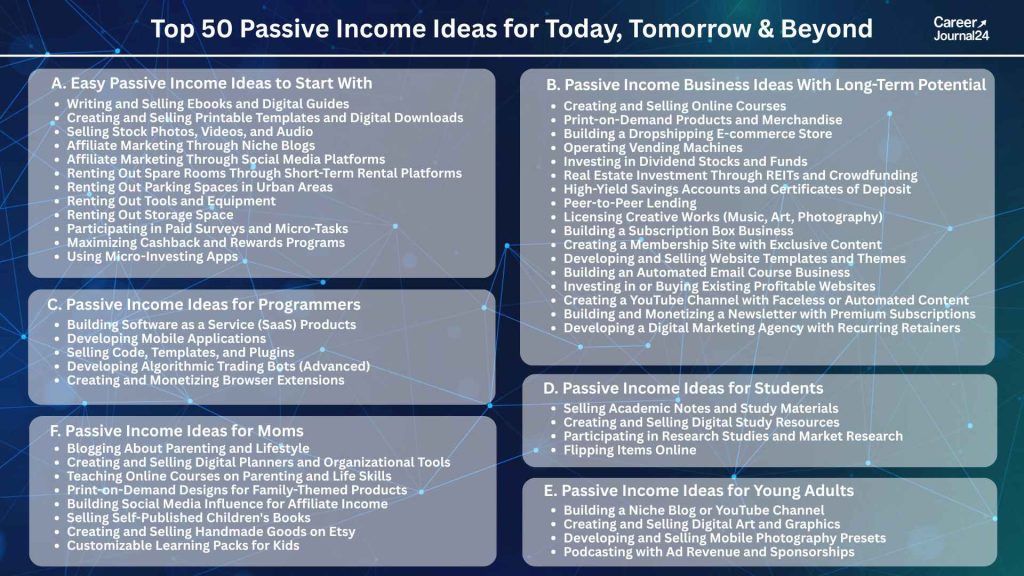
Easy Passive Income Ideas to Start With
Many people assume passive income necessitates substantial capital or advanced business acumen. While some strategies do, a wealth of easy passive income ideas can be initiated with little to no upfront investment, leveraging everyday skills. These are perfect for those new to the concept, students, or anyone looking to build supplemental income without major commitments.
1. Writing and Selling Ebooks and Digital Guides
If you possess expertise in a particular niche, whether it’s personal finance, gardening, cooking, or even a specialized hobby, transforming that knowledge into an ebook can be an incredibly lucrative venture. The process involves researching your topic thoroughly, organizing your insights into a coherent structure, and then writing the content. Once published on platforms like Amazon Kindle Direct Publishing, your ebook becomes available to millions of potential readers worldwide. A student who excelled in a challenging calculus course could compile an ultimate study guide that helps future students navigate the material. A young adult passionate about sustainable living could write a comprehensive guide on reducing food waste and living more consciously. The beauty of ebooks lies in their scalability: you write once, and the potential for sales continues indefinitely with minimal marketing effort required over time.
2. Creating and Selling Printable Templates and Digital Downloads
From elegant wedding planners and customizable budget spreadsheets to engaging social media templates and artistic wall art, the demand for digital templates is continuously growing. If you have an eye for design or strong organizational skills, platforms like Etsy and Gumroad provide accessible marketplaces to sell your creations. A young adult designing a set of aesthetically pleasing resume templates can tap into the vast job-seeking market, while a mom who has mastered the art of family organization could create customizable chore charts, meal planners, and school schedule templates that busy families gladly purchase. The initial investment is your time and creativity, but once uploaded, these products can generate sales repeatedly without additional effort.
3. Selling Stock Photos, Videos, and Audio
For those with a creative eye and some basic equipment, licensing creative work to stock media sites offers an excellent passive income opportunity. Platforms like Shutterstock, Adobe Stock, and Getty Images accept high-quality photographs, video clips, and audio files. Every time someone downloads your content, you earn a royalty fee. The key to success here is consistency and quality. Building a substantial portfolio takes time, but once established, new and existing uploads can generate income for years. A student with a passion for photography could document campus life, scenic landscapes, or everyday urban moments, while a young adult interested in videography could create footage of popular travel destinations or trending social media concepts.
4. Affiliate Marketing Through Niche Blogs
Blogging remains one of the most accessible paths to passive income through affiliate marketing. The concept is straightforward: you create a blog focused on a specific niche, such as budget technology for students, eco-friendly products for environmentally conscious consumers, or parenting hacks for new moms. Within your well-researched articles, you naturally recommend products you genuinely use and trust, embedding your unique affiliate links from programs like Amazon Associates, ShareASale, or individual company affiliate programs. When readers click your links and make purchases, you earn a commission. The initial phase requires significant effort in content creation and audience building, but once your blog gains traction, the income can become largely passive as older content continues to attract traffic and generate sales.
5. Affiliate Marketing Through Social Media Platforms
For those with engaging personalities and strong social media skills, platforms like Instagram, TikTok, and YouTube offer vast audiences for affiliate marketing. The key is building a following around a specific niche and establishing yourself as a trusted authority. Whether you’re reviewing the latest gadgets, demonstrating skincare routines, or sharing your favorite productivity tools, incorporating affiliate links into your content can generate substantial income. On Instagram, you can include links in your bio and use the “swipe up” feature (or link stickers on Stories) to direct followers to affiliate products. On YouTube, affiliate links can be placed in video descriptions. A young adult passionate about gaming could create content reviewing gaming accessories and include links to purchase those products, while a student who has discovered effective study apps could share their recommendations with their followers.
6. Renting Out Spare Rooms Through Short-Term Rental Platforms
If you have a spare room, guesthouse, or even a basement apartment that goes unused, listing it on platforms like Airbnb or Vrbo can transform that space into a consistent income generator. The process involves photographing your space attractively, writing an appealing description, and setting competitive pricing. While short-term rentals do require some active management, including guest communication, key exchanges, and ensuring the space is clean between guests, many hosts minimize their active involvement by using smart locks for self-check-in, hiring cleaning services, or working with property management companies. For moms who may already be home during the day or students living in college towns with high housing demand, this can be an excellent way to monetize unused space.
7. Renting Out Parking Spaces in Urban Areas
In densely populated urban areas, dedicated parking is a premium commodity. If you have access to a parking spot, driveway, or garage that frequently goes unused, platforms like Pavemint, SpotHero, or JustPark connect you with people seeking parking. This is particularly lucrative near stadiums, concert venues, hospitals, or business districts where parking is scarce. A student living in a city campus with limited parking could easily rent out their spot to commuters, generating passive income from an asset that would otherwise sit idle. The setup is minimal; list your space with photos and availability, and payment is typically handled automatically through the platform.
8. Renting Out Tools and Equipment
Specialized tools and equipment represent another underutilized asset that can generate passive income. Items like power tools, camping equipment, cameras, drones, and party supplies often sit unused for most of the year. Platforms like Fat Llama (now part of ShareGrid) or Loanables allow you to list these items for rent. A young adult who invested in professional photography equipment for a hobby could rent out their camera body and lenses when not using them, while a mom with a collection of party supplies for children’s birthdays could rent out decorations and favor bags to other families. The rental platforms handle the logistics, and you simply need to ensure your items are in good condition and available when requested.
9. Renting Out Storage Space
If you have unused space in your home, a basement, attic, garage, or even a large closet, it can be valuable to someone needing storage. Platforms like Neighbor or StoreMyBoat connect people with extra space to those needing storage for items ranging from furniture and boxes to boats and RVs. This is particularly effective if you live in an area where storage units are expensive or scarce. A mom with an empty basement could store another family’s seasonal items, decorations, or furniture during a move, while a student with extra space in their off-campus apartment could offer storage to local residents. The income is relatively passive, requiring only occasional access for the renter to retrieve or store items.
10. Participating in Paid Surveys and Micro-Tasks
While not generating substantial income, platforms that pay for surveys and micro-tasks offer an easy way to earn small amounts of passive income during downtime. Sites like Survey Junkie, Swagbucks, Amazon Mechanical Turk, and Clickworker pay users to share their opinions, complete small online tasks, or test websites. The pay per task is typically modest, but the barrier to entry is very low; anyone with an internet connection can sign up and start earning. A student between classes or waiting for a ride could complete several surveys, while a mom folding laundry could listen to paid research requests. While this won’t replace a full income, it can provide extra spending money or help offset small expenses.
11. Maximizing Cashback and Rewards Programs
Cashback apps and credit card rewards programs offer a form of passive income on purchases you’d make anyway. Apps like Rakuten, Ibotta, and Honey automatically apply coupons or give cashback on online purchases when you shop through their platforms. Additionally, credit cards that offer generous rewards programs, whether cashback on specific categories, travel points, or dining rewards, can effectively put money back in your pocket on everyday spending. The key is choosing the right rewards program for your spending habits and consistently using the associated cards or apps. Over time, these small percentages can accumulate significantly, effectively reducing your net spending or funding other investments.
12. Using Micro-Investing Apps
Micro-investing apps like Acorns, Stash, and Betterment make investing accessible even to those with minimal capital. These platforms typically round up your purchases to the nearest dollar and invest the difference in diversified portfolios of stocks and bonds. For example, if you spend $3.50 on coffee, the app rounds up to $4.00 and invests the extra $0.50. Over time, these small amounts compound into meaningful savings. Some apps also offer fractional shares, allowing you to purchase portions of expensive stocks. For students or young adults just starting their financial journey, micro-investing is an excellent way to build the habit of saving and investing without requiring large initial sums.
Passive Income Business Ideas With Long-Term Potential
For those ready to invest more upfront effort for potentially greater and more scalable returns, building a passive income business can be incredibly rewarding. These models often involve creating systems or products that can serve a large customer base simultaneously, with many incorporating strategic investment approaches for sustained wealth building.
13. Creating and Selling Online Courses
Online courses represent one of the most scalable passive income models available. The process involves identifying a topic where you have expertise, planning a comprehensive curriculum, and then creating the content, typically a combination of video lectures, written materials, quizzes, and downloadable resources. Platforms like Udemy, Skillshare, Teachable, and Thinkific provide the infrastructure to host your course, handle payments, and reach a global audience. A programmer could create a course on a specific programming language or framework, while a mom could develop a course on efficient meal prepping for busy families. The initial investment of time can be substantial, recording, editing, and polishing the content, but once published, a well-designed course can generate income for years with minimal ongoing maintenance. The key to success is choosing a topic with genuine demand and creating high-quality, valuable content that solves a real problem for students.
14. Print-on-Demand Products and Merchandise
Print-on-Demand (POD) allows you to create designs for products like t-shirts, mugs, phone cases, tote bags, and wall art without ever handling inventory or managing shipping. When a customer orders an item with your design, the POD company prints it and ships it directly to them, and you earn a commission on the sale. Popular POD platforms include Redbubble, TeePublic, Merch by Amazon, Printful, and Printify. The creative work is done once, designing appealing graphics or text, but sales can continue indefinitely. A young adult with artistic talent could create unique graphic designs, while a mom might design witty slogans about parenting or family life. To succeed in POD, it’s important to research trending niches, create original designs that resonate with specific audiences, and optimize your product listings with relevant keywords.
15. Building a Dropshipping E-commerce Store
Dropshipping is an e-commerce business model where you sell products online without ever holding inventory. When a customer places an order on your website, you purchase the item from a third-party supplier (often located overseas) who then ships it directly to the customer. Platforms like Shopify make it easy to set up an online store, while suppliers can be found through directories like SaleHoo, AliExpress, or Doba. The keys to successful dropshipping are identifying a profitable niche, selecting reliable suppliers, and investing in effective marketing to drive traffic to your store. While the day-to-day management is relatively passive once systems are in place, it does require ongoing attention to customer service, order tracking, and marketing optimization. A young adult passionate about a specific hobby could create a curated store featuring related products, leveraging their expertise to select high-quality items.
16. Operating Vending Machines
Vending machines represent a traditional but reliable passive income business. The initial investment involves purchasing the machine (new or used), stocking it with popular products, and securing a high-traffic location. Once operational, the machine generates income with minimal ongoing effort beyond periodic restocking and maintenance. The key to success is location; areas with consistent foot traffic, like office buildings, schools, hospitals, or laundromats tend to perform best. Some entrepreneurs work with location owners who provide space in exchange for a percentage of profits, reducing the need for securing your own commercial space. While not as technologically advanced as some digital options, vending machines offer tangible returns and can be scaled by purchasing additional machines in multiple locations.
17. Investing in Dividend Stocks and Funds
Dividend investing represents one of the most straightforward paths to truly passive income. When you invest in dividend-paying stocks, you receive a portion of the company’s profits, typically on a quarterly basis. These payments provide a steady stream of income that can be reinvested or used as spending money. For those who prefer diversification and less individual stock research, Dividend ETFs (Exchange Traded Funds) or mutual funds that focus on dividend-paying companies offer exposure to a basket of stocks. Examples include the SPDR S&P Dividend ETF (SDY), Vanguard Dividend Appreciation ETF (VIG), or iShares Select Dividend ETF (DVY). To get started, you can open a brokerage account with platforms like Fidelity, Charles Schwab, TD Ameritrade, or Robinhood. The income is genuinely passive, dividends are automatically deposited into your account, and the investments can appreciate over time.
18. Real Estate Investment Through REITs and Crowdfunding
Investing in real estate traditionally requires significant capital and active management, but Real Estate Investment Trusts (REITs) and crowdfunding platforms offer more accessible alternatives. REITs are companies that own, operate, or finance income-generating real estate, including apartment complexes, shopping malls, office buildings, and warehouses. They are legally required to distribute at least 90% of their taxable income to shareholders in the form of dividends, making them excellent sources of passive income. You can buy REIT shares through any brokerage account, just like regular stocks. Popular REIT ETFs include the Vanguard Real Estate ETF (VNQ) and iShares U.S. Real Estate ETF (IYR). For more direct real estate exposure, crowdfunding platforms like Fundrise, CrowdStreet, and RealtyMogul allow you to invest smaller amounts in specific properties or real estate developments, pooling your money with other investors.
19. High-Yield Savings Accounts and Certificates of Deposit
For those seeking truly passive, low-risk options to grow their savings, high-yield savings accounts and Certificates of Deposit (CDs) offer guaranteed returns with minimal effort. High-yield savings accounts, available through online banks like Ally Bank, Discover Bank, offer significantly higher interest rates than traditional brick-and-mortar banks, often 10 to 20 times higher. Your money is FDIC-insured and accessible whenever you need it. CDs require you to deposit a sum of money for a fixed period (ranging from a few months to several years) in exchange for a higher fixed interest rate. While your money is locked up for the term, CDs offer predictable returns and are insured by the FDIC. These options are ideal for building an emergency fund or parking money you won’t need immediately while earning more than a standard savings account would provide.
20. Peer-to-Peer Lending
Peer-to-peer (P2P) lending platforms like LendingClub, Prosper, and Upstart connect borrowers with individual lenders, cutting out traditional financial institutions. As a lender, you can review borrower profiles and choose to fund portions of loans that interest you, earning interest on your investment. The platforms handle the loan servicing, including collecting payments from borrowers and distributing them to lenders. The key to success in P2P lending is diversification, spreading your investments across many different borrowers to minimize the impact of any single default. While P2P lending offers higher potential returns than many traditional investments, it does carry some risk, as borrowers may default on their loans. It’s important to carefully review borrower credit scores, loan purposes, and other factors before investing.
21. Licensing Creative Works (Music, Art, Photography)
For creative individuals, licensing existing work offers an excellent path to passive income. Musicians can submit their tracks to music licensing libraries like AudioJungle, Epidemic Sound, or Artlist, which then license those tracks for use in films, TV shows, commercials, podcasts, YouTube videos, and advertisements. Every time your music is used, you earn a royalty payment. Visual artists can license their designs to companies for use on products like stationery, fabric, home decor, and merchandise through platforms or direct partnerships. Photographers can license specific photos for editorial use (in magazines, newspapers, blogs) or commercial use (in advertising, marketing materials) beyond stock photography sites. The creative work is done once, but licensing agreements can generate ongoing income whenever your work is utilized.
22. Building a Subscription Box Business
Subscription boxes have become enormously popular across numerous niches, from beauty products and snacks to books and pet supplies. The model involves curating a selection of products and delivering them to subscribers on a regular basis, monthly, quarterly, or otherwise. While the initial setup requires significant work in finding suppliers, designing packaging, and establishing logistics, successful subscription boxes can generate substantial recurring revenue. Platforms like Cratejoy provide marketplace access and subscription management tools.
The key to long-term success is creating genuine value for subscribers, offering products they couldn’t easily find or afford on their own, combined with the excitement of receiving a curated surprise. A young adult passionate about indie games could create a monthly box featuring independent tabletop games and accessories, while a mom might curate a monthly activity box for children’s crafts and educational toys. Building relationships with unique suppliers and maintaining consistent quality are essential for reducing subscriber churn and growing your customer base over time.
23. Creating a Membership Site with Exclusive Content
Membership sites offer a powerful recurring revenue model by providing exclusive content, resources, or community access behind a paywall. Unlike one-time product purchases, membership subscriptions generate consistent monthly income from active members. The content can take many forms: a library of training videos, a community forum, monthly live Q&A sessions, downloadable resources, or any combination that provides ongoing value. Platforms like MemberPress, Restrict Content Pro, or Kajabi provide the technical infrastructure to manage subscriptions and content access. A programmer could create a membership site offering advanced tutorials and code libraries, while a young adult fitness enthusiast could build a community around workout programs and nutrition guidance. The initial investment involves creating substantial content and setting up the technical infrastructure, but once established, the ongoing maintenance can be relatively minimal, allowing income to scale as member count grows.
24. Developing and Selling Website Templates and Themes
For those with web development or design skills, creating and selling website templates, WordPress themes, or landing page designs represents an excellent passive income opportunity. Businesses and individuals constantly seek professionally designed templates to quickly establish their online presence without custom development. Marketplaces like ThemeForest or TemplateMonster, provide access to large customer bases. The development work is done once, but each template can be sold repeatedly to unlimited customers. A programmer with front-end development skills could create WordPress themes for specific niches, restaurants, photographers, consultants, while a designer with UI/UX expertise could develop landing page templates optimized for conversions. Success requires staying current with design trends, ensuring cross-browser compatibility, and providing excellent customer support to maintain strong ratings and reviews.
25. Building an Automated Email Course Business
Automated email courses represent a unique hybrid of lead generation and passive income. The concept involves creating a valuable free email course that teaches a specific skill or solves a particular problem, delivered automatically to subscribers over a series of days or weeks. While the course itself is free, it positions you as an expert and builds trust with subscribers, who then become warm leads for higher-priced products or services. For example, a personal finance blogger might offer a free “5-Day Budgeting Bootcamp” via email, followed by offers for a comprehensive budgeting course, financial coaching services, or affiliate products.
Platforms like ConvertKit, MailerLite, or Drip allow you to set up automated sequences that deliver content, tag subscribers, and segment audiences for targeted offers. This model combines the passive nature of automation with the relationship-building benefits of email marketing, creating a powerful system for converting free subscribers into paying customers over time.
26. Investing in or Buying Existing Profitable Websites
Rather than building websites from scratch, some entrepreneurs choose to buy existing websites that are already generating income. This approach accelerates the passive income timeline by acquiring proven assets. Websites with established traffic, revenue, and track records can be purchased through marketplaces like Flippa, Empire Flippers, or Quiet Light Brokerage. The due diligence process is crucial, evaluating traffic sources, revenue stability, growth potential, and any risks like Google algorithm dependence. Once acquired, these websites can be optimized further, with additional content added or monetization methods improved, while existing income continues to flow. A young adult with some capital and web development skills could purchase a small niche blog, improve its SEO, add affiliate links or display advertising, and significantly increase its value before selling for a profit. This strategy requires more upfront investment than starting from scratch but can provide immediate cash flow and faster returns.
27. Creating a YouTube Channel with Faceless or Automated Content
YouTube remains one of the most powerful platforms for passive income through advertising revenue, sponsorships, and affiliate marketing. While traditional YouTube creation requires appearing on camera, a growing trend involves creating faceless channels that use animations, stock footage, voiceovers, or AI-generated content to deliver information. Popular niches include top 10 lists, educational content, history explainers, true crime, and ambient or relaxation videos. The key to success is identifying underserved niches with engaged audiences and consistently uploading high-quality content that keeps viewers watching. Once your channel meets the monetization threshold (1,000 subscribers and 4,000 watch hours), you can earn a share of advertising revenue. Additionally, YouTube channels can be monetized through sponsorships, affiliate links in descriptions, and selling your own products or services. Platforms like Canva help create visuals, while AI tools like Descript or Murf.ai assist with voiceover generation and editing.
28. Building and Monetizing a Newsletter with Premium Subscriptions
Newsletter monetization has evolved significantly, with platforms like Substack, Ghost, and ConvertKit enabling creators to build substantial businesses around their email lists. The model involves building an audience through free valuable content, then offering premium subscriptions for deeper insights, exclusive analysis, or community access. Successful newsletter entrepreneurs often focus on specific niches, technology, finance, career development, specific industries, where their expertise provides genuine value. Beyond paid subscriptions, newsletters can generate income through sponsorships (brands paying to reach your engaged audience), affiliate recommendations, and promoting the creator’s own products or services. A young adult with expertise in a specialized field could build a newsletter that becomes essential reading for professionals in that industry, eventually commanding premium subscription prices. The key is consistent delivery of high-value content that readers are willing to pay for, combined with strategic monetization that doesn’t alienate the audience.
29. Developing a Digital Marketing Agency with Recurring Retainers
While service-based businesses typically require active work, a digital marketing agency can be structured to generate relatively passive income through recurring retainer agreements. Rather than one-time projects, agencies secure monthly retainers from clients for ongoing services like social media management, content marketing, SEO maintenance, or email marketing. The key to making this more passive lies in systems, processes, and delegation, creating standardized service packages, developing reusable templates, and building a team that can execute work while you focus on client relationships and business growth. Platforms like HubSpot and Hootsuite help manage client work efficiently.
A young adult with digital marketing skills could start by offering services directly, then gradually systematize operations, hire subcontractors or employees, and eventually step back from day-to-day execution while retaining ownership of the recurring revenue. This approach requires significant upfront effort but can eventually yield a business that generates consistent monthly income without demanding your constant active involvement.
Passive Income Ideas for Programmers
Programmers possess highly sought-after skills that are perfectly aligned with generating passive income. Their ability to build digital products and automate processes puts them at a distinct advantage in creating scalable income streams.
30. Building Software as a Service (SaaS) Products
SaaS represents perhaps the ultimate passive income dream for programmers. The model involves building a software application that solves a specific problem for users, who then pay a recurring subscription fee (monthly or annually) to access the service. The initial development phase requires significant active effort, designing, coding, testing, and launching the product, but once established, the income is largely passive as long as the software continues to function and meet user needs. Examples include project management tools, customer relationship management (CRM) systems, accounting software, time-tracking applications, or specialized utilities for specific industries. Platforms like Stripe can handle payment processing, while cloud services like AWS, Google Cloud, or Heroku provide infrastructure for hosting. A programmer might identify a common pain point in their own work and create a tool to solve it, knowing other professionals face the same challenge.
31. Developing Mobile Applications
The mobile app market continues to grow exponentially, presenting significant opportunities for programmers to generate passive income. Whether for iOS, Android, or cross-platform development, creating useful or entertaining apps can yield substantial returns. The freemium model, offering a basic app for free and charging for premium features, ad removal, or subscriptions, is particularly effective. Alternatively, paid apps charge a one-time download fee, while in-app purchases allow users to buy additional features, content, or virtual goods within a free app. A programmer could create a simple but addictive mobile game, a utility app that solves a common problem, or a productivity tool that helps users manage their time more effectively. Once published on the Apple App Store or Google Play Store, apps can continue generating income through downloads and in-app purchases with relatively minimal ongoing maintenance.
32. Selling Code, Templates, and Plugins
Many developers are constantly seeking pre-built components to accelerate their projects, creating a robust market for code snippets, templates, and plugins. Marketplaces like CodeCanyon and ThemeForest allow programmers to sell their creations to other developers. These might include WordPress plugins, React components, UI kits, website themes, or utility scripts. The advantage is clear: you build the component once, and it can be sold repeatedly to an unlimited number of buyers. A programmer who has developed a particularly useful piece of code for their own projects could package and sell it to others facing similar challenges. Success requires identifying genuine needs in the developer community and creating high-quality, well-documented solutions.
33. Developing Algorithmic Trading Bots (Advanced)
For programmers with strong finance knowledge and risk tolerance, developing algorithmic trading bots represents a high-risk, high-reward passive income opportunity. These bots execute trades automatically based on predefined algorithms, buying and selling stocks, cryptocurrencies, forex, or other financial instruments according to specific criteria. The programming is done once, but ongoing monitoring, refinement, and risk management are essential. Platforms like QuantConnect, Quantopian, and Interactive Brokers provide tools and APIs for developing and testing trading algorithms. However, this approach carries significant financial risk, markets are unpredictable, and poorly designed algorithms can result in substantial losses. It should only be attempted by those with a deep understanding of both programming and financial markets.
34. Creating and Monetizing Browser Extensions
Browser extensions represent an often-overlooked but highly profitable opportunity for programmers to generate passive income. Extensions are small software applications that customize the web browsing experience, adding functionality, improving productivity, or enhancing existing websites. From ad blockers and password managers to tools that streamline social media, improve accessibility, or automate repetitive web tasks, the demand for useful extensions continues to grow across Chrome, Firefox, Edge, and Safari browsers. The development process involves identifying a common pain point, building the extension using web technologies like HTML, CSS, and JavaScript, and then publishing it to browser extension stores. Once approved and listed, extensions can generate income through paid downloads, freemium models (basic features free, premium features paid), or in-extension advertising.
A programmer frustrated by a specific website’s limitations could build an extension that solves that problem for thousands of users facing the same issue. Platforms like the Chrome Web Store, Firefox Browser Add-ons, and Microsoft Edge Add-ons provide global distribution, while payment processing can be handled through the platforms themselves or integrated with services like Paddle or Gumroad. The key to success is creating an extension that provides genuine value, maintaining it with updates as browsers evolve, and building a user base through effective listing optimization and word-of-mouth referrals.
Passive Income Ideas for Students
Students often face constraints of limited time and capital, making easy passive income ideas particularly appealing. The key is leveraging existing skills, knowledge, or minimal resources to generate supplementary income without interfering with academic responsibilities.
35. Selling Academic Notes and Study Materials
Students who excel in certain subjects can monetize their well-organized notes, study guides, and exam summaries. Platforms like StuDocu, Nexus Notes, OneClass, and Course Hero connect students willing to share their academic materials with those seeking study help. The beauty of this approach is that it leverages the effort you’re already putting into your coursework; your notes from a challenging economics class can help future students while generating income. High-quality, comprehensive materials that clearly explain complex concepts tend to perform best. A student who aced organic chemistry could create detailed study guides, reaction summaries, and practice problems that other pre-med students would gladly pay for.
36. Creating and Selling Digital Study Resources
Beyond general notes, students can create specialized digital products targeting specific academic needs. This includes comprehensive video tutorial series explaining difficult concepts, flashcard sets for memorization-heavy subjects, practice problem banks with detailed solutions, or template guides for common assignments like research papers or lab reports. Products can be sold through personal websites, Gumroad, or academic-focused platforms. A student skilled in graphic design could create visually appealing study aids that help information retention, while one with strong writing skills could produce guides on academic writing, citation formats, or presentation skills. The initial investment of time during the semester can generate income for years as new students encounter the same courses.
37. Participating in Research Studies and Market Research
Many universities and research institutions pay participants for contributing to academic studies. While not entirely passive, requiring your time and attention during the study, it offers compensation for activities you might do anyway. Similarly, market research companies pay for consumer opinions through focus groups, product testing, and surveys. Platforms like Respondent, UserTesting, and TestingTime connect participants with paid research opportunities that often pay significantly more than typical survey sites. High-paying focus groups or usability tests can pay $50-200 or more for an hour of your time. While not generating ongoing passive income, these opportunities provide accessible supplemental income with minimal barrier to entry.
38. Flipping Items Online
Buying low and selling high, whether textbooks, electronics, thrift store finds, or campus essentials, can generate income with relatively little time investment. The key is identifying undervalued items and knowing where to sell them for the best prices. At the end of each semester, students sell textbooks back to the bookstore for a fraction of their value, but listing them on Amazon, Chegg, or Facebook Marketplace often yields better returns. Similarly, finding quality items at thrift stores, estate sales, or clearance sections and reselling them on eBay or Poshmark can be profitable. A student with an eye for vintage clothing, rare books, or collectibles could build a sustainable side business during their free time.
Passive Income Ideas for Young Adults
Young adults are often eager to build financial independence and explore new opportunities. Many passive income ideas are perfectly suited to their tech-savvy nature, creativity, and willingness to experiment.
39. Building a Niche Blog or YouTube Channel
Content creation remains one of the most accessible paths to passive income for young adults. Starting a blog or YouTube channel around a passion, whether that’s gaming, fashion, technology, travel, cooking, or personal development, allows you to build an audience over time. Monetization comes through multiple channels: advertising revenue (Google AdSense for blogs, YouTube Partner Program for videos), affiliate marketing (promoting products you genuinely recommend), sponsorships (brands paying for reviews or mentions), and selling your own products (merchandise, digital products, courses). The initial phase requires consistent content creation and audience building, but successful channels can generate substantial passive income. A young adult passionate about budget travel could share tips and destination guides, eventually partnering with travel brands or promoting travel credit cards with generous affiliate commissions.
40. Creating and Selling Digital Art and Graphics
For young adults with artistic talent, the digital marketplace offers numerous opportunities to monetize creativity. Selling digital art, illustrations, icons, fonts, or design templates on marketplaces like Creative Market, Envato Elements, or Etsy allows artists to reach global audiences. Each sale represents pure profit after the initial creative work. Additionally, platforms like Redbubble and Society6 handle printing and shipping of physical products featuring your designs. Success requires developing a distinctive style, understanding current design trends, and optimizing listings with relevant keywords so customers can find your work.
41. Developing and Selling Mobile Photography Presets
The demand for professional-looking mobile photography has exploded with the rise of Instagram and social media. Young adults with editing skills can create and sell Lightroom mobile presets, pre-configured filter packages that instantly transform ordinary photos into polished, professional images. The process involves developing a cohesive aesthetic, creating a set of presets that work well together, and marketing them through Instagram, Etsy, or personal websites. A young adult who has developed a signature editing style, whether for portraits, landscapes, food photography, or urban scenes, can package that expertise into a product that photographers purchase to achieve similar results. The overhead is minimal, and each sale requires no additional work.
42. Podcasting with Ad Revenue and Sponsorships
Podcasting continues to grow as a content medium, offering multiple monetization pathways for creators who build dedicated audiences. Once a podcast consistently attracts listeners, revenue can come from advertising (pre-roll, mid-roll, or post-roll ads), sponsorships (brands paying for dedicated mentions or reviews), affiliate promotions, and premium content or memberships for listeners who want exclusive access. Starting a podcast requires minimal equipment, a quality microphone and recording software like Audacity or GarageBand, and platforms like Anchor or Libsyn handle distribution to all major podcast platforms. A young adult with expertise or passion in a specific area, career advice, entertainment, technology, or personal finance, can build an audience and eventually monetize through various partnerships.
Passive Income Ideas for Moms
Moms often seek flexible ways to earn income that can be managed around family life, childcare, and other responsibilities. Easy passive income ideas are particularly valuable, along with those that can be scaled or automated during nap times or after children’s bedtimes.
43. Blogging About Parenting and Lifestyle
Sharing parenting experiences, tips, and product recommendations through blogging offers moms a flexible path to passive income. A mom blog can cover topics like pregnancy, infant care, toddler activities, kid-friendly recipes, educational resources, or work-life balance. Monetization strategies include affiliate marketing (recommending baby products, educational toys, books, or family-friendly brands), advertising (display ads through networks like Mediavine or AdSense), sponsored posts (brands paying for reviews or features), and selling digital products (guides, printables, or courses). The key is building a genuine connection with readers by sharing authentic experiences and valuable advice. Over time, as traffic grows, the income can become substantial while allowing complete flexibility in when and where you work.
44. Creating and Selling Digital Planners and Organizational Tools
Moms often develop exceptional organizational skills out of necessity, and these skills can translate into profitable digital products. Creating printable planners, chore charts, meal prep templates, budget trackers, habit trackers, and family organizational tools for sale on Etsy or personal websites can generate consistent income. The target audience is broad, including busy parents, working professionals, students, and anyone looking to organize their lives. Products can be created once and sold infinitely, with occasional updates to keep them relevant. A mom who has perfected her family’s weekly meal planning system could create a comprehensive template that helps other families achieve similar organization, while one with experience managing a household budget could design budgeting spreadsheets and trackers.
45. Teaching Online Courses on Parenting and Life Skills
Moms possess invaluable expertise gained through hands-on experience that others would pay to learn. Online courses on topics like homeschooling strategies, efficient meal prepping on a budget, managing toddler tantrums, balanced screen time for kids, or returning to work after maternity leave can find eager audiences. Platforms like Udemy, Teachable, or Skillshare provide the infrastructure to reach students worldwide. The process involves planning a curriculum, recording video lessons, and creating supporting materials. Once published, a well-designed course continues to sell while requiring minimal ongoing effort. A mom who has navigated the challenges of homeschooling can share her curriculum, schedules, and teaching methods with other parents considering the same path.
46. Print-on-Demand Designs for Family-Themed Products
Designing products for the parenting and family niche through print-on-demand platforms offers moms a creative and flexible income stream. Witty t-shirts about motherhood (“Coffee first, questions later”), family reunion designs, children’s room decor, or personalized family gift items can find ready markets on Redbubble, TeeSpring, or Printful. The creative work is done on your own schedule, and the POD company handles all manufacturing, shipping, and customer service. A mom with humor and insight into family life could create designs that resonate with parents, while one with artistic talent could design children’s room art, growth charts, or family keepsake items.
47. Building Social Media Influence for Affiliate Income
Moms often have substantial social media presence, whether through Instagram accounts sharing family adventures, Facebook groups for local parents, or TikTok accounts with parenting humor. This influence can be monetized through affiliate marketing by recommending products genuinely used and loved. From children’s books and educational toys to household organization products and self-care items, every recommendation can include affiliate links that generate commissions when followers make purchases. Building influence takes time and consistency, but once established, the income can be relatively passive. Sharing genuine recommendations during regular content creation keeps the revenue flowing.
48. Selling Self-Published Children’s Books
Moms possess a unique advantage in the children’s book market, the authentic voice of lived experience. Writing and self-publishing children’s books through platforms like Amazon Kindle Direct Publishing or IngramSpark allows moms to create stories that resonate with young readers while generating ongoing royalties. The stories can range from bedtime tales and educational books about emotions or concepts to character-driven adventures featuring diverse families and experiences that children love. Many moms find that their experiences raising children provide endless inspiration for stories that teach valuable lessons about kindness, friendship, sharing, or navigating everyday challenges.
The initial investment involves writing the story, creating or commissioning illustrations, and formatting for publication, but once listed, each book sold contributes to passive income. A mom who has navigated the challenges of introducing a new sibling, dealing with nighttime fears, or learning to share toys could create books that help other parents address these same situations. Additionally, moms with artistic talent can illustrate their own stories, while those less artistically inclined can hire illustrators through platforms like Fiverr or Upwork. Building a series of connected books encourages readers to purchase multiple titles, while consistent publishing builds an audience that looks forward to new releases.
49. Creating and Selling Handmade Goods on Etsy
For moms with crafting skills, whether sewing, knitting, jewelry making, candle making, or any other creative craft, Etsy provides a powerful platform to turn hobbies into sustainable income. The handmade goods market on Etsy is robust and continues to grow as consumers increasingly value unique, artisanal products over mass-produced items. From children’s clothing and accessories to home decor items like candles and wall art, handmade gifts, and personalized items, the opportunities are nearly endless. A mom skilled in sewing could create custom burp cloths, baby blankets, or reversible outfits that parents love.
Another mom with jewelry-making skills could design minimalist pieces that appeal to other moms seeking understated elegance. The key to building a successful Etsy shop involves taking high-quality product photographs, writing compelling descriptions, pricing competitively while ensuring profitability, and providing excellent customer service to build positive reviews. Platforms like ShipStation can help streamline shipping logistics as order volume grows. While handmade items require more active time than purely digital products, the income can be significantly scalable, starting as a side hobby and potentially growing into a full-time business as demand increases and systems are developed for more efficient production.
50. Customizable Learning Packs for Kids
Creating downloadable educational resources is a brilliant way for moms to turn parenting insights into a scalable business. By designing themed bundles, like “Rainforest Research Packs” or “Math Worksheets”, on Canva, you can provide high-quality content for busy parents and homeschoolers. These digital files are sold on platforms like Teachers Pay Teachers, Etsy, or Gumroad, where delivery is fully automated.
This model is ideal because it requires zero inventory and leverages your real-world experience with kids. The business is highly scalable; one design can be adapted for multiple age groups or seasonal themes, such as “Summer Reading Challenges.” For a premium edge, use tools like Lovo.ai to add audio narration to your worksheets. A simple bundle priced at $12 can easily generate significant monthly revenue with basic promotion in parenting groups.
Building Your Freedom: Keys to Lasting Passive Income
The path to financial freedom through passive income looks different for everyone, but the goal is the same: more time, less stress, and greater control over your life. From simple ideas like selling digital templates to advanced business models and long-term investments, there are many ways to build income that grows beyond your daily effort.
Success, especially heading into 2026 and beyond, depends on a few core principles. Passive income takes patience and consistency; it’s built over time, not overnight. Start small, prove what works, and scale gradually. The most sustainable ideas often come from your existing skills and interests, making the process more enjoyable and realistic.
Focus on creating real value, automate where possible, and diversify your income streams to reduce risk. Stay open to learning as tools, platforms, and opportunities continue to evolve. Choose one idea, take action, and commit to the process. Your journey toward financial independence starts with that first step.
Also Read: The First 90 Days at a New Job: How to Start Strong






2 Comments