
Traits of a Good Leader: 30 Practical Qualities Anyone Can Develop
We often think of leadership as something reserved for CEOs in high-rise offices or generals on a battlefield. We imagine someone standing on a podium, delivering a stirring speech that changes the course of history. But in reality, leadership happens in much smaller, quieter moments. It happens when a parent stays calm during a toddler’s tantrum, when a coworker steps up to help a struggling teammate, or when a friend listens without judging. Understanding the traits of a good leader isn’t just about professional advancement; it is about how we show up for the people in our lives every single day.
Leadership isn’t a title you wear; it’s a choice you make. It’s the decision to take responsibility not just for your own tasks, but for the well-being and success of the group. When we look at the various qualities and traits of a good leader, we see a common thread: the ability to connect with others on a human level. It’s about building trust, fostering growth, and navigating challenges with a sense of purpose. Whether you are leading a Fortune 500 company or a local volunteer group, the core principles remain remarkably the same.
Part 1: Leadership Traits That Build Trust
Trust is the non-negotiable foundation of effective leadership. It is the currency through which influence is earned and exercised. Without it, a leader has only authority, not loyalty or commitment.
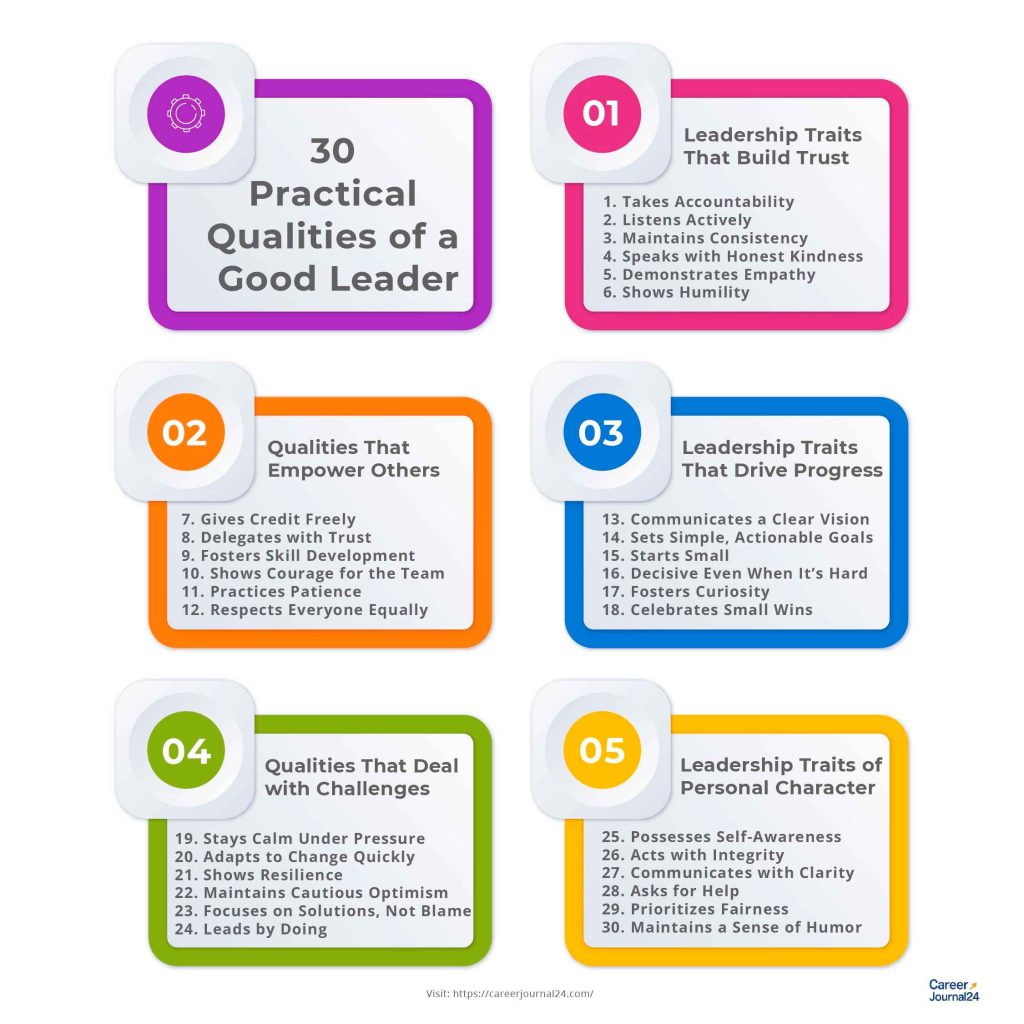
1. Takes Accountability
Accountability is the bedrock of credible leadership. In any organization, setbacks are inevitable. A leader who deflects blame erodes trust and fosters a culture of fear, whereas one who accepts responsibility demonstrates profound strength. This ownership shifts a team’s focus from defensive posturing to collaborative problem-solving, communicating that failure is a learning opportunity, not an occasion for persecution. As a 2023 Gallup poll revealed, 84% of employees who report high trust in their leadership have managers who embrace accountability.
Practical Tip: When a mistake occurs, begin the conversation with, “Here’s how we can address this,” before investigating the root cause. Frame your role in the solution, not just in the post-mortem.
2. Listens Actively
Active listening is a strategic discipline, not a passive act. It involves suspending one’s own agenda to fully absorb and understand another’s perspective. This practice provides critical intelligence, uncovers hidden challenges, and fosters a sense of psychological safety where team members feel valued and heard. As noted in a guide to active listening by Harvard Business Review, leaders who listen more than they speak cultivate significantly more engaged and high-performing teams.
Practical Tip: In your next one-on-one, commit to asking clarifying questions (e.g., “What I hear you saying is…”) and resist the urge to formulate your response until the other person has completely finished speaking.
3. Maintains Consistency
Consistency in behavior, decision-making, and application of standards creates a predictable and fair environment. When team members know what to expect from their leader, they can operate with a clear understanding of the rules of engagement. This predictability eliminates ambiguity and the anxiety it produces, allowing individuals to focus their energy on performance rather than on navigating a capricious leadership style.
Practical Tip: Identify one core team standard (e.g., meeting start times, feedback protocols). For the next month, commit to upholding this standard without exception to demonstrate your reliability.
4. Speaks with Honest Kindness
Effective communication rests on the delicate balance of candor and compassion. Honesty delivered without kindness can be perceived as criticism, shutting down dialogue and damaging morale. Conversely, kindness without honesty is a form of passive avoidance that withholds crucial feedback needed for growth. A skilled leader delivers direct, constructive feedback within a framework of respect and positive intent.
Practical Tip: When providing corrective feedback, use the “Intent-Behavior-Impact” model. For instance: “I know you intended to be efficient (Intent), but when you cut the meeting short (Behavior), the junior team members felt they couldn’t ask questions (Impact).”
5. Demonstrates Empathy
Empathy in leadership is the cognitive and emotional ability to understand another person’s experiences and perspectives. It is not about agreement or sympathy but about comprehension. An empathetic leader can anticipate team needs, de-escalate conflict, and make decisions that consider the human impact, fostering a more supportive and resilient organizational culture.
Practical Tip: If you observe a team member struggling, approach with curiosity rather than judgment. Start with an open-ended question like, “I’ve noticed you’ve been quieter in meetings lately. How are things going?”
6. Shows Humility
Humility is a sign of profound self-confidence, not weakness. It is the recognition that one does not have all the answers and that valuable insights can come from anywhere. A humble leader creates an environment where team members are empowered to contribute, question, and innovate without fear of overstepping. This posture of learning and openness is a catalyst for collective growth and problem-solving.
Practical Tip: Regularly use phrases like, “That’s a good point I hadn’t considered,” or, “What do you think we might be missing here?” to signal that you value and seek out others’ expertise.
Part 2: Leadership Qualities That Empower Others
Exceptional leaders understand that their primary function is not to command, but to elevate. They act as multipliers, amplifying the capabilities and confidence of those around them.
7. Gives Credit Freely
Publicly attributing success to the individuals and teams responsible is a powerful motivational tool. It reinforces desired behaviors, fosters a sense of ownership, and builds a culture of mutual recognition. Leaders who hoard credit create resentment and disengagement, while those who distribute it generously cultivate loyalty and inspire discretionary effort.
Practical Tip: In your next team meeting or public update, make it a point to specifically name at least one individual and their precise contribution that led to a recent success.
8. Delegates with Trust
Delegation is a strategic act of empowerment, not merely a tool for offloading tasks. Effective delegation involves entrusting a team member with both the responsibility for a task and the authority to complete it in their own way. This approach communicates trust, develops individual capabilities, and frees the leader to focus on higher-level strategic priorities.
Practical Tip: When delegating, define the desired outcome and any constraints, but resist the urge to prescribe the process. Offer your support, then step back and allow for autonomy.
9. Fosters Skill Development
Investing in the growth of team members is one of the highest-leverage activities a leader can undertake. By identifying individual aspirations and providing opportunities for learning, practice, and mentorship, a leader builds long-term organizational capability. This focus on development helps cultivate Transferable Skills, ensuring employees grow beyond their current roles.
Practical Tip: During performance conversations, shift the focus from past performance to future growth. Ask, “What new skill or competency would you like to build in the next six months, and how can I support that?”
10. Shows Courage for the Team
Leadership courage often manifests as advocating for one’s team. This can mean pushing back against unreasonable demands, protecting the team from organizational politics, or securing necessary resources. When a team sees its leader act as a shield and a champion, it fosters profound loyalty and a sense of security, allowing them to perform their work with focus and confidence.
Practical Tip: Before agreeing to a new request or deadline, pause and assess its impact on your team’s current workload and well-being. Be prepared to negotiate for a more realistic plan.
11. Practices Patience
Patience is a strategic leadership virtue, particularly when mentoring or onboarding team members. While it can be tempting to intervene and complete a task more quickly, exercising patience allows an individual to learn through struggle and build confidence. It is a long-term investment in an employee’s competence and autonomy over a short-term gain in efficiency.
Practical Tip: When a team member is struggling, replace the impulse to say, “Here, let me do it,” with the question, “What part is most challenging? Let’s walk through it together.”
12. Respects Everyone Equally
Respect should be unconditional and independent of an individual’s title, role, or status. A leader who treats every person, from the CEO to the cleaning staff, with dignity and courtesy sets a powerful cultural standard for the entire organization. This equitable treatment fosters an inclusive environment where all individuals feel seen and valued.
Practical Tip: Make a conscious effort to learn the names and acknowledge the contributions of support staff whose work often goes unnoticed. A simple, genuine “thank you” can have a significant impact.
Part 3: Leadership Traits That Drive Progress
Trust and empowerment are essential, but they must be channeled toward a productive end. These qualities are concerned with translating vision into tangible results and maintaining forward momentum.
13. Communicates a Clear Vision
A leader’s primary role is to provide direction and meaning. A clear, compelling vision answers the question “Why?” It gives context to daily tasks and aligns individual efforts toward a common, inspiring goal. This sense of purpose is a powerful intrinsic motivator that fuels persistence and resilience.
Practical Tip: Distill your team’s current primary objective into a single, powerful sentence that describes the ultimate impact you aim to have. Repeat this vision frequently.
14. Sets Simple, Actionable Goals
Complex visions must be broken down into simple, measurable, and actionable goals. Vague objectives like “improve performance” create confusion, while specific targets like “reduce customer response time by 15% this quarter” provide a clear benchmark for success. As a 2023 Gartner study found, clarity of purpose is directly linked to a team’s ability to meet its targets.
Practical Tip: When setting a goal, apply the SMART (Specific, Measurable, Achievable, Relevant, Time-bound) framework to ensure it is unambiguous and actionable.
15. Starts Small to Overcome Inertia
The most significant barrier to progress is often inertia. Great leaders overcome this by championing small, initial actions rather than waiting for a perfect, comprehensive plan. This agile approach creates momentum, allows for rapid learning, and makes large, intimidating goals feel more manageable.
Practical Tip: For any stalled project, identify a “15-minute task”—an action so small it can be completed almost immediately. Use this to break the cycle of procrastination and build momentum.
16. Is Decisive, Even When It’s Hard
In the face of uncertainty, a team looks to its leader for direction. While data-gathering and deliberation are important, a leader must ultimately be willing to make a decision and commit to a course of action. This decisiveness breaks “analysis paralysis” and provides the forward momentum necessary for progress.
Practical Tip: For reversible decisions, adopt a “decide and iterate” mindset. Make the best choice with the available information, and be prepared to adjust based on the outcome.
17. Fosters Curiosity
A culture of curiosity is the engine of innovation. A leader who encourages questions, challenges assumptions, and rewards experimentation creates a team that is constantly learning and improving. Instead of simply providing answers, such a leader poses powerful questions that stimulate critical thinking.
Practical Tip: Begin your next brainstorming session by asking, “What is a core assumption we hold about this project, and what if it were untrue?”
18. Celebrates Small Wins
On long and challenging projects, morale can wane. Acknowledging and celebrating small milestones along the way is crucial for maintaining motivation. This practice validates effort, provides a tangible sense of progress, and reinforces the team’s collective efficacy. This is often referred to as “The Progress Principle,” a key driver of engagement.
Practical Tip: Dedicate the first five minutes of your weekly team meeting to a “wins of the week” round-robin, where each person shares one small success.
Part 4: Leadership Qualities That Deal with Challenges
Leadership is most visible in times of adversity. The following qualities enable a leader to act as a stabilizing force, guiding their team through uncertainty with poise and purpose.
19. Stays Calm Under Pressure
In a crisis, a leader’s emotional state is contagious. By demonstrating composure and emotional regulation, a leader can prevent collective panic and maintain the team’s capacity for rational thought and action. This calm demeanor signals that the situation, while serious, is manageable.
Practical Tip: When faced with a stressful event, practice the “4-7-8” breathing technique (inhale for 4 seconds, hold for 7, exhale for 8) before speaking or taking action. This physiological reset promotes a calmer response.
20. Adapts to Change Quickly
The modern landscape is defined by volatility. An effective leader does not rigidly adhere to a failing plan but instead embraces adaptability. They view unexpected changes not as threats but as new data points that require a strategic pivot. This flexibility allows a team to reorient and find new pathways to success.
Practical Tip: When a plan is disrupted, frame the conversation around opportunity by asking, “Given this new reality, what new possibilities are now available to us?”
21. Shows Resilience
Resilience is the capacity to recover from setbacks and emerge stronger. A resilient leader models this by framing failure as a valuable source of learning rather than a definitive outcome. This perspective normalizes mistakes and encourages the calculated risk-taking necessary for innovation.
Practical Tip: After a project or initiative fails, conduct a blameless post-mortem focused exclusively on extracting lessons. The key question should be, “What will we do differently next time?”
22. Maintains Cautious Optimism
Effective leadership during tough times involves a duality known as the Stockdale Paradox: confronting the most brutal facts of the current reality while simultaneously maintaining an unwavering faith in the eventual positive outcome. This blend of realism and hope provides a credible and inspiring path forward.
Practical Tip: When communicating a challenge, acknowledge the difficulties directly (“I know this will be a tough quarter…”) before expressing confidence in the team’s ability to overcome it (“…and I am certain we have the talent and determination to succeed.”).
23. Focuses on Solutions, Not Blame
In the wake of a problem, a leader has a choice: focus on assigning blame or focus on finding a solution. A solution-oriented leader immediately directs the team’s energy toward constructive action, which is both more productive and better for morale.
Practical Tip: Train yourself and your team to replace the question, “Why did this happen?” with “How can we move forward from here?”
24. Leads by Doing
A leader’s credibility is powerfully reinforced when they are willing to engage in the same work they ask of their team. By “rolling up their sleeves” during critical moments, a leader demonstrates solidarity, a strong work ethic, and a refusal to place themselves above the team. This modeling behavior is far more impactful than any directive.
Practical Tip: Once a month, identify and perform a task that is essential but unglamorous. This simple act can significantly boost team morale and respect for your leadership.
Part 5: Leadership Traits of Personal Character
Ultimately, leadership is an expression of one’s inner character. These foundational traits are about who the leader is, and they inform every action they take.
25. Possesses Self-Awareness
Self-awareness, a deep understanding of one’s own emotions, strengths, weaknesses, and triggers, is the cornerstone of emotional intelligence. A self-aware leader can manage their reactions, understand their impact on others, and lead from a place of authenticity and intention.
Practical Tip: At the end of each day, take two minutes to reflect: “When did I feel most effective today, and why? When did I feel least effective, and what was the context?”
26. Acts with Integrity
Integrity is the unwavering alignment between one’s values, words, and actions. It is the commitment to doing the right thing, even when it is difficult or inconvenient. For a leader, integrity is the ultimate source of trust and long-term influence.
Practical Tip: Before making a difficult decision, apply the “publicity test”: Would you be comfortable with your choice and your reasoning being reported on the front page of a newspaper?
27. Communicates with Clarity
Clarity is a gift to any team. It reduces ambiguity, prevents wasted effort, and ensures alignment. A leader who can distill complex ideas into simple, understandable terms empowers their team to act with speed and confidence.
Practical Tip: Before sending an important communication, ask yourself: “What is the single most important message I want the recipient to take away?” Ensure that message is explicit and prominent.
28. Asks for Help
The most effective leaders understand that vulnerability is a strength. Asking for help is not an admission of incompetence but a sign of self-awareness and a commitment to achieving the best possible outcome. It also models a collaborative spirit for the entire team.
Practical Tip: Identify an area where you feel your knowledge is limited and proactively seek advice from a team member with expertise in that domain.
29. Prioritizes Fairness
Fairness, or organizational justice, is the consistent and impartial application of rules, distribution of resources, and administration of consequences. A leader who is perceived as fair builds a culture where team members trust that their hard work will be recognized and that they will be treated equitably.
Practical Tip: When assigning high-visibility projects or opportunities, consciously review your recent decisions. Ensure you are not unintentionally favoring the same few individuals.
30. Maintains a Sense of Humor
A sense of humor and perspective can be a powerful leadership tool. It can de-escalate tension, build rapport, and help a team navigate stressful situations without losing morale. The ability to laugh at oneself and at challenging circumstances fosters resilience and a more positive work environment.
Practical Tip: In a tense but low-stakes moment, allow yourself to point out the absurdity or irony of the situation. A shared laugh can be a powerful release valve for collective stress.
The Leader in All of Us
Ultimately, the traits of a good leader are not an esoteric set of inborn gifts. They are a series of acquirable skills and conscious choices, practiced daily. Priya, at the park, did not possess a formal title, but she demonstrated initiative, empathy, and a bias for action, the very essence of leadership.
If this list of 30 qualities seems daunting, do not be discouraged. The path to leadership is not about mastering all of them at once. It is about choosing one, practicing it intentionally, and building from there. In doing so, you will find that you are not just improving your ability to lead others; you are becoming a more effective and impactful person.





One Comment