
20 Transferable Customer Service Skills That Will Make You Valuable in Any Job
The average customer service professional develops more high-demand workplace abilities in one year than most people acquire in a decade of traditional office roles. These transferable customer service skills are consistently ranked among the most sought-after competencies by LinkedIn, World Economic Forum, and Fortune 500 hiring managers. Below are the twenty most powerful transferable skills for customer service, each proven to add measurable value in virtually every industry, from tech and finance to healthcare, education, and leadership.
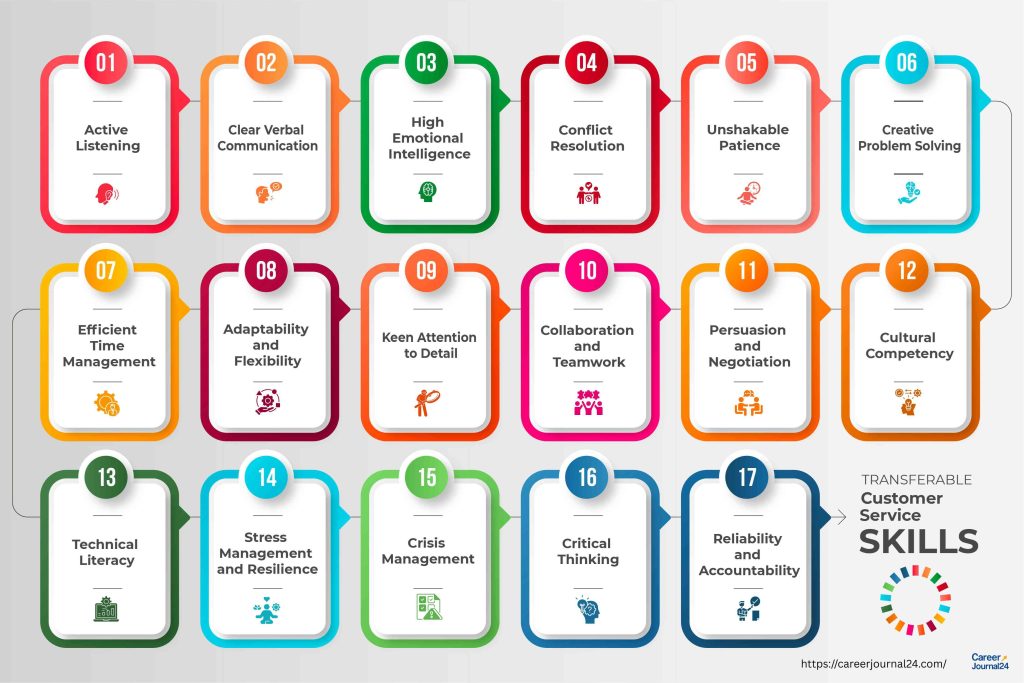
1. Active Listening
Active listening is far more than just staying quiet while someone else speaks; it is the ability to fully concentrate, understand, and respond to the underlying message. In a service role, you learn to pick up on subtle cues, a frustrated sigh or a hesitant tone, to figure out what a customer truly needs. This is one of the most critical transferable skills for customer service veterans because it builds trust instantly. In an office setting, this translates to better collaboration and fewer misunderstandings during project briefings. When you listen to understand rather than just to reply, you become a bridge-builder in any professional environment.
2. Clear Verbal Communication
The ability to explain a complex policy or a technical issue in simple, relatable terms is a superpower. In service, you often have seconds to convey a message before a customer loses interest or becomes confused. Mastering this ensures that your transferable customer service skills make you an asset in sales, marketing, or management. Being articulate isn’t about using big words; it’s about clarity and brevity. Whether you are presenting a pitch to a client or giving a status update to your manager, the habit of speaking clearly and concisely prevents errors and ensures everyone is on the same page.
3. High Emotional Intelligence
Emotional intelligence, or EQ, is the capacity to be aware of, control, and express one’s emotions while handling interpersonal relationships judiciously. Service workers deal with a spectrum of human emotions daily, from pure joy to irrational anger. Developing this allows you to “read the room” and adjust your approach accordingly. High EQ is highly sought after by recruiters on platforms like LinkedIn because it correlates with strong leadership. If you can stay composed while a customer vents their frustrations, you can navigate high-stakes corporate negotiations or sensitive HR issues with grace and professional maturity.
4. Conflict Resolution
Conflict is inevitable in any workplace, but service professionals are uniquely trained to lean into it rather than run away. You have likely spent years de-escalating tense situations and finding middle ground between company policy and customer expectations. This brand of diplomacy is a top-tier professional trait. In a new role, you will use these transferable customer service skills to settle disputes between coworkers or negotiate better terms with vendors. Instead of letting tension simmer, you know how to address the root cause of a problem and move toward a solution that satisfies all parties involved.
5. Unshakable Patience
Patience is the quiet engine of the service industry. It involves staying calm and helpful even when a situation is repetitive, slow-moving, or genuinely difficult. This isn’t just about waiting; it’s about maintaining a positive demeanor while you wait. In the broader professional world, projects often hit roadblocks, and software systems frequently fail. Your ability to remain patient during these “down times” keeps the team’s morale high. Employers value people who don’t crack under the pressure of a slow process, making this one of the most practical transferable skills for customer service experts to highlight.
6. Creative Problem Solving
When a standard solution isn’t working, service professionals have to think on their feet. Perhaps a product is out of stock, or a flight is canceled; your job is to find a “Plan B” that keeps the customer happy. This “outside-the-box” thinking is exactly what innovation-driven companies crave. Creative problem solving is a skill that applies to everything from coding to logistics. If you have experience navigating “gray areas” where the manual didn’t have the answer, you have developed the mental flexibility required for high-level strategic roles where there is no pre-written script for success.
7. Efficient Time Management
Working a “rush hour” teaches you more about time management than any seminar ever could. You learn to prioritize tasks based on urgency and importance, managing multiple “open loops” at once without dropping the ball. This sense of urgency and organizational discipline is a major asset in corporate environments. When you transition to a desk job, you’ll find that your ability to triage a heavy workload is far superior to those who haven’t worked in high-volume service environments. This makes you more productive and less prone to the burnout that comes from poor work-day organization.
8. Adaptability and Flexibility
The service world changes in an instant. A new promotion launches, the power goes out, or a teammate calls in sick, and you have to adjust your entire workflow immediately. According to the World Economic Forum, adaptability is one of the most important skills for the future workforce. Because you are used to a shifting landscape, you don’t fear change; you embrace it as part of the job. This makes you an “agile” employee who can pivot when a company changes its strategy or adopts new technology, ensuring you remain relevant regardless of industry shifts.
9. Keen Attention to Detail
In a service environment, small details matter. Getting an order wrong or mistyping a customer’s email address can lead to significant problems down the line. You have likely developed a “check-twice” habit that is incredibly valuable in data-driven roles. Whether you are reviewing a legal contract, auditing a financial spreadsheet, or proofreading a marketing campaign, your trained eye for detail prevents costly mistakes. This precision is one of the transferable customer service skills that hiring managers in technical fields value most, as it demonstrates a commitment to quality and accuracy in every task.
10. Collaboration and Teamwork
No service worker is an island. You have to work in sync with the kitchen, the warehouse, or the technical support team to deliver a great experience. This teaches you how to be a “team player” in the truest sense, understanding that your success depends on the success of others. In a corporate setting, this translates to “cross-functional collaboration.” You know how to communicate across departments and support your colleagues to reach a common goal. This cooperative mindset is essential for any project-based work, making you a person people actually enjoy working with.
11. Persuasion and Negotiation
Service isn’t just about fixing problems; it’s often about “upselling” or convincing a customer to try a different solution. This is essentially sales and negotiation training. If you can convince a frustrated person to give a brand a second chance, you have mastered the art of persuasion. These transferable skills for customer service are gold in any business development or management role. You understand how to present benefits, handle objections, and close a “deal”, whether that deal is a million-dollar contract or simply getting a coworker to agree to a new internal process.
12. Cultural Competency
In customer service, you interact with people from all walks of life, cultures, and backgrounds. This exposure builds a deep sense of cultural competency and inclusivity. You learn to communicate effectively with people whose primary language or social norms might differ from your own. In our increasingly globalized economy, the ability to work respectfully with a diverse range of people is a mandatory skill. This empathy and awareness make you a better leader and a more effective communicator in international business settings, ensuring that your message is received correctly across different cultural boundaries.
13. Technical Literacy
Most service roles today require the use of complex Point of Sale (POS) systems, Customer Relationship Management (CRM) software, or digital inventory tools. Being able to learn these systems quickly shows that you have high technical literacy. This is a vital transferable customer service skill because it proves you are “teachable.” When you apply for a new job, you can point to your experience with these tools as evidence that you can master their specific software suite. In a world where technology moves fast, being a quick study with digital tools is a massive competitive advantage.
14. Stress Management and Resilience
Few things are as stressful as a long line of customers and a system that just crashed. Service workers develop a “thick skin” and a high level of resilience. You learn how to stay focused on the task at hand even when you are under immense pressure. In any career, there will be “crunch times” and high-pressure deadlines. Your background in service means you are less likely to panic when things get intense. This resilience allows you to maintain a high standard of work and a professional attitude even when the environment around you is chaotic.
15. A Proactive Growth Mindset
Great service workers don’t just wait for instructions; they look for things that need to be done. Whether it’s tidying a station or updating a FAQ page, this proactivity is a sign of a growth mindset. Employers love “self-starters” who take ownership of their environment. When you bring this mindset to a new career, you become the person who identifies inefficiencies and suggests improvements. This proactive nature is what leads to promotions and leadership opportunities, as it shows you are invested in the overall success of the organization, not just your specific checklist of duties.
16. Data Accuracy and Entry
Handling transactions or updating customer profiles requires a high level of data integrity. You understand that a single typo can lead to a lost package or a billing error. This discipline is highly transferable to roles in administration, accounting, or data analysis. If you have spent years maintaining accurate records under the watchful eye of a customer, you have developed the focus necessary for high-stakes data management. Highlighting your “zero-error” record in your previous service roles proves to a new employer that you are reliable and meticulous with sensitive information.
17. Crisis Management
Every service worker has a “war story” of a time when everything went wrong at once. Handling these moments is essentially crisis management. You learn to stay calm, prioritize safety or satisfaction, and follow emergency protocols without hesitation. This ability to lead during a crisis is a rare and valuable trait. In a corporate office, a “crisis” might be a PR disaster or a major client leaving. Your experience in “the trenches” of customer service means you have the emotional regulation and quick-thinking skills to help lead a team through a difficult period.
18. Critical Thinking
While there are manuals for service, the real world often requires you to make a judgment call. Is it better to follow the rule strictly or to make an exception to save a relationship? Using your brain to weigh the pros and cons of a situation is critical thinking in action. This is one of the most important transferable customer service skills for anyone looking to move into a supervisory or analyst role. It shows that you don’t just follow orders blindly; you understand the “why” behind the “what” and can make informed decisions independently.
19. Reliability and Accountability
In the service industry, if you don’t show up, the whole system slows down. This builds a strong sense of professional accountability. You understand the impact of your presence on the rest of the team. Reliability is the “baseline” skill that every employer looks for but often struggles to find. By having a strong track record in a demanding service environment, you prove that you are someone who can be counted on. This dependability is the foundation upon which all other professional successes are built, making it a cornerstone of your transferable toolkit.
20. Professionalism and Brand Representation
When you are on the front lines, you are the company. You learn how to set aside your personal feelings to represent a brand’s values and voice. This level of professionalism is a high-level skill that applies to any role where you interact with external stakeholders or partners. Whether you are writing an official press release or attending a networking event, you know how to carry yourself with the poise and integrity that reflects well on your employer. This “brand-first” mentality makes you a safe and sophisticated choice for any company looking for professional representation.
How to Market Your Service Background
To make these skills work for you, you must learn to “translate” them on your resume and in interviews. Instead of focusing on the tasks you performed, focus on the outcomes you achieved. For example, don’t just say you “worked at a front desk.” Instead, explain how you “optimized check-in processes to reduce wait times by 20%.” By using the language of the industry you want to enter, you make it easy for hiring managers to see your value.
The journey from customer service to a new career path is not about changing who you are; it’s about highlighting the powerful professional you have already become. These transferable customer service skills are the tools that will help you build your future.
Final Thoughts
Transitioning out of a service-oriented role can feel like standing at the base of a mountain, looking up at a peak you aren’t sure you can reach. However, as we have explored, you aren’t starting that climb empty-handed. In fact, you are better equipped than most. The customer service transferable skills you have spent months or years honing, patience, critical thinking, and high-stakes communication, are the exact tools needed for a successful ascent into any professional field. You have already survived the “pressure cooker” of public-facing work; the corporate world is simply a different environment for those same talents.
Your next step is to rebrand your experience and step into your next interview with total confidence. Employers are actively searching for candidates who can bridge the gap between technical tasks and human connection. By leveraging your transferable skills for customer service, you position yourself as a rare, well-rounded professional ready for any challenge. For more insights on navigating modern career shifts, you can explore resources on Forbes to keep your professional momentum going.






One Comment