Transferable Skills on a Resume That Employers Actually Care About
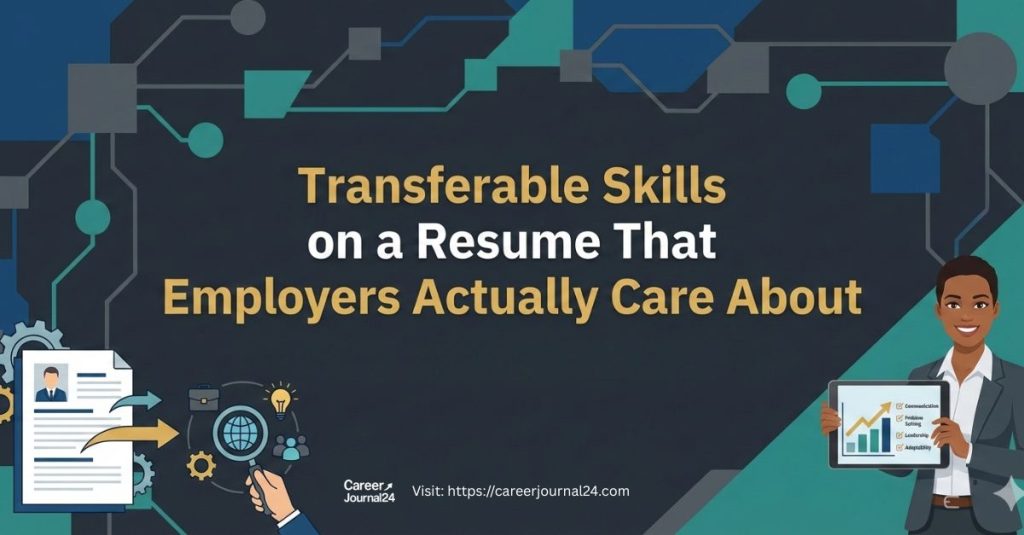
The professional environment in 2026 is moving faster than ever before. Many people find themselves looking at a job posting that feels like a perfect fit, even if they have never held that exact title. You might be a retail manager looking to move into corporate human resources, or a healthcare worker wanting to transition into technical sales. When you face this kind of career pivot, you often worry about whether your past experience counts. The reality is that you possess a toolkit of transferable skills on resume documents that hiring managers are desperate to find. These are the versatile abilities that work regardless of the industry or the specific software you used in your last role.
The challenge most job seekers face is not a lack of talent but a lack of translation. You have spent years solving problems, managing people, and hitting targets. However, if you describe those wins only in the context of your old job, a new employer might not see how those wins help them. By learning how to frame your transferable skills for resume submissions, you turn your background into a bridge. You stop being a candidate with the “wrong” experience and become the candidate with the exact right perspective. This article will show you how to uncover these hidden strengths and present them so they land at the top of the recruiter’s pile.
What Are Transferable Skills?
Transferable skills are the core competencies that move with you from one job to another. Think of them as the foundation of your professional house. While the “decorations” might change depending on the company, the foundation of how you communicate, organize, and solve problems stays the same. These are the skills that make you an effective worker whether you are in a hospital, a tech startup, or a non-profit organization. They are often developed in everyday situations and refined through years of experience.
In the current job market, employers are looking for flexibility. They know that technical tools change every six months, but a person who knows how to lead a team through a crisis is always valuable. According to Forbes reports on workplace evolution, the ability to adapt is now one of the most sought-after qualities in new hires. These skills are not just “soft skills” like being a nice person. They are hard-won professional abilities like strategic planning, conflict resolution, and data analysis. When you identify these within yourself, you realize that you are never truly starting from zero in a new career.
Every task you have performed in the past has a core skill attached to it. If you were a teacher, you were not just teaching math; you were managing diverse groups of people and translating complex information into simple ideas. If you were a server, you were not just delivering food; you were managing high-speed logistics and performing under intense pressure. Recognizing these resume transferable skills examples in your own history is the first step toward a successful career change. It allows you to approach the job market with a sense of confidence that your past experience is an asset rather than a hurdle.
How to List Transferable Skills on a Resume
Putting these skills on paper requires a strategic approach. You cannot simply list them and hope for the best. You need to show the recruiter how your specific background solves their current problems. This requires a shift in how you view your resume. It is no longer just a list of places you have worked but a targeted advertisement for what you can do next.
1. Start With a Strong Resume Summary
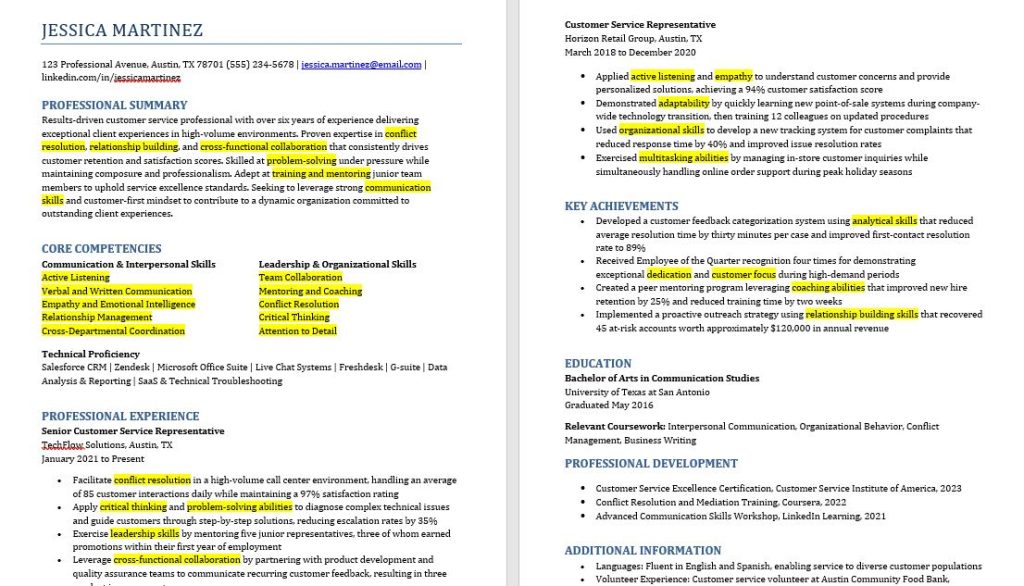
The resume summary is the very first thing a hiring manager reads. It is your elevator pitch in written form. Instead of using this space to say what you want from a company, use it to state what you offer. If you are changing fields, this is where you connect the dots for the reader. Use this section to highlight your most powerful transferable skills on resume summaries right away.
For example, if you are moving from education to project management, your summary should not focus on lesson planning. Instead, focus on your ability to lead cross-functional teams and meet strict deadlines. You might write that you are a “dedicated professional with a decade of experience in instructional design and stakeholder management.” This language tells a recruiter in project management that you understand their world. You are using their vocabulary to describe your history. This immediate alignment makes them want to keep reading instead of moving on to the next candidate.
2. Show Transferable Skills in Work Experience
Your work experience section is where you provide the evidence. This is where many people fall back into the trap of listing daily chores. To make your transferable skills for resume sections pop, you must use action-oriented language that highlights the skill rather than the industry-specific task. Every bullet point should start with a strong verb that reflects a universal ability.
Consider the difference between saying “handled customer complaints” and “facilitated conflict resolution in a high-volume environment.” The second version uses the language of management. It shows that you did not just talk to people but that you applied a specific skill to reach a result. If you are moving into a role that requires data entry, do not just say you “used Excel.” Say you “optimized data management systems to increase department efficiency by twenty percent.” This shows that your skill has a direct, positive impact on the business. It turns your past jobs into a series of successful case studies.
3. Use a Dedicated Skills Section Wisely
A dedicated skills section serves two purposes. First, it helps your resume get through Applicant Tracking Systems which are the software programs that scan for keywords. Second, it gives the human recruiter a quick visual anchor to see if you have the basics they need. However, you should not just throw every word you can think of into this section. It should be curated and organized for maximum readability.
Group your skills into categories such as “Leadership,” “Communication,” and “Technical Proficiency.” This helps a recruiter find exactly what they are looking for in a matter of seconds. If the job description emphasizes “teamwork,” make sure your collaboration skills are at the very top of that list. This section should act as a summary of the strengths you have already proven in your work experience section. It is a reinforcement of your value proposition.
4. Reinforce Skills With Achievements
The most effective resumes focus on achievements rather than duties. An achievement is a specific instance where you used a skill to solve a problem or reach a goal. This is how you prove that your transferable skills on resume documents are real and not just buzzwords. Whenever possible, use numbers and percentages to tell your story. Numbers are a universal language that every recruiter understands.
If you claim to have organizational skills, show an achievement where those skills saved time. You could write that you “developed a new filing system that reduced retrieval time by thirty minutes per day.” If you claim to have leadership skills, mention that you “mentored three junior staff members who were promoted within one year.” These specific examples provide the “how” and the “why” behind your skills. They give the recruiter a clear picture of what you will do once you are on their payroll. This level of detail transforms a standard resume into a compelling narrative of professional success.
Transferable Skills vs Technical Skills
Understanding the difference between these two types of skills is crucial for building a balanced and effective resume. Technical skills, or hard skills, are specific, teachable abilities that can be defined and measured. Think of proficiency in a programming language like Python, the ability to use Adobe Photoshop, or certification in Google Analytics. These skills are often job-specific and are the first things recruiters look for to ensure you meet the basic qualifications.
Transferable skills, on the other hand, are broader and more universal. They relate to how you work and interact with others. They are not tied to a specific job or industry. While a Python developer’s technical skills might not transfer to a marketing manager role, their problem-solving, project management, and communication skills absolutely will. A great resume doesn’t choose one over the other; it weaves them together to present a complete picture of a capable candidate. Your technical skills get you the interview, but your transferable skills get you the job.
Matching Transferable Skills With Job Descriptions
You have a list of amazing skills and you know how to frame them. The final step is to be strategic. A resume is not a one-size-fits-all document. The most effective job seekers customize their resume for every single application. This process is about mirroring the language of the job description.
Before you apply, print out the job description and a copy of your resume. Grab two different colored highlighters. With one color, highlight the key skills and qualifications the employer is asking for. Are they looking for someone who can “manage client relationships,” “work autonomously,” or “drive innovation”? With the second color, highlight the places on your resume where you demonstrate those exact skills. If there are skills on the job description you haven’t highlighted on your resume, it’s time to rephrase your bullet points to better align with what they’re seeking. This process shows the recruiter that you are not just a qualified candidate, but the perfect candidate for their specific needs. According to a study by Jobscan, using keywords from a job description can make your resume up to 75% more likely to be selected for an interview by an Applicant Tracking System (ATS).
Conclusion
Your career is a collection of experiences, not just a list of job titles. The skills you’ve picked up along the way are your most valuable assets. By learning to identify, articulate, and showcase your transferable skills on a resume, you unlock your true potential. You stop being a candidate who might fit and become a professional who delivers value. Don’t let a career change or a gap in your resume hold you back. Focus on the abilities that truly matter, the ones that transcend any single role. So go ahead, look at your resume with fresh eyes. Find those hidden strengths and frame them with confidence. Your next great career move is waiting.




One Comment