
Why Good Leaders Are Good Followers

The traditional image of leadership often involves a solitary figure at the front of the room, making bold decisions and issuing commands. However, the most successful organizations today recognize that this top-down approach is incomplete. In reality, good leaders are good followers who understand the mechanics of cooperation before they attempt to direct it. This perspective shift is essential for anyone looking to build a sustainable career or a thriving business.
To lead effectively, one must first possess the humility and discipline to be led. This isn’t about being passive; it is about mastering the art of participation. By understanding the responsibilities of a follower, an individual gains the unique insights required to guide others with empathy and precision.
Why Followership Precedes Leadership
Before an individual can command a complex system, they must demonstrate competence within its structure. Followership is the crucible where essential leadership attributes are forged and tested. It is a proactive stance, not a passive acceptance of direction. Understanding how excellent leaders develop loyal followership begins with mastering these foundational stages.
1. Building Foundational Competence
A leader who has never excelled as a follower lacks firsthand knowledge of operational realities. Executing tasks under direction forces an individual to absorb established protocols, manage competing priorities dictated by others, and understand the true resource cost of execution. This practical understanding grounds subsequent leadership decisions in reality rather than abstract theory.
2. Cultivating Empathy and Trust
When ascending to a leadership role, the capacity to empathize with the team’s daily challenges is paramount. An individual who has previously been a reliable subordinate instinctively understands the pressures, ambiguities, and frustrations inherent in execution. This shared experience rapidly builds trust, as subordinates recognize that their leader understands the effort required at every level.
3. Mastering Information Assimilation
Effective followership requires active listening and the discipline to assimilate complex instructions accurately. Leaders must process vast amounts of data and directive input. Practicing this skill under direction hones the ability to filter noise, prioritize essential information, and confirm understanding of all critical inputs for high-stakes decision-making later on.
4. Demonstrating Commitment to Shared Goals
Followership is the demonstration of allegiance to a collective vision, even if one has reservations about the specific tactical path chosen. The commitment to see a directive through, offering constructive input only at the appropriate juncture, signals reliability. Leaders who know their teams are inherently reliable in execution are far more effective at delegation and strategic risk-taking.
5. Developing Intellectual Humility
The act of following requires setting aside personal ego in favor of the designated chain of command or the recognized area of expertise. This practice cultivates intellectual humility, the recognition that one’s own perspective is inherently limited. This humility becomes the protective barrier against organizational stagnation when the individual assumes a leadership role.
Why Good Leaders Are Good Followers
The transition to leadership does not nullify the need for followership; it transforms it into a strategic capability. Good leaders are good followers because they understand that authority is situational and expertise is distributed throughout the organization.
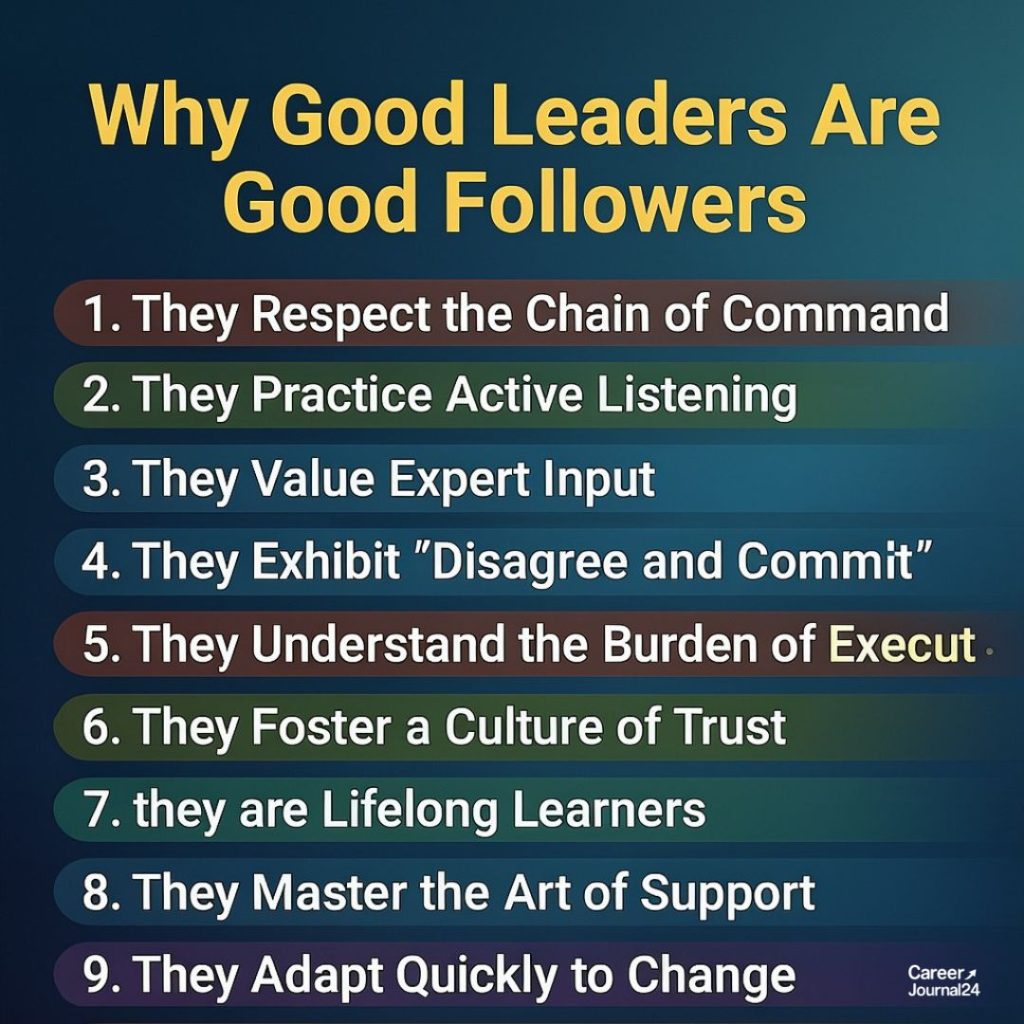
1. They Respect the Chain of Command
Even at the highest levels, everyone has a stakeholder to answer to. Whether it is a board of directors or the customer base, good leaders are good followers of the protocols that keep an organization stable. They understand that rules exist to protect the collective, and by adhering to them, they set a standard of integrity that permeates the entire company culture.
2. They Practice Active Listening
Good followers must listen intently to execute tasks correctly and avoid costly errors. When these individuals become leaders, they retain that habit of focused attention. They don’t just wait for their turn to speak; they listen to understand the nuances of their team’s concerns, ensuring that every employee feels heard and valued.
3. They Value Expert Input
A leader who knows how to follow isn’t threatened by someone else’s expertise or specialized knowledge. If a junior developer knows more about a specific coding language or a new market trend, a leader with a follower’s mindset will happily take their direction. They prioritize the best possible result for the company over the need to be the smartest person in the room.
4. They Exhibit “Disagree and Commit”
In followership, you learn that once a decision is finalized, you support it fully even if you initially shared a different perspective. This is a vital leadership trait that prevents organizational paralysis. It allows a leader to maintain team unity and move projects forward without lingering resentment, proving that the mission is more important than individual pride.
5. They Understand the Burden of Execution
Because they have spent significant time in the trenches, these leaders don’t set impossible deadlines or arbitrary quotas. They know exactly what they are asking of their staff because they once navigated those same pressures themselves. This leads to higher retention, realistic goals, and a workplace culture built on mutual respect.
6. They Foster a Culture of Trust
Trust is a two-way street that begins with a leader demonstrating their own reliability. A leader who was once a reliable follower knows how to show that same consistency to their own subordinates. They lead by example, showing that they are just as committed to the “drudge work” as they are to high-profile strategy sessions.
7. They are Lifelong Learners
Followership is inherently a state of learning and intellectual curiosity. A leader who remains a “follower of the craft” stays updated on industry trends, new technologies, and evolving methodologies. They never assume they have reached the peak of knowledge, which keeps the organization innovative and competitive in a changing market.
8. They Master the Art of Support
A major part of followership is making your leader look good by delivering exceptional work. When the roles flip, these leaders focus their energy on making their subordinates look good. They realize that their own success is now measured by the growth, achievements, and professional recognition of their team members.
9. They Adapt Quickly to Change
Followers are often the first to have to pivot when a strategy changes or a project is canceled. This agility stays with them as they ascend the corporate ladder. When a market shift occurs, a leader who is comfortable “following the data” can steer the company in a new direction without the rigidity that often comes with high-level authority.
10. They Recognize and Reward Good Followership
Finally, because good leaders are good followers, they have a keen eye for spotting high-potential employees in the early stages of their careers. They recognize the quiet, disciplined, and hardworking followers who are the true backbone of the company. This allows them to mentor the right people and ensure that the next generation of leaders is built on a solid foundation.
Real-World Examples of Followership in Leadership
The concept of the leader as an intentional follower is visible across industries where complexity demands collaboration.
The Military Model
In the armed forces, the path to becoming an officer almost always involves rigorous training where you must first learn to follow orders without question. This structure ensures that by the time a commander is giving orders, they have a deep, visceral understanding of the discipline and sacrifice required from those under their command.
Professional Sports Captains
Consider a legendary athlete like Tom Brady or LeBron James. Even as the leaders of their teams, they are famous for being “coachable.” They follow the game plan designed by the coaching staff with more intensity than the rookies. Their leadership is effective because they are the best followers on the field.
Entrepreneurial Apprenticeships
Many of the world’s most successful entrepreneurs, such as those featured on Inc.com, started as interns or assistants to industry giants. For example, Steve Jobs had to follow the technical constraints of his engineers and the market demands of his consumers. His ability to “follow the vision” of what technology could be allowed him to lead a global revolution.
Surgical Teams
In a high-stakes operating room, the lead surgeon is the authority. However, that surgeon must also be a follower of the anesthesiologist’s data and the nurses’ observations. If a nurse flags a drop in vitals, the surgeon must follow that “lead” immediately. The best surgeons are those who value the input of every specialist in the room.
Final Thoughts
The narrative that positions leadership as the opposite of followership is deeply flawed and ultimately limiting. True organizational maturity recognizes that these roles are fluid and interdependent. Good leaders are good followers because they understand that influence is maximized when authority is earned through competence, respect, and the humility to execute expertly when directed, and to listen critically when guiding. By consciously practicing high-quality followership at every stage of your career, you are not diminishing your ambition; you are rigorously preparing for the responsibility of effective leadership. Excellence lies in mastering both sides of the influence coin.